
 By Camille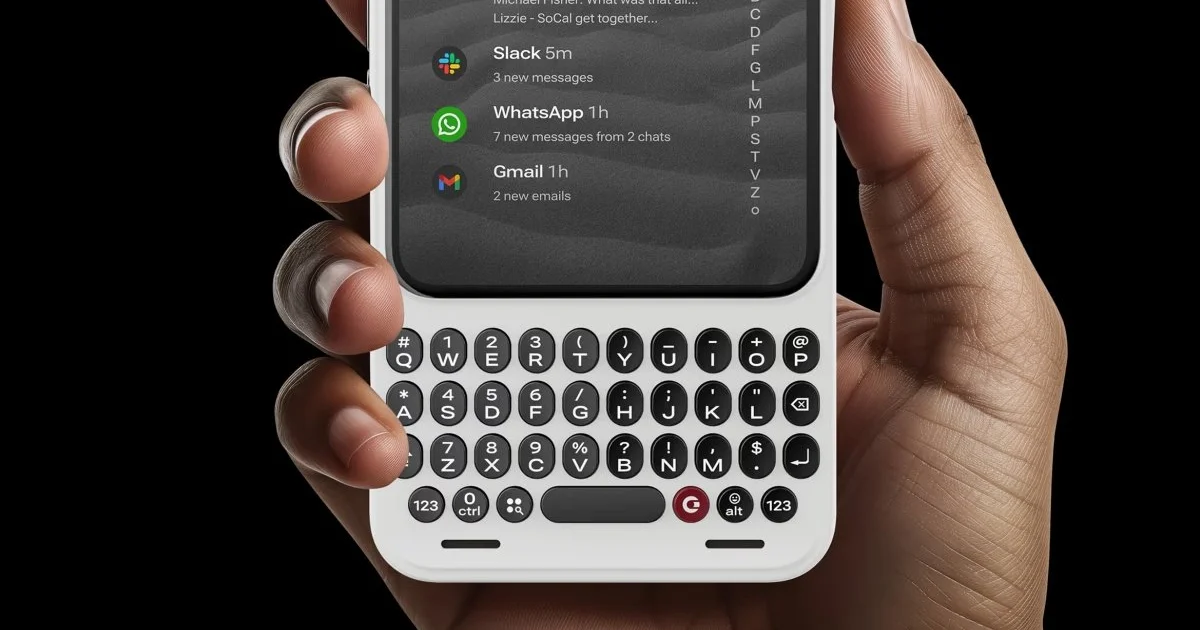
RAM jumps from 8GB to 12GB without an upgrade fee
Clicks finalized the Communicator specification on September 18. When the phone was introduced in January, it was supposed to ship with 8GB of RAM. Production units will now get 12GB.
Existing reservation holders do not have to pay extra for the upgrade. The company is keeping its $499 launch price through September 30.
On October 1, the MSRP rises to $649. That $150 jump is large enough to make the preorder deadline nearly as notable as the additional memory.
Customer shipments are scheduled to begin in December after final certification work.
The battery gets larger, but the chemistry changes
Clicks originally announced a 4,000mAh silicon-carbon battery. During development, that planned capacity later increased to 4,450mAh.
The final production specification is different: a 4,350mAh lithium-ion cell. Clicks says validation testing led it to prioritize reliability and safety over the silicon-carbon design it had previously planned.
The company rates the battery for more than 800 charging cycles. It is not yet providing a final real-world battery-life estimate.
The decision is an interesting reminder that energy density is only one part of a battery program. A small company shipping its first phone may reasonably place a different value on manufacturing risk than a vendor producing tens of millions of devices.
Android 17 will ship out of the box
Communicator was initially expected to launch on Android 16. Its later shipping schedule now lets Clicks move directly to Android 17.
The company promises operating-system updates through Android 20 and five years of security updates.
That commitment matters for a device positioned around messages, email and work accounts rather than merely as a nostalgia gadget.
The hardware is also Android StrongBox-ready, giving Clicks access to Android's hardware-backed secure-storage mechanisms.
The keyboard does more than imitate a BlackBerry
Communicator places a 4.03-inch 120Hz AMOLED display above a full physical keyboard. The keyboard surface is touch-sensitive, allowing users to scroll through pages, navigate interfaces or make fine cursor movements without moving a finger to the screen.
The spacebar doubles as a fingerprint reader. A programmable Clicks Key launches shortcuts, while a dedicated Prompt Key can trigger speech-to-text or access Gemini.
A customizable Signal Light can indicate which person, chat or application is asking for attention before the user opens the phone.
There is also a configurable physical Kill Switch for disabling selected functions at the hardware level.
A Dimensity 8300-class platform drives a four-inch display
The phone uses MediaTek's MT8883, a 4nm platform based on much of the same architecture as the Dimensity 8300 family. It is not intended to compete with late-2026 flagship silicon, but it offers substantial headroom for the communication-focused workload Clicks is targeting.
The 12GB of RAM comes with 256GB of onboard storage. A microSD slot can add up to 2TB, an increasingly unusual feature on modern smartphones.
The small display has a 1080-by-1200 resolution. Its near-square proportions are part of how Clicks fits a permanent keyboard beneath the screen without making the entire device excessively tall.
It weighs 170 grams, but it is 12mm thick
Communicator measures approximately 130.5 by 78.6mm and 12mm thick, with a quoted weight of 170 grams.
It is therefore not especially thin. The keyboard and supporting hardware consume physical space, while the compact display keeps its overall height below many conventional smartphones.
Clicks openly expects two different use cases. It says the Communicator can work as a primary phone, while nearly half of its customers currently expect to use it as a secondary device dedicated mainly to messages and communication.
The headphone jack and microSD slot survive too
The hardware combines several features that rarely appear together anymore: a 3.5mm headphone jack, microSD expansion, physical nano-SIM, eSIM, NFC, Wi-Fi 6 and USB-C video output.
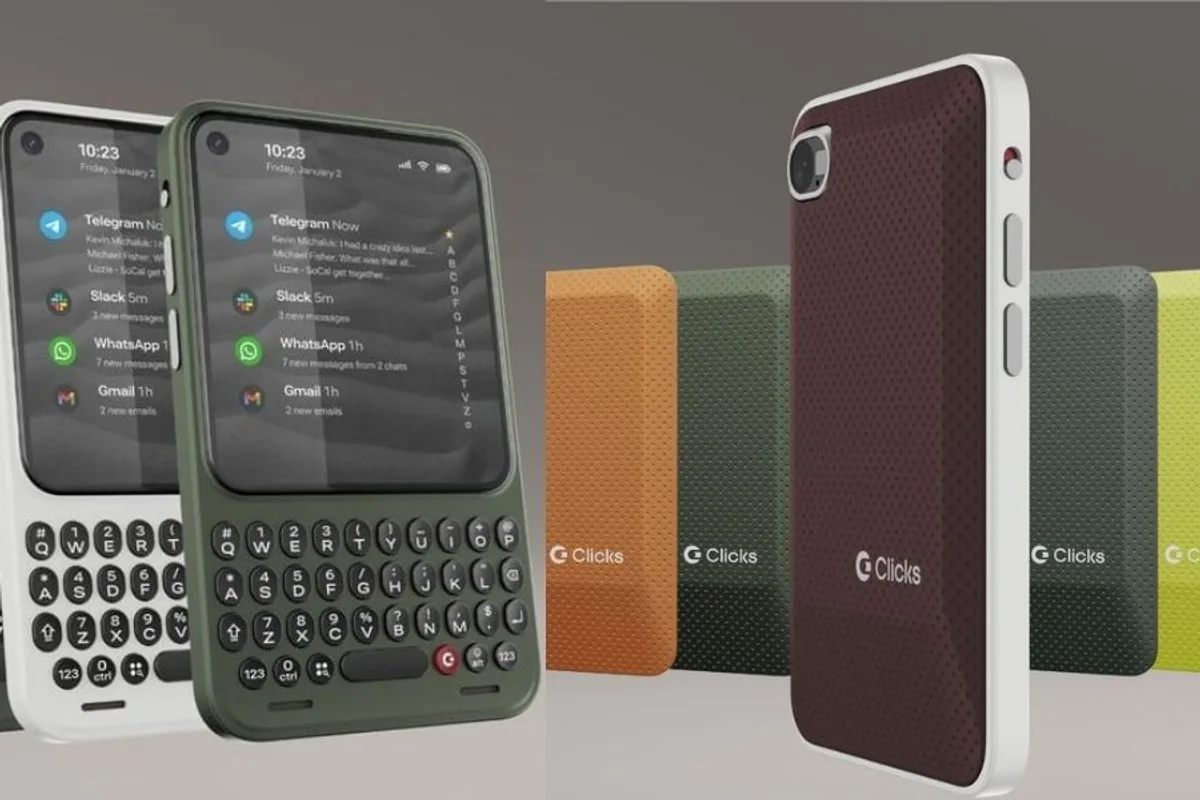
Interchangeable rear Charging Covers add magnets and up to 15W wireless charging, with Clicks offering multiple finishes including saffiano leather options.
The main camera is a 50MP unit with optical stabilization, while the front camera is 24MP. Nothing about the product suggests Clicks is trying to compete primarily on photography.
Clicks is building services around the hardware
The specification update also comes with a broader ecosystem. Clicks Mobile introduces eSIM voice and data plans, initially in the U.S. and U.K.
Clicks Care adds accidental-damage replacement coverage, while a partnership with dbrand brings the MNML case and Prism screen protector to the device.
Those services matter for a company moving from keyboard accessories into complete smartphones. Building Android hardware is only one part of the job; repairs, connectivity, accessories and years of software maintenance have to exist around it.
Its biggest difference is that it is not trying to be a normal smartphone
At a $649 MSRP after September 30, Communicator cannot win a conventional specification contest. Regular touchscreen phones at that price can offer faster processors, larger displays or more elaborate camera systems.
Clicks is selling a different priority: a deliberately small screen, a permanent physical keyboard and software organized around conversations rather than endless content feeds.
Twelve gigabytes of RAM and Android 17 make that idea easier to live with technically. The real experiment begins in December, when buyers get to decide whether they genuinely want a phone designed primarily for writing instead of watching.