
 By Adri
Qualcomm has spent years trying to become more than a supplier of smartphone processors and wireless modems.
Its latest earnings report illustrates why that ambition matters.
The company is growing rapidly in automotive technology and preparing a substantial expansion into AI data centers.
Yet a sharp decline in its handset business was still enough to pull overall quarterly revenue lower.
The results create a useful measure of Qualcomm's progress: diversification is clearly happening, but the company has not escaped its dependence on the mobile device market.
Handset revenue takes the biggest hit
For the three months ended September 27, 2026, Qualcomm reported $10.322 billion in GAAP revenue.
That compares with $11.270 billion in the equivalent quarter a year earlier, an 8% decline.
Non-GAAP revenue reached $10.442 billion, down 7%.
The distinction reflects the company's accounting adjustments and should be preserved when comparing results.
The most significant weakness came from its Handsets business.
Revenue in that category fell from $6.961 billion to $5.137 billion.
That represents a 26% decline.
The figure measures Qualcomm's sales of products associated with smartphones, not the percentage decline in global handset shipments.
Changes in customer orders, product mix and component pricing can all affect the amount of revenue Qualcomm recognizes.
Nevertheless, the result shows how vulnerable the company's financial performance remains to demand for mobile devices.
Even after the decline, handset products account for more than half of the Qualcomm Technologies chip business's quarterly revenue.
Growth in adjacent categories therefore has to be substantial before it can offset weakness of this magnitude.
The wider smartphone market is also struggling
Qualcomm's performance did not occur in isolation.
Reuters reported that global smartphone shipments declined approximately 20% during the September quarter, citing Counterpoint Research.
The research firm described an unusually weak period for the market.
One of the pressures involves memory component prices.
Demand from AI infrastructure is contributing to tight conditions in parts of the semiconductor supply chain, including products used in servers and computing systems.
Higher memory costs can increase the price of building smartphones.
Manufacturers must then decide whether to accept lower margins, adjust specifications or increase retail prices.
Those decisions can influence demand and procurement patterns.
However, it would be inaccurate to blame the entire smartphone slowdown on data center investment.
Consumer replacement cycles, economic conditions and device manufacturers' individual strategies also influence the market.
The relevant conclusion is that Qualcomm faces a difficult combination of weaker smartphone demand and rising input costs.
Apple's modem strategy adds a separate challenge
Apple is another important factor in Qualcomm's changing business.
For years, Qualcomm supplied cellular modems for iPhone products.
Apple is gradually expanding the use of its own modem technology as part of its effort to control more of the components inside its devices.
Reuters identifies declining Apple-related revenue as one contributor to Qualcomm's handset results.
That trend affects hardware sales, but it should not be confused with the complete end of the companies' commercial relationship.
Qualcomm's earnings announcement specifically highlights renewed long-term licensing agreements with Apple, Huawei and Transsion.
Its QTL business derives revenue from intellectual property agreements covering telecommunications technologies.
That business operates differently from supplying physical modem chips.
A smartphone company can reduce purchases of Qualcomm hardware while continuing to license technology covered by its patents.
The result is a more complicated relationship than a simple loss of Apple as a customer.
Qualcomm has not disclosed a complete customer-by-customer breakdown that would allow the entire handset revenue decline to be attributed to Apple.
Automotive revenue becomes a genuine growth engine
The automotive segment delivered the strongest growth in Qualcomm's quarterly report.
Revenue reached $1.990 billion, compared with $1.053 billion a year earlier.
That represents an 89% increase.
Qualcomm supplies technologies used in connected vehicles, digital cockpits and other automotive computing applications.
Its Snapdragon Digital Chassis portfolio is part of that commercial strategy.
Automotive development generally operates on longer timelines than smartphones.
A semiconductor platform selected for a vehicle program may remain in production across several model years.
That can create a different pattern of revenue visibility for suppliers.
However, automotive sales remain tied to production schedules and the decisions of individual manufacturers.
The latest growth rate is a completed quarterly result, not a guarantee that the category will continue expanding by 89% every year.
IoT growth is positive but less dramatic
Qualcomm's Internet of Things category generated $1.888 billion during the quarter.
That compares with $1.807 billion a year earlier, an increase of 4%.
The category covers a broad range of connected computing and industrial applications.
It provides Qualcomm with another revenue stream outside traditional smartphones.
Combined Automotive and IoT revenue reached approximately $3.878 billion during the quarter.
Qualcomm says the combined categories grew 36% year over year.
That is meaningful progress.
But the combined total remains below the $5.137 billion generated by Handsets.
The numbers explain why diversification has not yet been sufficient to eliminate the impact of the handset decline.
The company has several growing businesses, but its largest established market still sets much of the financial tone.
Full-year results reveal a complicated profit picture
Qualcomm reported $43.120 billion in GAAP revenue for fiscal 2026.
A year earlier, it generated $44.284 billion.
The annual decline was 3%.
Qualcomm Technologies generated $37.208 billion during the year, also down 3%.
The licensing business reported $5.556 billion, essentially flat compared with fiscal 2025.
The company's reported GAAP net income rose sharply to $13.628 billion from $5.541 billion.
That apparent improvement requires important context.
Qualcomm disclosed a $5.7 billion tax benefit during fiscal 2026 resulting from the release of a valuation allowance established in the previous year.
The tax adjustment had a substantial effect on reported annual earnings.
Non-GAAP net income actually fell 15% to $11.311 billion.
Those two measures are not interchangeable.
The GAAP increase should not be portrayed as proof that the underlying semiconductor business became proportionally more profitable.
The adjusted decline offers a different view, although it also excludes items detailed in the company's reconciliation.
Qualcomm wants a $5 billion data center business in fiscal 2027
The company's biggest forward-looking claim concerns AI infrastructure.
Qualcomm reiterated its target of $5 billion in data center revenue for fiscal 2027.
Chief executive Cristiano Amon expects the coming fiscal year to mark an acceleration in businesses outside handsets.
The company forecasts non-handset revenue growth of more than 60% year over year.
Data centers are intended to become a major part of that expansion.
Qualcomm is developing technologies for AI inference, where trained models are executed to generate responses or perform computing tasks.
Inference workloads can involve enormous numbers of requests across a large fleet of servers.
The economics depend on throughput, memory capacity, response time, electricity consumption and the cost of operating the hardware.
Qualcomm is attempting to apply its experience in energy-efficient computing to this market.
The opportunity is considerable, but so is the competitive challenge.
Nvidia and AMD already sell substantial AI computing platforms, while cloud providers develop custom silicon for their own workloads.
Qualcomm needs not only capable hardware but also software support and system-level integration suited to production data centers.
The fiscal 2027 revenue target is a forecast.
It does not represent completed sales recorded during fiscal 2026.
Amazon is an important part of the data center strategy
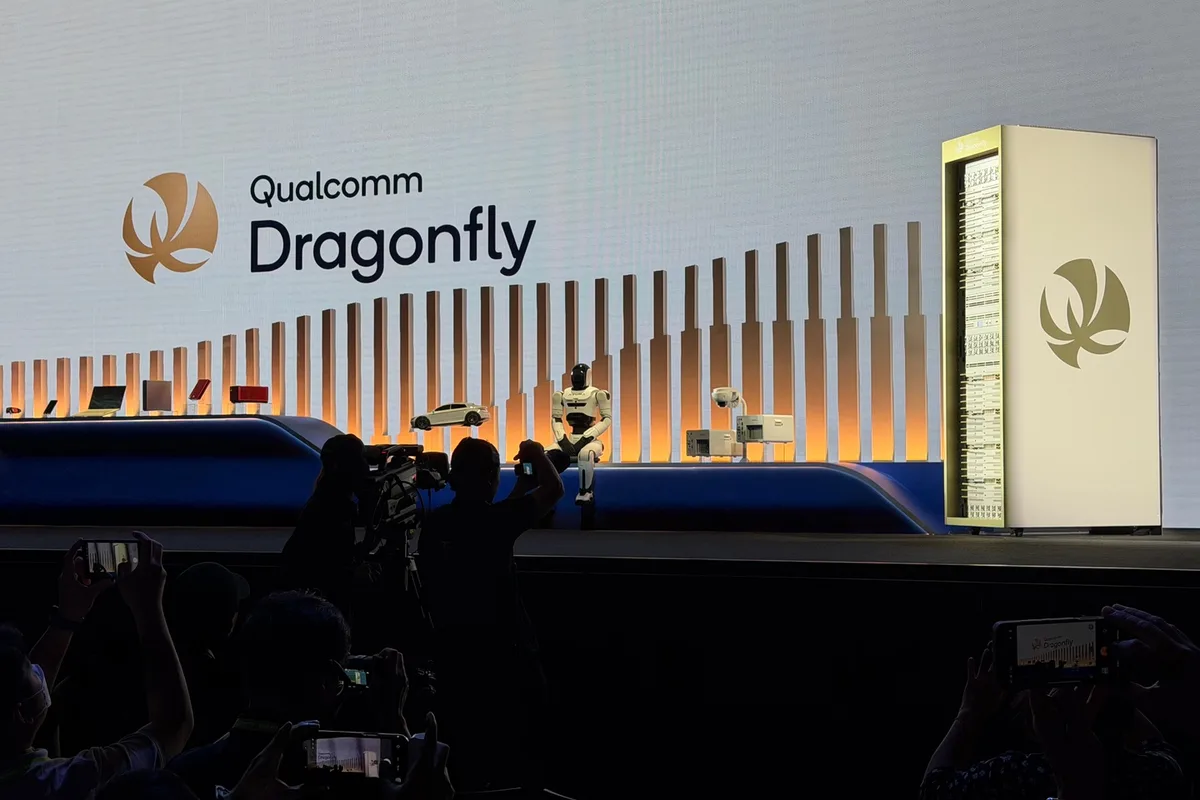
Qualcomm is highlighting its multigenerational collaboration with Amazon, announced in September 2026.
The partnership is intended to support future AI data center infrastructure.
Amazon's scale makes it an important potential customer and development partner.
However, the presence of a major cloud company in a partnership does not establish that every planned technology has already reached commercial deployment.
Accelerators must be integrated into servers, supported by appropriate software and deployed economically across large workloads.
The resulting performance and operating costs will determine how attractive the technology becomes.
Qualcomm's investments in AI infrastructure also expose it to a different business model from selling premium smartphone processors.
Some large-scale deployments involve custom configurations and demanding commercial terms.
These projects can produce significant revenue without necessarily delivering the same margin profile as established mobile products.
The company therefore needs to demonstrate both volume growth and sustainable profitability.
Data center sales may accelerate before the margins recover
Reuters reports that Qualcomm expects approximately $650 million in data center revenue for the first quarter of fiscal 2027.
That figure is a projected contribution for the coming quarter, not a completed quarterly result.
The broader guidance indicates improving demand outside smartphones, but margin pressure remains a concern.
Qualcomm expects the chip business's operating margin to fall into a range of 20% to 22% in the next quarter, according to financial reporting cited by Barron's.
Rising production costs are a significant factor.
The company's own earnings release identifies increases in wafer fabrication, assembly, testing, advanced packaging, memory and other material expenses.
Qualcomm is taking pricing actions to reflect these higher costs.
However, it expects the full benefit of those adjustments to appear only during the second half of fiscal 2027.
That creates a period during which costs may rise faster than the commercial benefits of price changes.
It is an uncomfortable situation for a company facing softer smartphone demand while investing in an emerging infrastructure business.
Higher revenue alone will not necessarily resolve the pressure.
The next-quarter outlook is better than the recent results
For the first quarter of fiscal 2027, Qualcomm expects revenue between $10.4 billion and $11.2 billion.
The midpoint is $10.8 billion.
QCT revenue is expected between $9.0 billion and $9.6 billion.
Qualcomm forecasts QTL revenue between $1.3 billion and $1.5 billion.
Adjusted diluted earnings per share are expected in a range of $2.15 to $2.35.
Reuters reported that the revenue guidance was above analysts' expectations.
The relatively positive forecast did not prevent a negative market reaction.
Qualcomm shares fell more than 6% in after-hours trading following the announcement, according to Reuters.
Investors were weighing the company's diversification plans against the weakness in handset demand and uncertainty surrounding semiconductor margins.
That market reaction is a short-term observation rather than a prediction of the company's long-term performance.
The underlying question is whether the planned growth in AI infrastructure can arrive quickly enough, and at attractive enough margins, to change Qualcomm's earnings profile.
The SpaceX agreement opens another infrastructure opportunity
Qualcomm also announced a multiyear agreement with SpaceX on November 4.
The company will provide Dragonwing platforms for the planned terrestrial 5G network associated with Starlink Mobile in the United States.
The arrangement includes radio and baseband processing technology for cellular infrastructure.
SpaceX expects deployments to begin in 2027, with tens of thousands of sites planned over the life of the agreement.
These installations remain future deployments rather than an existing nationwide Starlink terrestrial network.
The contract extends Qualcomm's diversification into telecom infrastructure.
It also illustrates how the company is attempting to apply its wireless technology expertise across different customer categories.
The commercial conditions and final revenue contribution have not been disclosed.
That limits how precisely the SpaceX agreement can be incorporated into forecasts.
The next version of Qualcomm is still under construction
Qualcomm's latest results show both the need for its strategic transition and the early evidence supporting it.
Smartphone chip revenue fell sharply, while automotive sales grew at an unusually strong rate.
The IoT business expanded more slowly.
The company is preparing for substantial AI infrastructure revenue, supported by new commercial partnerships and an expanding product strategy.
None of those developments has yet removed smartphones from the center of its financial performance.
The industry-wide increase in manufacturing costs adds another challenge, particularly because Qualcomm expects the full benefits of its pricing adjustments to take time.
Investors and customers will need to watch three developments in the coming quarters: whether handset demand stabilizes, whether semiconductor margins recover and whether the data center business delivers revenue approaching management's ambitious targets.
For now, Qualcomm's diversification is real, but its financial transformation remains incomplete.
The fiscal 2026 results make the stakes unusually clear.