
 By Tsuky
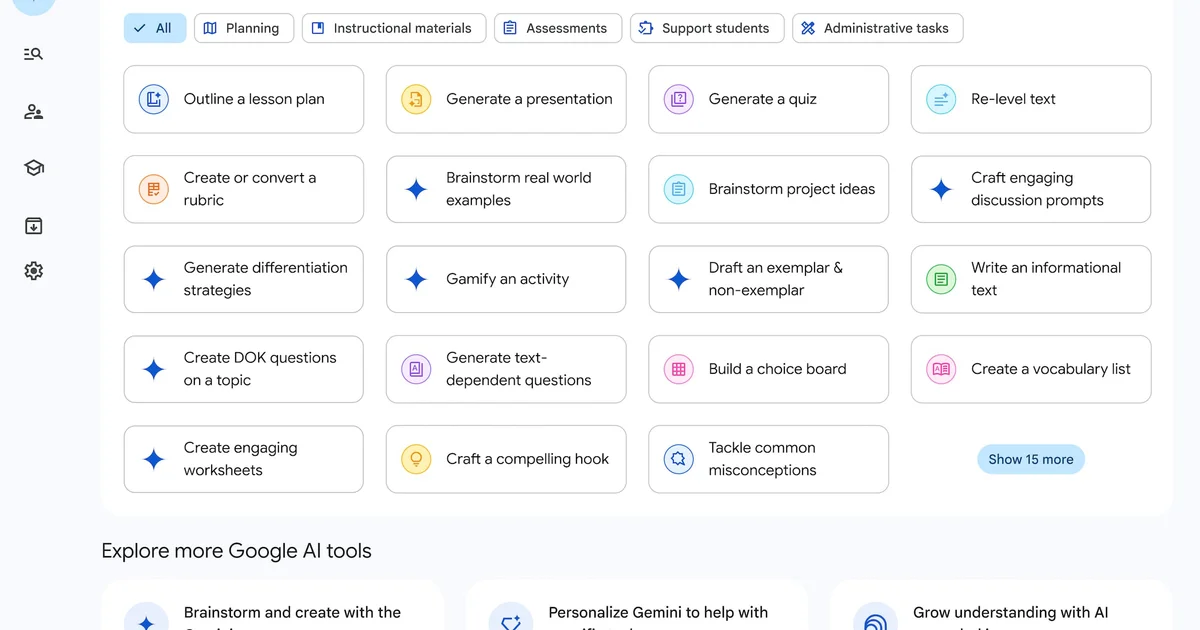
Giving schools control over artificial intelligence sounds straightforward.
An administrator should be able to decide which services students can access, and teachers should have a say in how those tools are used for learning.
Google's newly announced policy appears to address that demand.
The company plans to disable several AI-related services by default for primary and secondary school accounts, requiring administrators to explicitly enable them.
Yet Google Search creates a significant complication.
Schools will be able to activate Search without separately enabling the Gemini chatbot. They will not, however, be offered an official setting that removes all generative AI capabilities from Search itself.
The distinction has transformed what Google presented as an improvement in school controls into a debate about the company's influence over educational technology.
Four services will require explicit administrator approval
The new policy applies to K-12 student accounts managed by schools.
Google identifies four affected products: Gemini, Gemini Notebook, Gemini in Classroom and Google Search.
Under the planned changes, access to these services will be off by default until a school administrator deliberately enables it.
Chris Phillips, Google's vice president and general manager of Education, says the decision follows feedback from teachers, educational institutions, researchers and policymakers.
The company argues that schools should determine when and how AI is introduced into student activities.
The announcement represents a change in the default access model.
Instead of assuming that particular services should be available unless a school blocks them, Google will require an affirmative administrative decision.
That does not mean every Google Workspace application will stop functioning.
The announced controls do not automatically disable Gmail, Docs, Sheets or the ordinary functionality of Google Classroom.
They concern the specific services identified in Google's announcement.
Nor have the new defaults been imposed universally and immediately.
Google says further information will be shared with schools ahead of the rollout, which is planned for the coming months.
Search and Gemini are separate switches, but Search and AI are not
One part of the clarification is important.
Schools can choose to enable Google Search without enabling the standalone Gemini application.
These are separate services with independent administrative controls.
However, Google Search already incorporates AI Overviews and AI Mode.
AI Overviews generates summaries within search results, while AI Mode provides a more conversational way to explore information.
Those features are not the same as opening the Gemini chatbot.
According to explanations Google provided to American news outlets, artificial intelligence is now deeply integrated into Search.
As a result, the company does not plan to offer schools an official setting that retains traditional search results while eliminating its generative AI components.
A school that rejects the presence of generative AI in Search would therefore need to disable Google Search for the affected student accounts.
That leaves administrators with meaningful control over services, but less control over the features bundled inside them.
Google's clarification addresses only part of the controversy
Following criticism of the initial announcement, Google published an additional explanation through its official social media account.
The company emphasized that schools would have more choices, not fewer.
It also reiterated that Gemini, Gemini Notebook and Search could be activated independently.
This resolves a potential misunderstanding: schools do not have to enable every Google AI service as a single package.
But the clarification does not provide an official way to remove AI Overviews and AI Mode while retaining Search.
That remains the central concern for institutions wishing to offer conventional web research without generative answers.
Google sees AI integration as part of the development of its search engine.
Critics argue that the decision limits schools' ability to decide how students should encounter information online.
The conflict is therefore about the structure of the product as much as the policy governing access.
Why educators care about AI-generated search summaries
Traditional web research requires students to identify sources, examine evidence and compare different explanations.
A search engine presents possible sources, but the user still needs to determine which ones are relevant and reliable.
Generative AI changes that process by presenting synthesized answers directly in the results.
This can make information easier to obtain, particularly for unfamiliar subjects.
It can also reduce the incentive to inspect original documents when a summary appears to answer the question immediately.
For teachers, the concern involves the development of research and critical-thinking skills.
Students need to understand why information is credible, recognize uncertainty and identify contradictory evidence.
AI-generated answers introduce another challenge because they can contain errors even when their wording appears confident.
An answer accompanied by citations still needs to be checked against the sources themselves.
These issues do not establish that all AI-assisted learning is harmful.
They explain why some schools want the option to retain ordinary web research while removing generative summaries.
Google's planned administrative settings do not provide that precise combination.
The decision has attracted political criticism
The response quickly expanded beyond technology and education publications.
US Senator Bernie Sanders criticized Google's approach, arguing that schools were being pressured to accept artificial intelligence in order to preserve Search access.
New York City Mayor Zohran Mamdani also challenged the degree of influence a technology company should have over classroom decisions.
Lina Khan, the former chair of the Federal Trade Commission, raised concerns about the use of Google's position in search to encourage AI adoption.
Other public officials and child advocacy organizations have expressed related objections.
These statements represent political criticism and competition-policy concerns.
They do not constitute a completed legal finding that Google's new school policy violates antitrust law.
Google's response is that schools requested stronger controls and that the company is developing AI experiences designed specifically for education.
The disagreement centers on whether those educational benefits justify bundling AI features with a widely used search service.
Guided Learning is Google's proposed alternative to instant answers
Google is also changing how its AI tools respond to educational questions.
The company is introducing Guided Learning features intended to support problem solving rather than simply provide a finished answer.
For example, a student entering a physics problem might receive a series of questions about the concepts involved.
The system could encourage the learner to recall a formula, identify a missing step and work toward the solution.
For a writing assignment, Guided Learning might ask the student to organize arguments or explain an idea in their own words.
Google describes the approach as supporting active learning and productive effort.
The distinction is pedagogically relevant.
An explanation that helps a learner identify a mistake may provide a different experience from a chatbot that immediately completes the assignment.
However, the effectiveness of the approach depends on how the system behaves in practice.
A feature designed to encourage critical thinking does not automatically guarantee better outcomes for every student.
Google has published research supporting Guided Learning, but its results need to be interpreted in context.
Google reports stronger results from a controlled study
In research published alongside the education announcement, Google describes a randomized controlled study involving more than 300 students at the University of Tokyo.
Participants spent half a day studying statistics with access to standard online resources.
One group also received access to Guided Learning.
According to Google, students using only conventional web resources improved their test scores by 5.3 percentage points.
Students who could use Guided Learning improved by 8.1 points.
The company describes that as approximately 1.5 times the learning gain during the study session.
The findings suggest that guided AI assistance can be useful under the tested conditions.
They do not establish that the same improvement will occur across every age group, subject or classroom environment.
The study focused on university students and a specific learning exercise.
It also does not establish the long-term effects of repeated AI use on independent problem solving.
Google additionally describes a four-week pilot involving three UK secondary schools working with Ark.
Teachers and students reported encouraging experiences, particularly when learners needed assistance during independent work.
Those observations are informative, but they should not be treated as universal evidence that AI tutoring is superior to every alternative.
Guided Learning is beginning to roll out in Google Classroom
While the new Search controls remain a future change, Google has already started rolling out a Guided Learning integration in Classroom.
A Google Workspace update dated November 4 confirms that teachers can attach guided activities to assignments.
Educators can select classroom materials to provide context for the experience.
This allows the system to focus on the subjects and resources associated with the actual lesson.
Students can use the guided activities to work through difficult questions or obtain additional explanations.
Teachers retain access to information about the activity.
Google says they can view AI-generated summaries of student progress, including class-wide and individual insights.
They can also access individual conversation transcripts associated with the assigned activity.
These features may help teachers identify common difficulties.
They also make student data governance an important consideration for school administrators.
The November announcement does not, by itself, provide a complete analysis of every country's privacy requirements.
Schools will need to consider the relevant account settings, retention policies and local obligations.
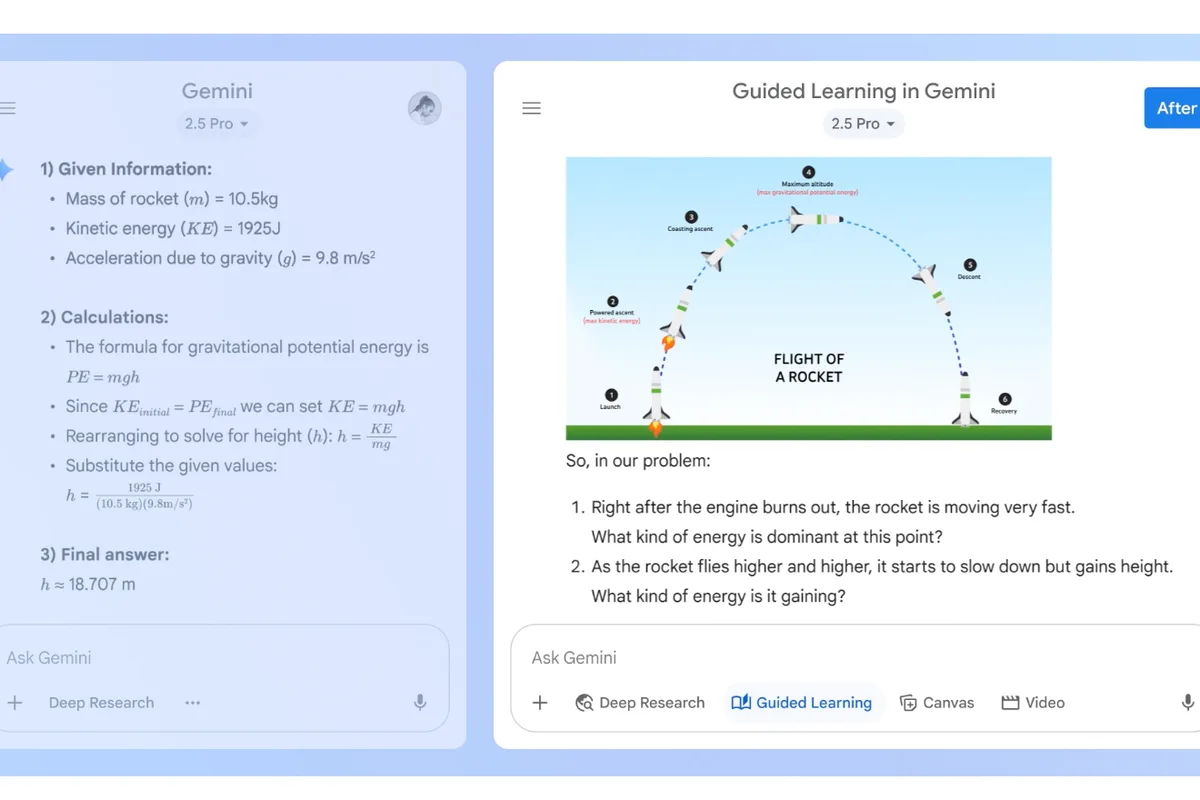
The illustration shows an earlier version of Guided Learning in Gemini. The Classroom integration adds teacher-assigned activities and progress visibility.
The classroom experience includes additional restrictions
Google has designed the assigned Guided Learning interface to keep students focused on their task.
When an activity opens from Classroom, the Gemini side navigation panel is hidden.
The option to create new conversations is disabled within the relevant tab.
Students remain in Guided Learning mode rather than immediately switching to an unrelated chat.
This can reduce certain distractions and help preserve the context of an assignment.
It does not necessarily prevent a student from opening another application on an unrestricted device.
Google also offers integration with Class Tools on compatible Chromebooks.
Supported configurations can provide additional supervision, including focused classroom environments and tools allowing teachers to view student screens.
These capabilities depend on the school's equipment and subscribed services.
The expanded Classroom rollout began on November 3 and is taking place across supported Gemini languages.
Google lists Education Fundamentals, Education Standard and Education Plus among the supported editions.
Administrators must enable Gemini for the relevant groups or organizational units before students and teachers can use the activities.
A global rollout does not mean every account receives the feature at the same moment.
Guided Learning in Search is still a pilot
Google's Search initiative follows a different timetable.
The company plans to begin testing Guided Learning within Search at selected US schools later in November 2026.
The experience is intended to identify certain homework-related searches and provide structured guidance.
For example, a student who pastes a complex problem into Search may be encouraged to work through its underlying concepts.
Google plans to gather educator feedback before extending the feature to additional districts.
This is not a confirmed worldwide launch.
The company has not provided a comprehensive timetable for international availability.
Schools therefore need to distinguish between the existing AI capabilities of Search, the planned administrative controls and the future Guided Learning pilot.
Each has a different implementation status.
What can schools do if they want AI-free web research?
The official Google settings will allow schools to enable Search separately from Gemini.
They will not provide a dedicated switch removing all generative AI functions from Search.
Institutions seeking conventional web research without AI-generated summaries will therefore need to consider alternatives.
Possible approaches include other search engines or browser and network-level filtering tools.
Some extensions can hide AI Overviews from search results.
However, hiding an AI-generated section on a page does not necessarily prevent Google from generating or delivering it in the first place.
Such methods may also stop working when search interfaces change.
The Learning Technology Center in Illinois has published practical guidance distinguishing Google's own administrative controls from third-party filtering methods.
Schools considering alternatives must evaluate compatibility, management requirements and student privacy.
The wider question is whether institutions should be able to reject individual AI features inside services that have become central to their daily work.
More choice over products, but not over every feature
Google's new policy offers an important change: administrators will have to deliberately enable several services for K-12 student accounts.
The company says that decision reflects feedback from educators and institutions seeking greater control.
At the same time, Search reveals a limitation of the approach.
Schools can decide whether to provide the service, but Google determines which AI functions remain part of it.
The company argues that the integration reflects the evolution of search technology.
Critics argue that schools should not have to sacrifice conventional web search to reject generative AI.
The practical consequences will depend on the final rollout and how administrators configure their environments.
As of November 4, 2026, Google has confirmed the policy direction and begun deploying Guided Learning in Classroom.
The broader administrator-control changes and the Guided Learning pilot in Search are still scheduled for future implementation.
The central issue is already clear: schools that want to keep Google Search for their managed student accounts will also have to accept the AI capabilities Google now considers inseparable from its search engine.