 By Adri
For most of its history, Arm has built a business around helping other companies design processors.
Its intellectual property appears in chips used by smartphone manufacturers, cloud providers, automotive suppliers and countless embedded-device makers.
Those customers pay for access to processor technologies and, under many agreements, pay additional royalties as the resulting chips are shipped.
It is a business model that allows Arm to participate in enormous numbers of devices without manufacturing every processor itself.
The company's latest quarterly results demonstrate the continued strength of that approach.
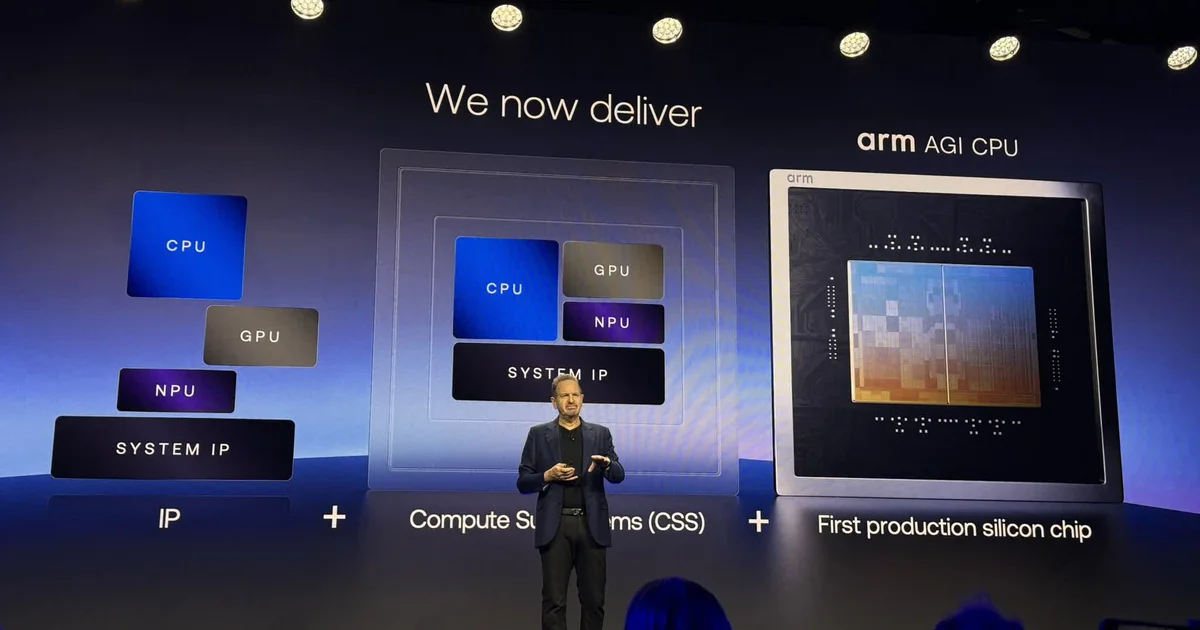
But its recently introduced Arm AGI CPU adds something new: Arm-designed production silicon offered directly to customers.
That changes the commercial relationship. Arm is becoming both an intellectual-property supplier and, in a targeted market, a processor vendor in its own right.
Record revenue does not mean every financial metric improved
Arm recorded $1.443 billion in revenue during the three months ended September 30, 2026.
The figure represents 27% growth compared with the same period a year earlier and marks the company's fifth consecutive quarter of revenue growth exceeding 20%.
Licensing and other revenue rose 50% to $773 million.
Royalty revenue increased by a more modest 8% to $670 million.
These businesses operate on different timelines.
Licensing revenue is linked to agreements that grant customers access to Arm technologies. Royalty revenue generally follows as customers ship products containing those technologies.
Strong licensing activity can therefore support future royalty growth, but the timing and scale of that growth depend on product launches and customer shipments.
Arm also notes that large licensing agreements can make quarterly revenue uneven.
The bottom line offers a useful counterweight to the strong sales figures.
GAAP net income declined to $130 million from $238 million a year earlier, a 45% reduction.
Non-GAAP net income increased 36% to $566 million, while adjusted diluted earnings per share rose to $0.52 from $0.39.
The adjusted figures exclude items identified in Arm's financial reconciliation. They are useful for some comparisons but are not a substitute for its results under generally accepted accounting principles.
Arm's investment in engineering and its expansion into production silicon make the differences between reported and adjusted earnings particularly relevant.
The data center business is changing Arm's market position
The most important shift in Arm's revenue mix is happening inside data centers.
The company says royalties from data center deployments doubled year over year.
That reflects growing use of Arm-based designs across large cloud infrastructure providers.
Amazon develops Graviton processors, Google uses Axion, Microsoft has its Cobalt line, and Nvidia is expanding the role of its Vera CPU platform.
Those are different products designed for different workloads, but they share a dependence on technologies from the Arm ecosystem.
Arm says its architecture accounted for more than half of server deployments among leading hyperscalers in calendar 2025, up from 15% in 2024.
The company expects that proportion to exceed 60% by the end of 2026.
This should not be confused with a claim that Arm already controls 60% of the worldwide installed server base.
The figure relates to the company's defined hyperscaler deployment segment, and the year-end percentage is a forecast.
Even with those limitations, the trend is important.
Arm is no longer primarily associated with energy-efficient mobile processors. Its architecture is now a significant part of the most demanding cloud computing environments.
Arm AGI CPU turns the company into a silicon supplier
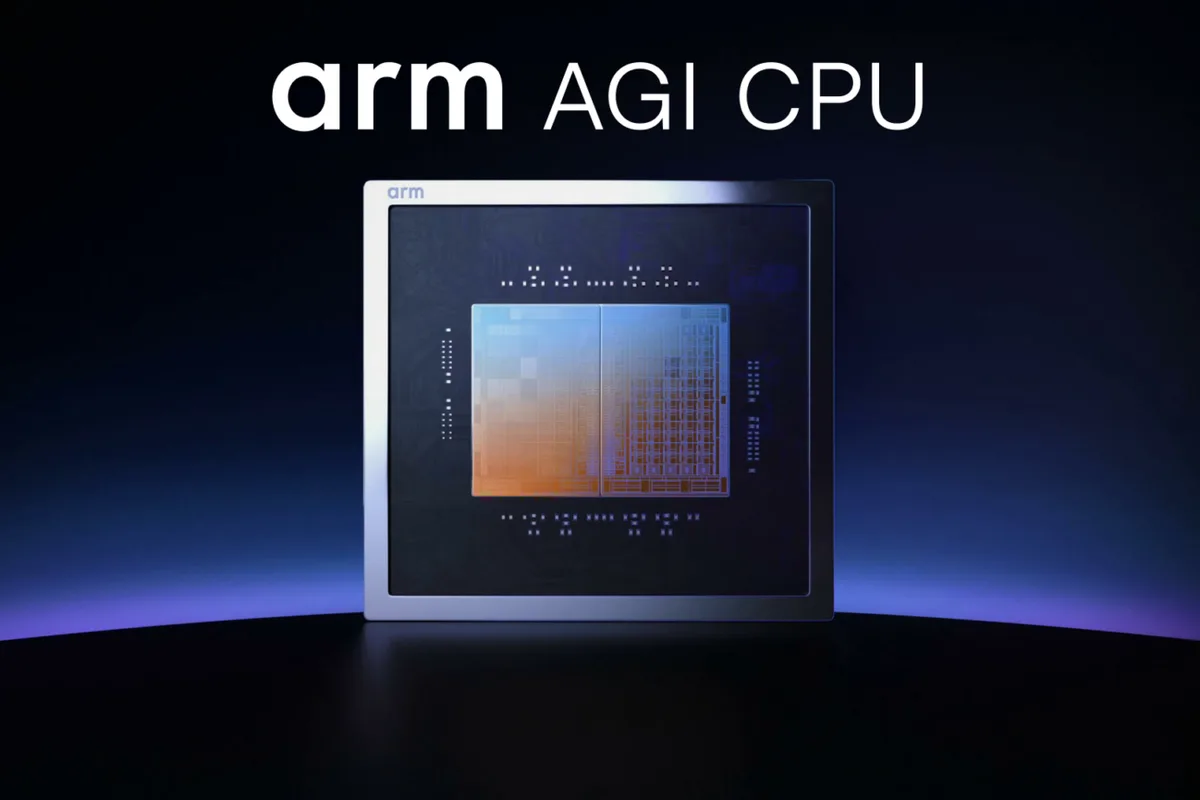
Arm introduced its first production silicon product in March 2026.
Called Arm AGI CPU, it targets infrastructure supporting large numbers of autonomous AI agents and related data center workloads.
The product sits alongside Arm's existing intellectual-property and Compute Subsystem offerings rather than replacing them.
That distinction gives customers several options.
A cloud company can license Arm architecture and develop a customized processor, integrate an Arm Compute Subsystem into its own design, or purchase an Arm-designed CPU.
For Arm, finished processors create a new opportunity to capture revenue directly from hardware sales.
They also introduce operational challenges that are less central to conventional IP licensing.
Production capacity, manufacturing schedules, component availability, hardware qualification and logistics become more important when a company sells actual processor packages.
Arm says customer demand has strengthened since the March announcement.
The company has secured purchase orders from multiple customers covering deliveries through calendar 2027.
Its first commercial deliveries remain scheduled for the fourth quarter of fiscal 2027, which runs from January through March 2027.
That is a future delivery milestone, not confirmation that large-scale commercial shipments were already completed in November 2026.
What makes an AI-focused CPU different?
AI computing is often discussed almost exclusively in terms of GPUs.
Accelerators are central to training large models and performing high-throughput inference, but they do not perform every task in an AI application.
General-purpose processors still handle operating systems, application logic, data preparation, networking, scheduling and communication with external services.
Autonomous agents can increase the amount of that work.
An agent may repeatedly query databases, call APIs, execute programs and coordinate with other agents between model invocations.
Those operations can place substantial demands on CPU resources even when the actual model inference is handled by separate accelerators.
Arm AGI CPU is designed around this workload profile.
Based on the Neoverse CSS V3 platform, the processor supports configurations with up to 136 Neoverse V3 cores.
Arm lists 2MB of dedicated L2 cache per core, clock speeds reaching 3.7GHz and a 300W thermal design power.
The processor uses a TSMC 3nm manufacturing process.
The company emphasizes throughput and density at rack scale rather than relying exclusively on single-processor peak performance figures.
This makes sense for facilities where electrical capacity, cooling and physical rack space can limit expansion.
Arm's two-times performance claim needs context
Arm has published results from testing by Signal65 indicating approximately twice the performance per rack compared with a reference system using AMD EPYC 9755 processors.
That is a specific rack-level comparison.
It is not evidence that one Arm AGI CPU is universally twice as fast as every competing AMD or Intel processor.
Performance depends on the workload, processor configuration, memory system, power constraints and the number of devices included in the comparison.
A rack-level advantage may reflect density and energy efficiency as much as the speed of an individual processor.
Arm also connects its efficiency strategy to the availability of electricity for expanding AI data centers.
That issue is increasingly relevant as infrastructure operators face limits on how much electrical power they can obtain at particular locations.
However, theoretical improvements in compute efficiency do not automatically translate into equivalent reductions in global electricity shortages.
The actual effect depends on how customers deploy hardware and whether efficiency improvements reduce consumption or encourage additional computing demand.
Broader independent benchmarking will be necessary as commercial systems become available.
The $2 billion target is a forecast, not realized revenue
Arm says it has become more confident about generating up to $2 billion in AGI CPU revenue across fiscal 2027 and 2028.
Management attributes that confidence to stronger customer commitments, improved supply availability and changes in the customer mix.
The statement is forward-looking.
It does not mean the company has already recognized $2 billion in sales from those processors.
Nor does it establish that every dollar of the target is covered by non-cancelable orders.
Manufacturing, customer acceptance and deployment schedules will determine the actual revenue contribution.
Oracle Cloud Infrastructure is among the businesses planning to offer Arm AGI CPU-based instances in 2027.
The service has been announced, but its general availability had not been established in Arm's November 4 results.
The company has also highlighted interest from organizations developing large-scale AI infrastructure.
That broader ecosystem support is commercially useful, but different levels of commitment should not be treated as interchangeable.
An announcement of planned support is not the same thing as a completed shipment or a generally available production service.
Neoverse CSS N4 keeps Arm's original business model alive
Arm's transition into finished processors does not mean it has abandoned the companies that design their own chips.
The recently introduced Neoverse CSS N4 expands its Compute Subsystem offering.
Compute Subsystems provide pre-integrated building blocks that customers can use when developing their own silicon.
They can reduce part of the engineering effort required to combine processor cores, interconnects and supporting system functions.
Arm claims that Neoverse CSS N4 offers up to twice the performance per socket and 25% better performance per watt than the preceding generation under its stated comparison conditions.
These figures describe the Compute Subsystem product, not the commercial performance of Arm AGI CPU.
The distinction matters because Arm now serves multiple stages of the processor-development process.
Some customers want maximum architectural freedom. Others prefer a more integrated subsystem. Still others may choose to purchase a complete Arm-designed processor.
The strategy could expand Arm's addressable market while allowing long-standing licensing partners to continue developing differentiated products.
It could also create competitive tension when Arm sells processors into markets served by some of those partners.
The financial report does not provide evidence sufficient to quantify the long-term impact of that tension.
Smartphones remain enormous, but their growth is not uniform
Arm's technology remains deeply embedded in the smartphone market.
The company continues to develop processor and graphics technologies for on-device AI workloads, where performance needs to improve without exhausting battery life.
Yet overall royalty growth was only 8% during the reported quarter, much slower than the expansion in licensing revenue.
Arm identifies higher memory prices and their effects on the smartphone market as one factor limiting royalty growth.
Changes in the cost of components can influence smartphone manufacturers' product decisions and shipment patterns.
Arm's growing presence in data centers therefore provides a potentially valuable counterbalance to fluctuations in consumer electronics.
The company is also expanding its role in personal computers.
Arm says its technology now accounts for approximately 20% of global PC shipments.
That is a company-reported market estimate rather than an independently verified market share figure established by the earnings release itself.
Nevertheless, it underscores the breadth of the markets Arm now addresses, from mobile devices to high-density servers.
More than 10 billion Arm-based chips shipped in one quarter
The scale of Arm's existing ecosystem provides an important context for its move into finished silicon.
For the first time, its partners reported shipping more than 10 billion Arm-based chips during a single quarter.
That represented an increase of approximately 1.5 billion units compared with the previous year.
These were not processors manufactured and sold directly by Arm.
They were chips designed and shipped by partner companies using Arm technologies.
The figure spans many types of devices and computing applications.
It demonstrates the broad reach of the company's licensing model and helps explain why even modest royalty contributions across large product volumes can be commercially significant.
Arm also reports an ecosystem of more than 30 million developers.
Software familiarity and established tooling can lower some barriers to deploying Arm-based systems in new environments, although compatibility and performance optimization remain workload-specific concerns.
The next quarter will test the growth forecast
Arm expects fiscal third-quarter revenue of $1.54 billion, plus or minus $50 million.
The company also forecasts adjusted diluted earnings per share of $0.56, plus or minus $0.04.
Reuters reported that the revenue outlook was slightly above analysts' estimates.
Those projections reflect the expected contribution of licensing and royalties, alongside preparations for Arm's emerging silicon business.
They remain forecasts, not completed results.
The larger strategic test comes with AGI CPU deliveries, which are scheduled to begin commercially during the final quarter of Arm's fiscal 2027.
The company is attempting to expand from designing technologies used in other companies' processors to offering a finished chip that cloud customers can deploy directly.
Its existing licensing business remains the financial foundation of that effort.
The November results demonstrate strong revenue growth and meaningful data center momentum, but also show that reported net profit can move in the opposite direction while investment continues.
The coming quarters should reveal whether Arm can translate its first AGI CPU orders into a durable additional revenue stream without weakening the economics of its established licensing relationships.