
 By Adri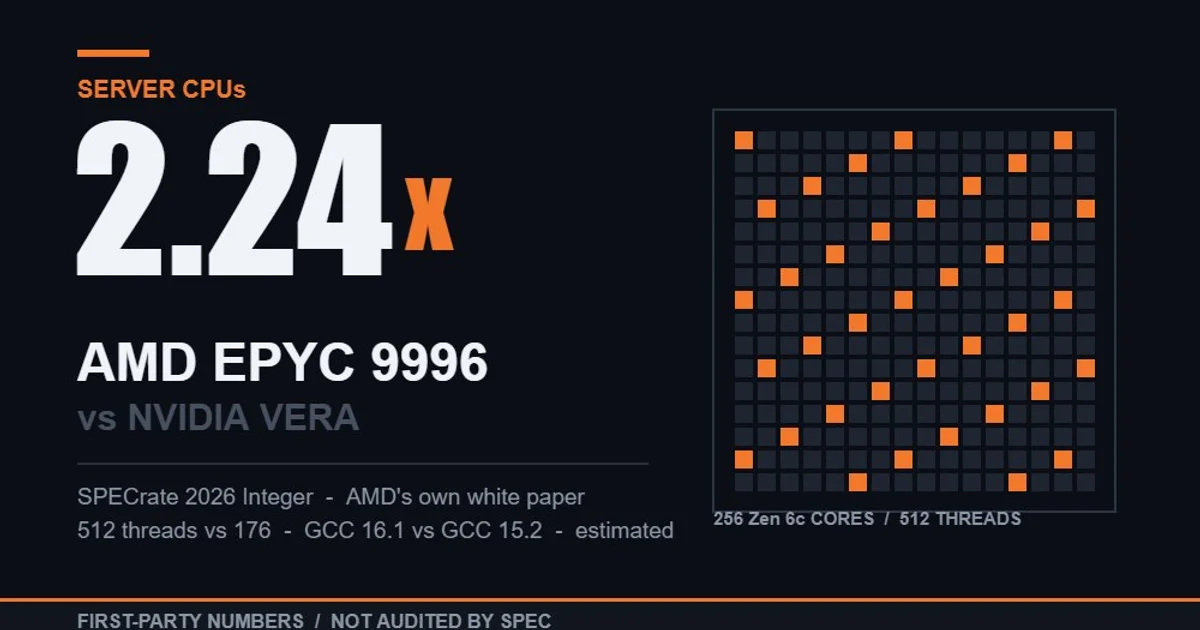
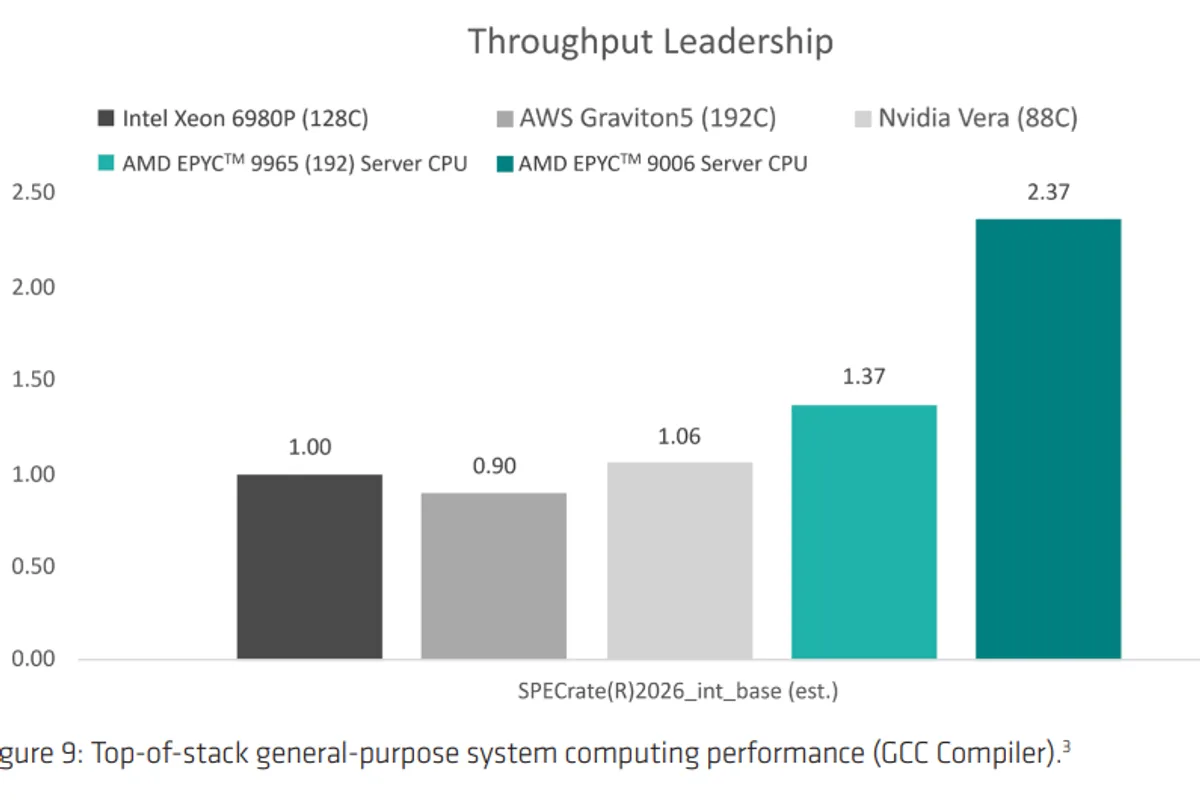
The EPYC 9996 is built to make throughput charts look crowded. It combines 256 Zen 6c cores, 512 threads, 1,024 MB of L3 cache and a 600 W default power rating. AMD's SPEC CPU 2026 Integer Rate figures put it at 2.24x the platform throughput of Nvidia's 88-core Vera and 2.37x Intel's 128-core Xeon 6980P.
The ratios are real numbers from AMD's published material. Their meaning needs a little unpacking.
A throughput benchmark rewards what the 9996 has in abundance
The 9996 exposes 512 hardware threads, compared with 176 from the 88-core Vera configuration. That is close to three times as many threads before the benchmark starts.
SPEC Rate measures aggregate throughput by running multiple copies of workloads concurrently. A dense 256-core server processor is designed for exactly that kind of work. Calling the result simply “2.24x faster” therefore hides a fairly important part of the engineering tradeoff.
AMD's generational comparison is cleaner. In the same broad throughput context, the EPYC 9996 is reported to be roughly 78% ahead of the previous 192-core EPYC 9965. More cores contribute to that result, but the comparison stays inside AMD's own platform lineage.
The 96-core comparison is less dramatic and more revealing
AMD also presents Venice at 96 cores against Nvidia's 88-core Vera, which makes the core counts far closer. In that comparison, AMD reports around 1.2x per-core performance in the SPEC CPU 2026 Integer Rate summary.
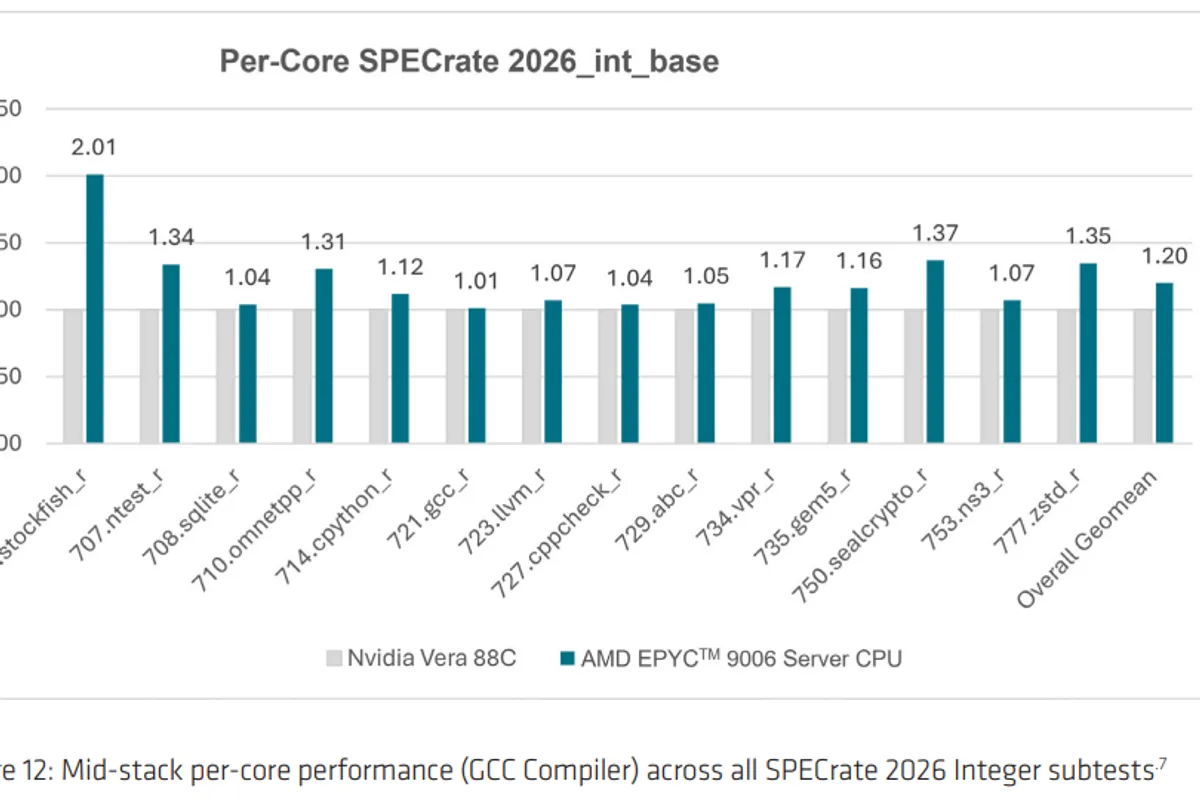
The individual subtests are much less uniform than the headline. Some results sit only slightly ahead of Vera, several reach well above 30%, and a particularly favorable Stockfish result stretches much further.
AMD also reports an 18% sustained memory-bandwidth advantage in STREAM with the 96-core Venice configuration. Normalized per core, the claimed advantage is closer to 8%.
Compiler versions complicate the picture
One caveat matters more than most. Tom's Hardware notes that some newer Venice per-core results were produced with GCC 16.1, while the Vera data AMD references used GCC 15.2. GCC 16 includes Zen 6 support, and compiler changes can alter generated-code performance.
That does not automatically invalidate AMD's result. It does mean the comparison is not isolating silicon alone.
The broader benchmark set also mixes results gathered at different times and under different configurations. Treating every bar as one perfectly controlled cross-vendor laboratory run would overstate what the current data can prove.
Venice is an unusually large platform even before the charts
AMD lists the EPYC 9996 at a 2.55 GHz base clock and up to 4.1 GHz boost, with 1 GB of L3 cache. The SP7 platform supports 16 memory channels, with bandwidth reaching roughly 1.6 TB/s using fast MRDIMMs, alongside PCI Express 6.0 connectivity.
The Venice family is broader than the 256-core flagship. Standard Zen 6 configurations scale to 128 cores, while frequency-focused 96-core parts can reach 5 GHz. The 9996 uses the denser Zen 6c implementation instead.
That split is important. AMD does not need its maximum-density processor to also be its strongest per-core SKU.
Nvidia is now part of AMD's CPU target list
The competitive framing is almost as notable as the benchmark numbers. EPYC launches spent years aiming primarily at Intel Xeon. Venice material now spends considerable effort comparing AMD's server CPUs with Nvidia Vera.
Vera is the Arm CPU component of Nvidia's Rubin systems. AMD's pitch is that CPU performance still matters around accelerators for databases, networking, orchestration, vector search, web services and other infrastructure surrounding AI workloads.
AMD's enterprise and cloud tests claim advantages ranging from 2.4x to 3.7x over Xeon 6980P in selected workloads, with similarly large figures appearing in parts of its HPC suite. They remain vendor-selected and vendor-run benchmarks.
A cleaner answer will require broadly available systems, matched software stacks and independent testing. Until then, the EPYC 9996's 256 cores make for an impressive set of charts, but the footnotes are doing real work too.