
 By Kilam
REDengine 3 still refuses to retire
The Witcher 4 has moved to Unreal Engine 5, but Geralt closes this stage of his career on a heavily revised version of REDengine 3. The most significant change concerns lighting. Compared with the 2022 next-gen update, ray-traced global illumination now produces a much clearer difference, particularly in how interiors, vegetation and characters receive light.
The remaster is brighter overall. That direction will not necessarily appeal to players who prefer the darker appearance of the previous version, but this is more than a contrast adjustment: higher-detail textures, denser vegetation and the revised lighting model work together to change the image.
Path tracing arrives with the bill attached
On PC, path tracing represents the visual ceiling. It further improves lighting coherence, but its cost makes upscaling and frame generation particularly important. ComputerBase's benchmarks already place conventional ray tracing in demanding territory: targeting 60 frames per second at 3840 × 2160 with optimized RT settings required Nvidia hardware in the RTX 5080 or RTX 4090 class within its test set.
Rasterization is naturally much easier to handle. Under the same methodology, 60fps at 2560 × 1440 becomes achievable with GPUs including the RTX 5060, RTX 4060 Ti, RX 9060 XT, RX 7700 XT and Intel B580. Areas with many NPCs can move the bottleneck toward the CPU.
Almost the entire upscaling alphabet
The PC menu includes DLSS 4.5 Super Resolution with Ray Reconstruction, FSR 4.1, XeSS, DLAA, native modes and multiple frame-generation solutions. Reflex, Anti-Lag 2 and XeLL complete the selection. ComputerBase found that DLSS 4.5 notably produced cleaner vegetation than the alternatives it tested, which is hardly a minor concern in a game that spends so much time rendering forests and swamps.
Stability results require more nuance. ComputerBase describes its review build as generally clean, while VULKK encountered frequent stuttering in its pre-release PC build, particularly with ray tracing enabled. Neither observation alone guarantees identical launch behavior across every PC. ComputerBase also required an appropriate Radeon driver during testing to eliminate major rendering problems on some RDNA 4 cards.
Switch 2: the most dramatic leap needs no path tracing
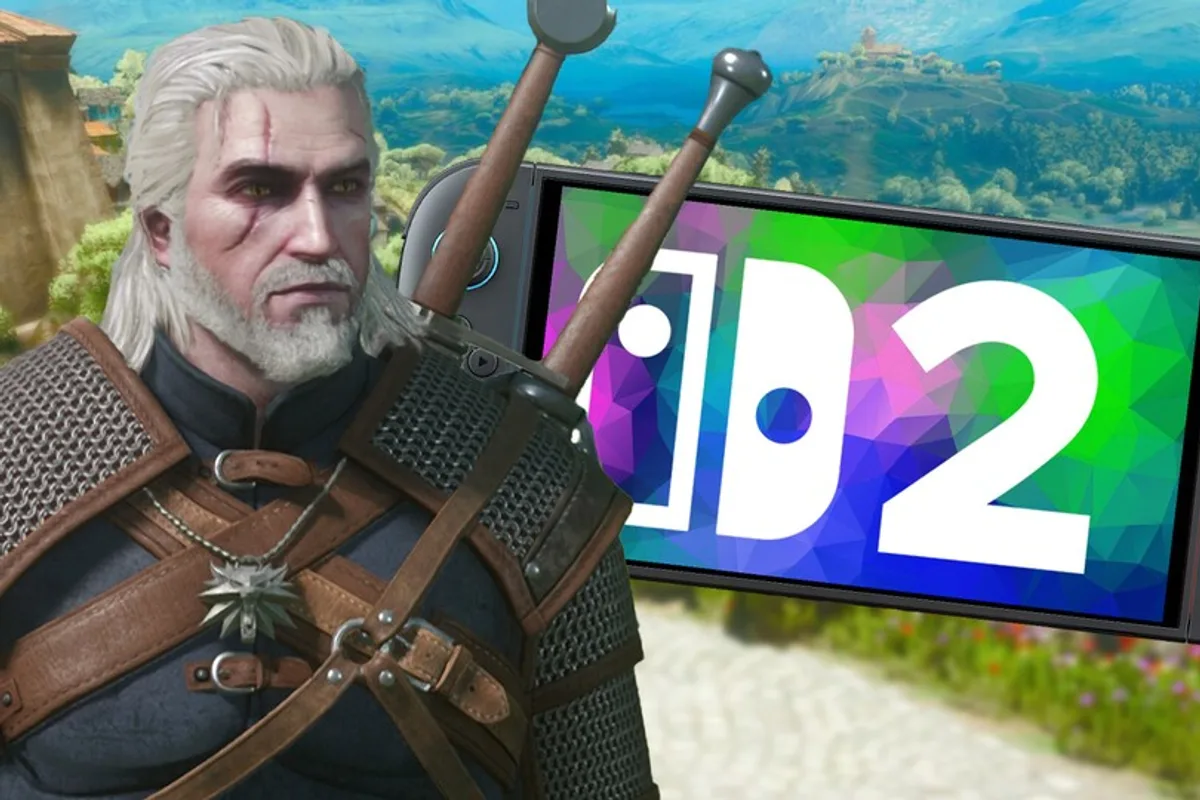
The native Switch 2 version illustrates the opposite end of the project. Compared with the original Switch port, textures, lighting, vegetation and image clarity improve dramatically. The game targets up to 1080p while docked and 720p in handheld play, with VRR and frame rates capable of reaching 40fps depending on conditions.
The compromise remains visible on the handheld display. RPG Site reports a softer image than expected and argues that an optional 30fps quality mode would be useful. Loading also remains behind PS5: in its matching-save test, Switch 2 required roughly 27 to 29 seconds versus 11 to 13 on PS5, while a tested fast-travel route took 42 to 43 seconds versus 24 to 26.
Eleven years do not disappear under additional rays
Even at maximum settings, the technology cannot make The Witcher 3 look entirely like a game designed in 2026. Some animation work and geometric detail density still belong to foundations created in 2015. That is precisely what makes the result technically interesting: the remaster pushes its old engine remarkably far without pretending to have replaced it.
The visual improvement is substantial enough to exceed routine preservation work, but hardware cost rises quickly once ray tracing and path tracing enter the equation. For existing owners, at least, the software cost of that experiment remains zero: the upgrade is free on qualifying platforms.