
 By Kilam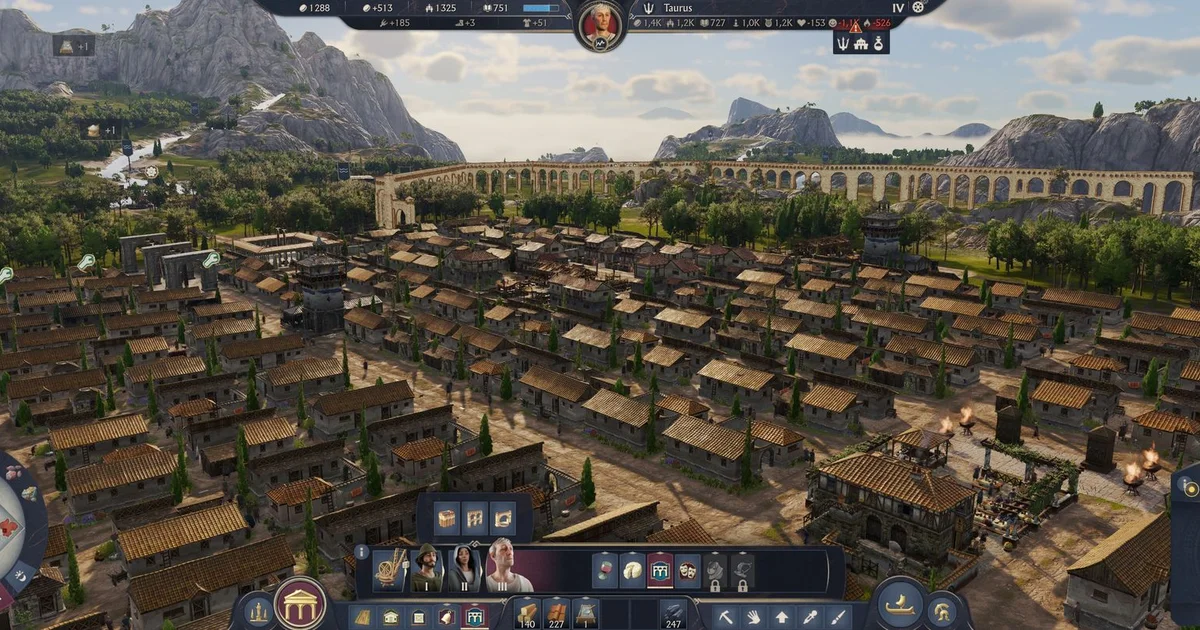
Cities are considerably heavier than they look
Anno 117 renders thousands of small animations, buildings, residents, vehicles, ships, weather effects and lights while continuing to run its economic simulation in the background.
ComputerBase nevertheless finds the processor to be a less severe constraint than it was in Anno 1800. Tests using a roughly forty-hour save still reveal CPU differences, but they are far less dramatic than in the previous game.
That distinction matters in Anno because the meaningful performance test never occurs in the opening hour. It occurs after the map has filled with production.
Ray tracing is genuinely integrated into the visual design
ComputerBase finds that the pure rasterized presentation loses substantial visual quality compared with ray-traced modes. Reflections matter, but lighting is particularly important to the final appearance of the cities.
RT Medium already captures much of the benefit, while RT High improves lighting further at an additional performance cost.
This is not a negligible effect that can always be disabled without consequence. It is also why maximum settings become so expensive.
Ultra Max turns a Roman city into a benchmark
Notebookcheck records enormous scaling between presets. An RTX 4050 can comfortably exceed sixty frames per second at 1080p Low, yet Ultra Max can overwhelm an RTX 5070 and prevent even an RTX 5080 from reaching forty frames per second in its test sequence.
DLSS and other upscaling technologies therefore become important rather than decorative when chasing the highest visual settings.
Integrated GPUs are much less convincing. Notebookcheck concludes that smooth Full HD play is generally unrealistic on that class of hardware.
Frame pacing matters more than the highest number
ComputerBase specifically praises stability and frame pacing in the final PC release. GameWatcher reports some stutter and pop-in on an RTX 3080 system but does not describe a broadly unstable client.
The biggest improvement over Anno 1800 becomes visible in heavily developed cities: CPU performance still matters, but the simulation appears less aggressively bottlenecked.
At sensible settings, PC therefore offers a much healthier quality-to-performance balance than Ultra Max alone suggests.
PS5 preserves the spectacle but not the same ergonomics
GameSpew responds very positively to the PS5 presentation while recommending mouse and keyboard when possible. PlayStation Universe is harsher, criticizing menu navigation and awkward controller input.
Keyboard and mouse support significantly reduces the problem on console. It also illustrates how naturally a dense city-builder interface still fits a pointer.
Ubisoft continued improving this layer after release, including a fix for high mouse-input latency on PlayStation 5 in update 1.4.
2026 also demonstrated the risks of large patches
Update 1.4 temporarily disabled ray tracing on consoles because of a bug before 1.4.1 restored it. Later, update 1.5 arrived with known problems including rare crashes, cooperative desynchronization and performance issues during volcanic eruptions in Prophecies of Ash.
Ubisoft subsequently issued a public apology acknowledging that the update had not met its expected quality level. Versions 1.5.1, 1.5.2 and 1.6 addressed many of those regressions.
September's 2.1 update is much more focused on balance and polish, suggesting a client that has returned to a more stable phase.
The most impressive technical trick happens when the camera moves closer
City builders can look convincing from a distance and collapse once the camera descends. Anno 117 largely avoids that problem.
Plazas, temples, workshops and streets retain enough detail for players to observe their settlements almost like dioramas. Crowds, materials and lighting continue to hold together at an inspection distance where many strategy games hide their approximations.
That ambition explains part of the hardware cost. It also explains why Pax Romana is one of the rare city builders where optimizing a settlement and simply watching it can feel almost equally important.