 By Camille
The trouble started with June firmware
The issue traces back to firmware versions 114.602.050.1 and 114.602.080.1 released across several recent Bravia generations from June.
Those updates were associated with Sony’s move from Android TV 12 to Android TV 14 on affected platforms. Owners soon began reporting problems when external HDMI sources were connected to the TV and audio was then passed to a soundbar or AV receiver through eARC.
The most obvious failure was lip-sync drift. On some systems, audio delay became progressively worse during playback.
Other reports described complete audio dropouts, crackling or situations where the television had to be restarted before it would communicate correctly with the external audio system again.
The TV-as-HDMI-hub configuration was particularly exposed
The common setup explains why not every owner encountered the same problem.
A console, Blu-ray player or streaming box connects to an HDMI input on the Bravia. The TV handles the video and passes the accompanying audio to a soundbar or receiver through its HDMI eARC port.
That chain generated many of the reports. Internal Google TV apps or systems where source devices are connected directly to the AV receiver could behave differently.
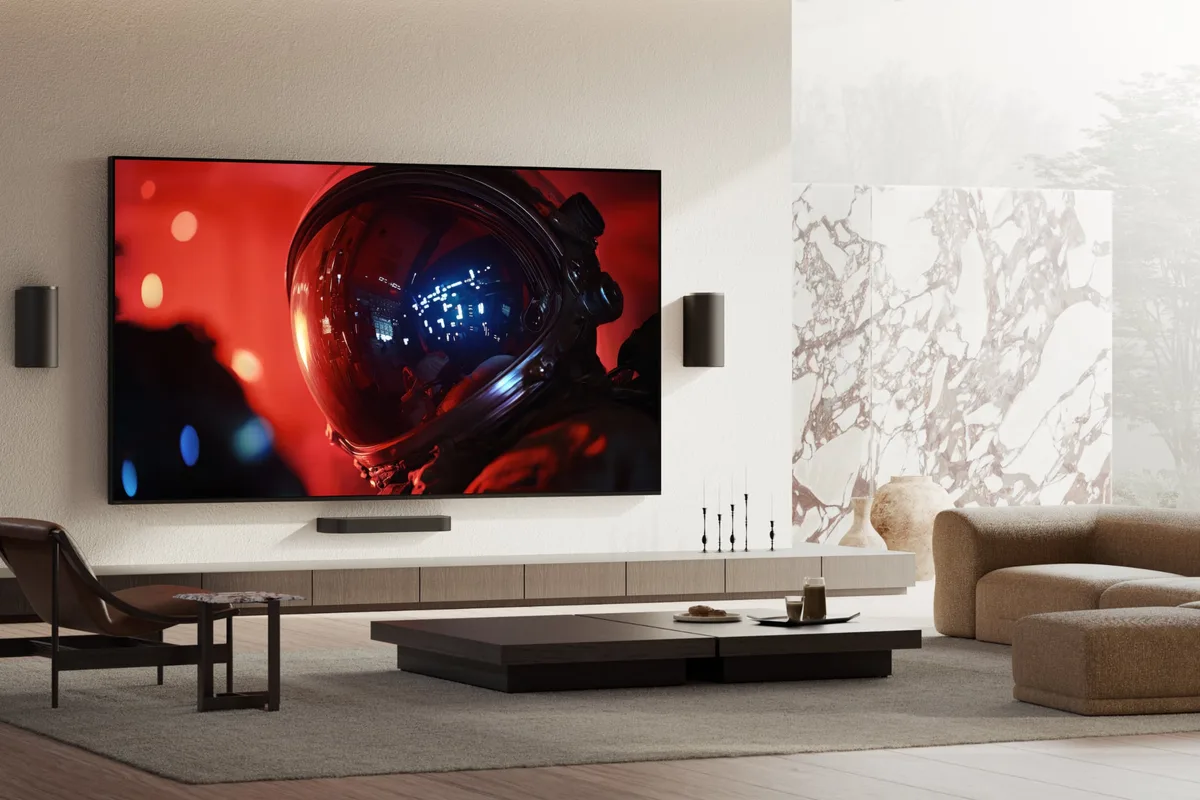
That makes the bug particularly frustrating because simplifying exactly this kind of system is one of eARC’s main purposes, while still carrying high-bandwidth formats such as Dolby TrueHD and DTS-HD.
Dolby Vision had problems too
The same software cycle also caused serious video trouble for some users. Dolby Vision content from external HDMI devices could fail to play correctly or produce a black screen.
Sony later issued another firmware revision that appears to have addressed much of the Dolby Vision problem.
Audio synchronization and dropouts proved more persistent, which is why version 114.603.100.1 has attracted so much attention.
Sony Japan finally acknowledged the lip-sync issue
In September, Sony Japan published a support notice confirming that some recent Google TV-based Bravia televisions could develop audio-video synchronization problems after the June software update.
The affected list includes product families such as Bravia 9 II, Bravia 7 II, Bravia 9, Bravia 8, Bravia 7, Bravia 5 and A95L in the relevant market.
Sony said a September software update was planned to improve the lip-sync problem.
Its language about crackling and audio noise was less conclusive. The company said it was still investigating the cause of those symptoms.
Firmware 114.603.100.1 is live in North America
Sony USA released firmware 114.603.100.1 on September 15 for multiple affected models, with support pages for products including Bravia 9 II, Bravia 9, Bravia 7 and Bravia 5 listing the new version.
The download is a little over 3GB and can be installed either through the television’s normal update system or manually using a USB drive.
Automatic deployment is staggered, so two owners of the same television may not receive the update notification on exactly the same day.
Firmware branches are also regional. A North American update file should not simply be downloaded and forced onto a European television for which it was not released.
Early owner reports are genuinely encouraging
Initial U.S. feedback after installing 114.603.100.1 is positive. Several owners say severe audio-sync delays have disappeared or improved substantially.
Some users also report that the eARC audio dropouts they experienced previously have stopped.
That is useful evidence, but it is not yet universal validation. The sample is small, home-cinema configurations vary enormously, and Sony has not officially stated that every source of dropout or crackling is fixed by this release.
An Apple TV feeding one soundbar is not the same HDMI chain as a game console feeding a different AV receiver. More combinations need to remain stable before the issue can safely be considered finished.
Europe does not necessarily receive the same number at the same time
Regional rollout makes the story harder to follow. While 114.603.100.1 appeared on U.S. support pages, European versions of some televisions were still listing different firmware branches.
European Bravia 7 II and Bravia 9 II models, for example, previously received 114.602.170.1, which addressed a black-screen issue when starting certain content from external HDMI devices.
That does not mean Europe will miss the audio fix. Sony routinely maintains region-specific firmware versions and deployment schedules.
Owners should therefore check the support page for their exact television model and country rather than searching only for a version number quoted by North American users.
Why an eARC bug can become surprisingly complicated
eARC looks like a simple audio connection from the outside. Internally, the television, source device and audio system negotiate formats, capabilities and timing.
The TV also has to keep an increasingly complicated video pipeline synchronized with audio that may be forwarded to another device. Dolby Vision processing, game modes and different audio formats do not necessarily introduce identical latency.
Changing the operating system or HDMI pipeline can therefore alter timing enough to create visible drift even when the exact same hardware worked perfectly on the previous firmware.
That is also why a reliable fix can take time: it needs to survive a large number of source, receiver and soundbar combinations rather than one laboratory configuration.
It is a rough reminder about automatic TV updates
The episode raises a familiar question for AV enthusiasts: should a perfectly stable television install every software update immediately?
Connected TVs need security and compatibility updates. At the same time, many home-cinema systems are relatively static hardware chains whose owners do not want critical HDMI behavior changing every few weeks.
A firmware release can add Android TV 14 or useful features while accidentally breaking an eARC path that had worked flawlessly for a year.
Ideally, owners should not have to choose between current security software and reliable audio.
The fix looks real, but “resolved” is still slightly premature
The situation is considerably better than it was earlier in September. Sony has acknowledged the synchronization problem, a firmware release matching the promised timing exists in a major region, and early user reports are positive.
Two qualifications remain. Distribution is not yet uniform worldwide, and Sony’s own support communication still treats some crackling and noise symptoms as under investigation.
For affected owners, 114.603.100.1 increasingly looks like the update they were waiting for.
Calling the entire three-month eARC problem finished should probably wait until the firmware has spent more time across different regions, soundbars, receivers and HDMI sources.