
 By Camille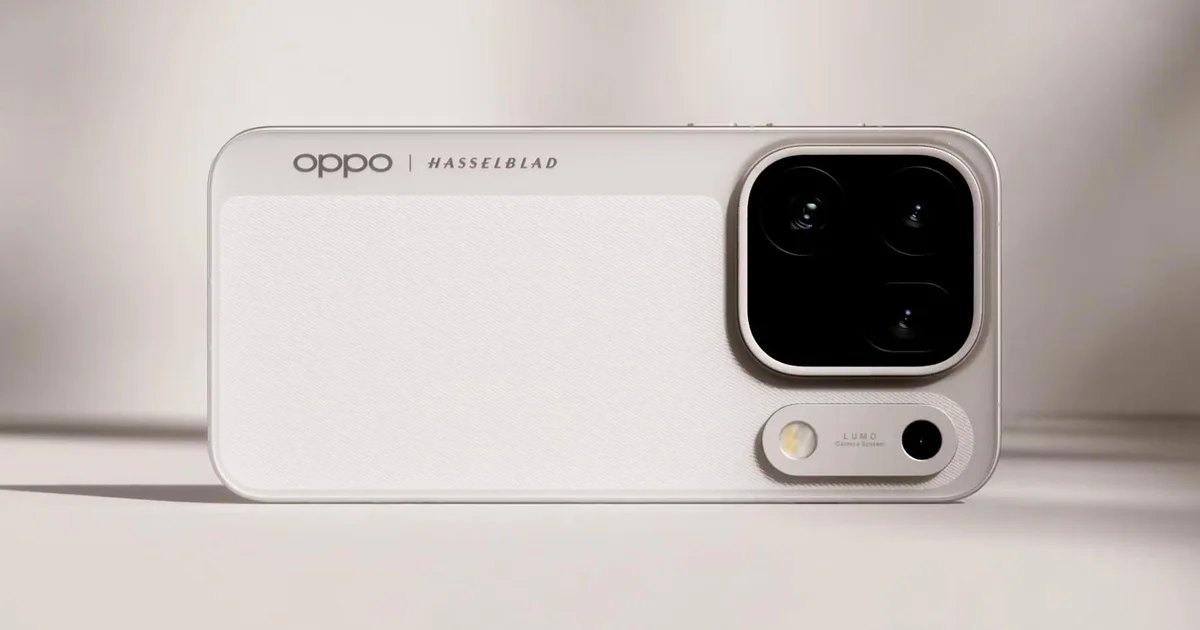
Three 200MP cameras, with three very different jobs
OPPO launched Find X10 Pro Max in China on September 22. It is the first commercially released smartphone to use 200MP sensors across all three of its primary rear cameras.
The main camera uses a 1/1.3-inch sensor behind a 24mm-equivalent f/1.5 lens, with autofocus and two-axis optical stabilization.
The ultrawide moves to a 13mm-equivalent lens with a 124-degree field of view. Its 1/1.56-inch 200MP sensor is unusually large for this category, and the f/2.2 module retains autofocus.
The periscope camera also uses a 1/1.56-inch 200MP sensor, paired with a 70mm-equivalent f/2.1 lens. OPPO quotes CIPA 7.5 stabilization performance and focusing as close as approximately 10cm for telephoto macro work.
A 600MP specification does not create a 600MP photograph
The three cameras do not combine into one enormous sensor. At any given focal length, the corresponding module remains the primary source, supplemented by computational processing and information available elsewhere in the camera system.
High resolution gives OPPO more room for crop-based zoom, fine detail and multi-frame processing.
Pixel count alone still cannot establish image quality. Lens performance, sensor readout, stabilization, noise handling and processing matter at least as much.
The encouraging part is that OPPO has not relied solely on the 200MP badge. All three sensors are substantial for their respective focal lengths, while the main and periscope lenses are particularly bright.
DeepPix brings a claimed 17 stops of dynamic range
The main camera debuts what OPPO calls DeepPix sensor technology, with the company claiming up to 17 stops of dynamic range.
The intended benefit is most obvious in difficult mixed-light scenes: a backlit portrait, city lights at night or a sunset where bright highlights and dark shadows need to survive in the same frame.
DeepPix works alongside OPPO's LUMO color and light-processing systems and the continuing Hasselblad collaboration.
The 17-stop figure remains a manufacturer measurement. It should not be compared directly with another phone or professional camera without understanding how each figure was obtained.
The Hasselblad teleconverter makes the phone almost modular

OPPO is also continuing the move toward add-on optics. A new Hasselblad Teleconverter Kit attaches in front of the periscope camera.
With the accessory fitted, OPPO advertises up to 10x optical magnification, a 20x lossless mode and digital zoom reaching 200x.
Without the external lens, OPPO's own phone specification lists 3x optical zoom and up to 120x digital photo zoom.
The separate kit includes the teleconverter, matching case, mounting ring, grip hardware, strap and storage accessories. It costs CNY 1,099 in China.
Its target scenario is obvious: concerts, stadiums and other situations where the photographer cannot simply walk closer.
Video is almost as aggressive as the still-camera specification
Find X10 Pro Max records 8K video at 30fps, with OPPO promoting 8K capture across its focal-range system.
The official specification also lists 4K capture at up to 120fps and Dolby Vision recording at up to 4K/120.
A professional video mode, HDR recording, stabilization and dedicated production-oriented tools expand the video side beyond ordinary point-and-shoot use.
The front camera is a 50MP autofocus unit capable of 4K60 Dolby Vision recording.
A dedicated shutter control still has a place
OPPO keeps a physical Snap Key designed around faster camera access and capture.
That fits the intended concert, sport and street-photography use cases particularly well. In those situations, opening an app, selecting the correct mode and finding a virtual shutter button can be enough to miss a moment.
The camera software also provides customizable color treatments and Hasselblad-influenced looks.
MediaTek's Dimensity 9600 Pro moves to 2nm
The hardware behind the camera system is MediaTek's Dimensity 9600 Pro, manufactured on TSMC's N2P 2nm process.
Its All-Big-Core CPU includes two C2-Ultra cores reaching 4.55GHz plus six additional performance cores.
MediaTek claims roughly 17% higher overall CPU performance and up to a 61% improvement in multi-core CPU energy efficiency compared with the previous generation. The G2-Ultra NX GPU is claimed to deliver around 27% higher performance under selected sustained workloads.
Those are platform claims rather than independent phone results. The more meaningful 2nm test will be how much performance Find X10 Pro Max can maintain after extended camera, gaming and AI workloads without excessive heat or battery drain.
The 2nm chip sits beside an 8,000mAh battery
Battery capacity reaches 8,000mAh, the largest cell OPPO has placed in a Find-series phone so far.
The company uses its silicon-carbon Glacier battery technology, with a typical stored energy figure of 29.76Wh.
Wired charging reaches 80W SuperVOOC, while wireless charging is rated at up to 50W.
OPPO claims up to 30 hours of online short-video playback and 14 hours in a popular MOBA under its own test conditions. Those figures will need independent battery testing before they mean much in comparison with rivals.
The display reaches 144Hz, but only in selected games
The flat 6.78-inch LTPO display has a 2772-by-1272 resolution. Its normal adaptive refresh range operates between 1Hz and 120Hz.
OPPO also supports up to 144Hz in selected gaming scenarios, so 144Hz should not be interpreted as the phone's default maximum in every application.
Claimed full-screen peak brightness reaches 2,000 nits, while PWM dimming can operate as high as 3,840Hz in the relevant low-brightness modes.
OPPO also advertises coverage of 95% of BT.2020 using new display materials developed for this generation.
An 8,000mAh phone that remains 8.4mm thick
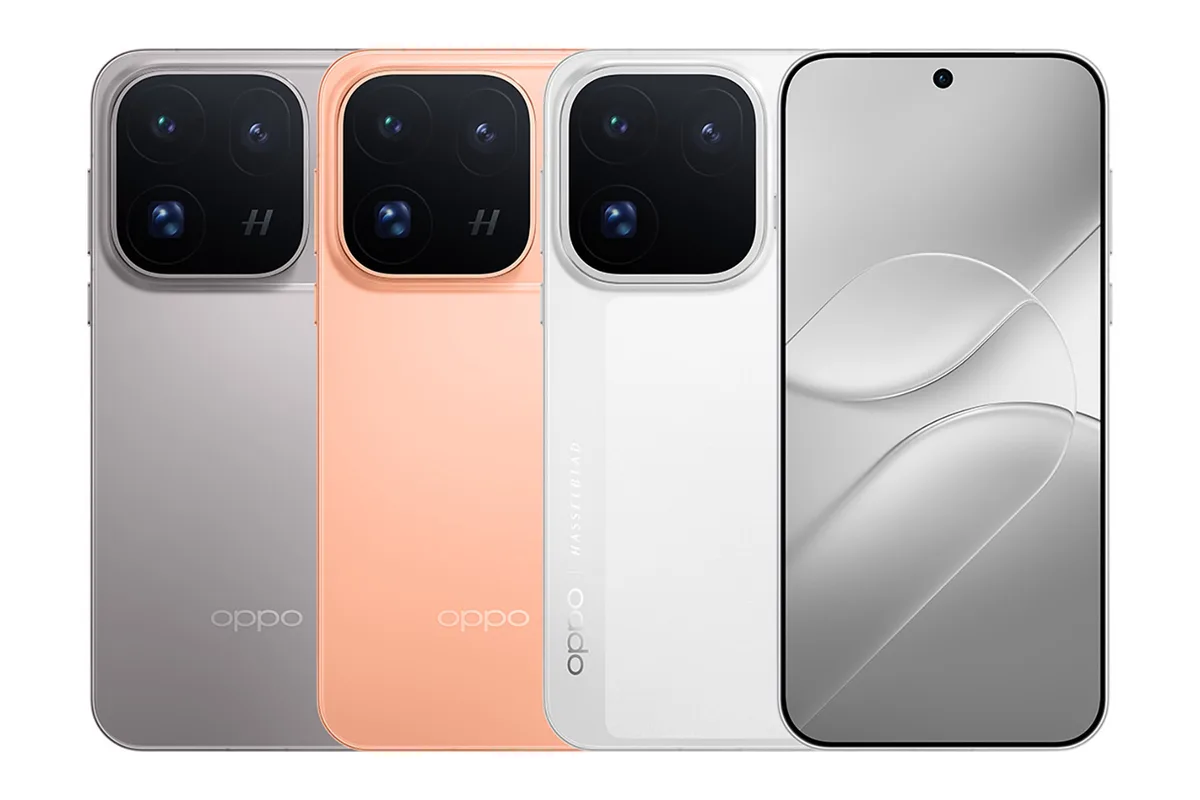
Find X10 Pro Max is approximately 8.4mm thick. Weight varies slightly by finish, with Moon White listed at about 233g and Warm Orange and Light Titanium at roughly 235g.
That is still a heavy phone, but the context has changed. An 8,000mAh battery no longer automatically means a rugged-phone-sized body.
Environmental protection is unusually broad, with IP66, IP68 and IP69 ratings.
An ultrasonic fingerprint reader, symmetrical stereo speakers and OPPO's latest cooling system complete the physical package.
ColorOS 17 runs on Android 17
The Chinese model launches with ColorOS 17, including OPPO's new Laminar Flow Engine developed jointly with MediaTek.
The system is intended to coordinate rendering and task scheduling more tightly, improving app launches and keeping interface loading smooth during demanding operations such as rapidly scrolling through large photo libraries.
Dimensity 9600 Pro also divides AI work between a high-performance NPU and a lower-power NPU intended for persistent tasks.
Chinese pricing starts at CNY 6,799
The entry Find X10 Pro Max configuration combines 12GB of RAM with 256GB of storage for CNY 6,799.
A 12GB/512GB model costs CNY 7,499, 16GB/512GB rises to CNY 7,999, and the 16GB/1TB flagship configuration reaches CNY 8,999.
Memory is LPDDR5X and storage uses UFS 4.1. There is no microSD expansion.
The three finishes are Moon White, Warm Orange and Light Titanium. OPPO explicitly notes that “Light Titanium” is the color name and does not indicate a titanium chassis.
An international launch is already confirmed
Global availability is no longer speculative. OPPO confirmed on September 15 that Find X10 Pro Max will launch in international markets.
OPPO stores in France, Germany, Austria and the UK are already running Find X10 Series launch campaigns and early-access programs.
French and German Early Bird deposit periods began on September 22 and continue into October, but final European retail pricing has not yet been disclosed.
That is now one of the few major unknowns left around the product.
Three 200MP sensors still have to prove they produce better photographs
OPPO has achieved something unusual on a specification sheet: there is barely a conventional secondary camera left on its most ambitious phone.
Main, ultrawide and telephoto all receive substantial sensors, high resolution and hardware that appears designed to do more than fill an empty circle in the camera app.
The real comparison will be much less spectacular: skin tones, moving subjects, shadow noise, consistency between lenses and the ability to produce a good image quickly.
Find X10 Pro Max brings 600 million pixels to that problem. Independent testing will determine how many of them actually matter.