 By Adri
AI coding systems have become very good at producing changes. Managing what happens to those changes is a different engineering problem.
A development team still needs to locate files, understand modifications, review competing implementations, preserve version history and decide which code is ready to be merged or deployed.
Those tasks are central to OpenAI's proposed acquisition of Pierre Computer Company, announced on November 4.
Pierre builds software components designed for code exploration and review, along with Code Storage, a service for storing and tracking source code using Git.
Two of its products, Trees and Diffs, are already used inside the Codex application. OpenAI is therefore moving to acquire a supplier whose technology contributes to its existing developer experience.
The deal remains pending. OpenAI says the companies will operate independently until customary closing conditions, including regulatory approvals, are satisfied.
The technology Codex users already rely on
Trees provides a way to navigate project files and folders. Its function is straightforward, but the details become important when a project contains large numbers of files and changes arrive from several coding agents.
Developers need to identify the relevant files without spending excessive time searching through project structure.
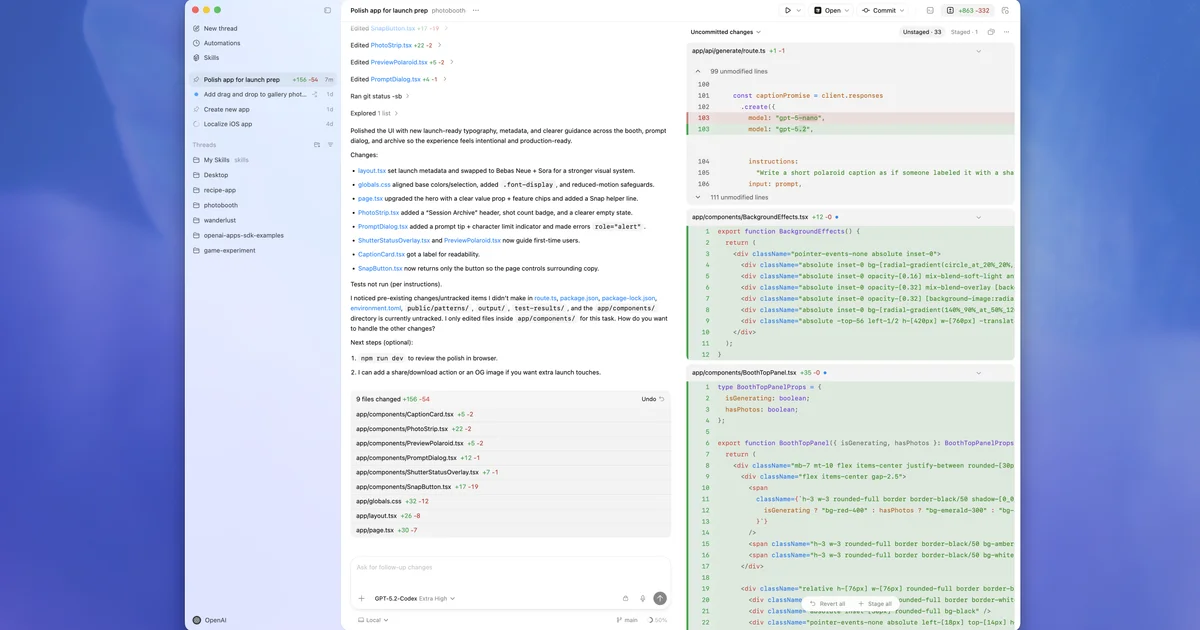
Diffs addresses a related challenge by rendering differences between versions of a file. It allows a reviewer to see which lines were inserted, removed or modified.
The library supports several presentation styles, including unified and side-by-side comparisons. Pierre also provides functionality for annotations and more advanced code review interfaces.
Its Edit mode allows a reviewer to correct code within the diff interface itself.
This matters when a proposed change is mostly acceptable but still contains a small error. A reviewer can make a targeted correction rather than treating the generated output as an indivisible block.
Pierre's documentation also describes interfaces for reviewing merge conflicts and accepting or rejecting modifications.
These tools provide visibility and control, but they do not establish that a software change is correct. Automated tests, human review and other validation processes remain necessary.
Highlights addresses the speed of streamed code
Pierre's recently released Highlights library focuses on syntax highlighting.
Its purpose is to keep code readable by distinguishing programming-language structures as text appears.
That work has become more important in AI-assisted development because coding agents may stream generated code into interfaces continuously.
Instead of waiting for a complete file, a developer might see changes unfold while an agent is still working.
The interface needs to remain responsive as that content changes, particularly when a task involves multiple files or extensive modifications.
Highlights is designed for this type of incremental display, complementing the navigation and revision capabilities provided by Trees and Diffs.
Together, the libraries form part of the presentation layer surrounding AI-generated code.
They are not themselves models that generate programs. Their role is to make resulting code easier to navigate, inspect and adjust.
Code Storage is the larger infrastructure opportunity
The most strategically important product in the announcement may be Code Storage.
Where Trees organizes a visible file hierarchy and Diffs displays changes, Code Storage deals with preserving the code and its history using Git.
Git underpins many modern software-development workflows. It records revisions, supports branches and provides the history needed to understand how a project evolved.
Code Storage exposes this functionality through infrastructure and APIs that applications can use to manage source code.
For developers working with autonomous agents, code storage is not a secondary concern. Several agents may simultaneously create branches, experiment with implementations or generate changes that need to be reviewed separately.
The resulting history must remain accessible and understandable.
OpenAI says it intends to bring Code Storage features and functionality into Codex after the acquisition closes.
The announcement does not establish exactly how that will be delivered.
A fully integrated hosted repository service, an API-oriented infrastructure component and deeper workflow integrations are different possibilities, but OpenAI has not specified a finished product architecture or release date.
There are no announced future prices or mandatory migration requirements.
Pando shows why OpenAI is investing in Git infrastructure
The Pierre announcement follows another significant development.
On November 2, OpenAI published a technical explanation of Pando, a Git-compatible backend it developed for its internal engineering infrastructure.
The company says the growth of parallel coding-agent workloads placed increasing pressure on its source-control systems.
An engineer may now have several active changes progressing at once. Each branch can generate pushes, fetches, merges and continuous-integration jobs.
As concurrency increases, repository infrastructure needs to handle many writes and reads without creating a shared bottleneck.
Pando addresses this problem through an architecture that allows updates to independent branches to proceed with less coordination.
It also reuses Git packfiles when serving repository data, reducing the need to generate separate responses for every requesting client.
OpenAI reports that Pando has reduced median push latency by nearly a factor of five in its production environment and now delivers close to a petabyte of Git data per day.
These are company-reported measurements from its internal system. They are not benchmark results for Pierre's Code Storage service or a promised performance improvement for Codex customers.
OpenAI has also not disclosed a technical plan to merge Pando and Code Storage into one product.
The two initiatives address related problems, but the relationship between their architectures remains an open question.
A potential challenge to GitHub's broader position
OpenAI is increasingly extending Codex beyond writing individual code changes.
A development platform also needs tools for managing repositories, preserving history, reviewing proposed changes and coordinating work between contributors.
Microsoft-owned GitHub offers many of those services today, including repository hosting and collaborative review workflows.
The planned Pierre acquisition would strengthen OpenAI in several adjacent areas.
Codex already supports code creation and modifications. Pierre's libraries contribute file navigation and review. Code Storage could supply more of the source-control infrastructure required to maintain and manage that work.
Axios characterized the acquisition as an effort to compete more directly with GitHub.
That assessment follows from the product overlap, but it is an interpretation rather than an announced replacement strategy.
OpenAI has not launched a complete GitHub equivalent as part of the November 4 announcement.
Nor has it stated that Codex users will have to move their repositories away from GitHub or other existing services.
The competitive relationship is particularly notable because OpenAI and Microsoft are partners in AI while operating products that can overlap in developer tooling.
The acquisition could expand that overlap, but its practical effects will depend on future product decisions.
Open-source projects are expected to remain available
OpenAI has made a specific commitment concerning Pierre's open-source software.
It says those projects will remain open source and that OpenAI will continue contributing to them.
For developers using Pierre components independently of Codex, this is an important part of the announcement.
The libraries can serve applications beyond OpenAI's own coding environment, so their continued availability matters to the broader developer ecosystem.
However, a commitment to retain open-source status is not a guarantee that maintenance priorities, governance or release schedules will remain unchanged indefinitely.
Developers will need to examine future project activity and licensing details as the integration progresses.
OpenAI has also said that existing Code Storage customers can continue using the service after the acquisition closes while its capabilities are incorporated into Codex.
The company has not announced changes to pricing or specified how long individual integrations will take.
The transaction is pending, and the roadmap is still incomplete
As of November 4, 2026, the distinction between existing capabilities and future plans is straightforward.
Trees and Diffs are already integrated into Codex. Pierre's other products, including Highlights and Code Storage, exist independently.
OpenAI has announced an agreement to acquire the company and wants to develop new tools and platforms around source control and agent-assisted software development.
The purchase has not closed. Its price has not been disclosed, regulatory approvals remain outstanding and no specific integration launch date has been provided.
For teams using Codex today, there is no announced requirement to change repository providers or migrate source code as an immediate consequence of the deal.
The longer-term opportunity is to reduce the distance between producing changes and managing their complete lifecycle.
As coding agents take on more simultaneous tasks, the ability to inspect, compare, store and trace their work may become as important as the models generating it.
OpenAI's Pierre acquisition is aimed at that surrounding infrastructure. Whether Codex becomes a full software-development platform will depend on the features that are actually delivered after the transaction is completed.