 By Tsuky
NVIDIA has entered into a definitive agreement to acquire Hugging Face for $12.9303 billion. The transaction is one of the largest acquisitions in NVIDIA's history, but it has not closed yet.
A regulatory filing breaks the structure down into approximately $11.9 billion for Hugging Face shareholders and an equity-based retention program worth up to another $1 billion for employees joining NVIDIA. Closing is expected in the first half of 2027, subject to regulatory approvals and customary conditions.
NVIDIA is buying distribution as much as software
Hugging Face says more than 18 million developers, researchers and creators now use its platform. They have shared more than 3 million models, 500,000 datasets and 1 million applications, while more than 200,000 companies use its services to discover, evaluate, customize and deploy AI.
That scale makes Hugging Face a particularly unusual acquisition target. It is a model hub, but also a collection of widely used libraries, datasets, evaluation tools, inference services and deployment infrastructure. For much of the open-model ecosystem, it has become part of the basic workflow.
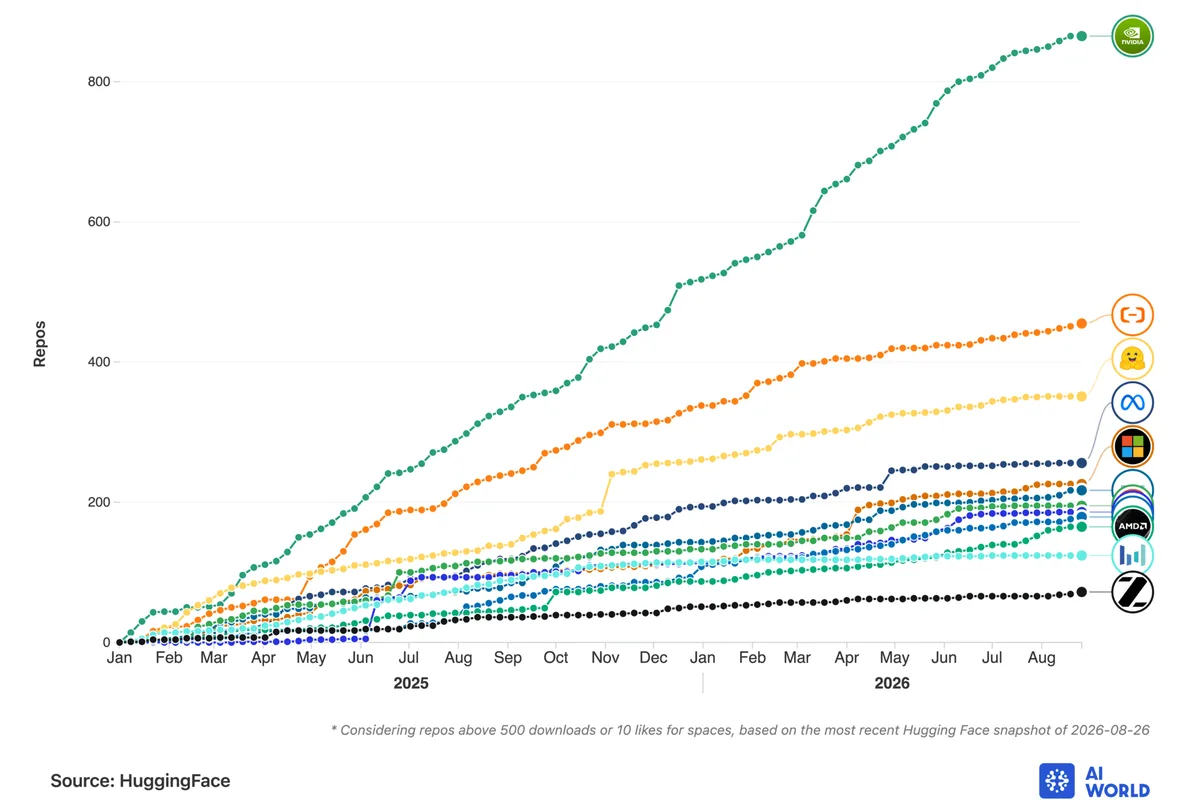
NVIDIA was hardly an outsider. Jensen Huang says the company is already Hugging Face's largest contributor of open models and data, with more than 500 models and over 250 datasets published on the platform.
Developer behavior is valuable infrastructure too
Owning a platform this central to AI development creates a useful view of the market. Hugging Face sits close to the point where developers decide which models to download, which architectures are gaining attention and which deployment tools they actually use.
Reuters notes that this could strengthen NVIDIA's relationship with developers at a time when several major customers are designing their own accelerators. Meta, Microsoft and OpenAI are among the companies looking for ways to reduce dependence on NVIDIA hardware.
That makes software and distribution increasingly important. NVIDIA does not need every company to buy a GPU directly if it can remain embedded in the tools, libraries and infrastructure through which AI workloads are built.
The neutrality promise is now the important part
NVIDIA knows what developers are likely to worry about. Huang says Hugging Face will remain open to models from across the ecosystem and will continue to support multiple clouds and multiple accelerator platforms.
The commitment is unusually explicit: NVIDIA says its compute will not be required to build or deploy through Hugging Face. Its SEC filing also says the platform will continue supporting other silicon vendors.
That matters because Hugging Face's usefulness comes partly from not being tied to one hardware stack. The company has worked with competing chipmakers, cloud providers and AI labs for years.
A hard lock-in is not the only possible concern, though. NVIDIA could gain an advantage through tighter software integration, faster optimization for its own accelerators or simply a smoother deployment path. Reuters reported that developers and analysts were already raising that possibility after the deal was announced.
Open models are becoming strategically useful to NVIDIA
The economics are straightforward. Open-weight models can be downloaded, customized and deployed outside a proprietary API. As they improve, more companies can build AI systems without paying a closed model provider for every request.
That does not necessarily hurt NVIDIA. Those models still require compute. If open models expand the number of companies deploying AI, NVIDIA can benefit from that growth even when the model itself comes from another developer.
Hugging Face puts the company directly inside that ecosystem rather than merely underneath it.
A $4.5 billion valuation became a $12.93 billion acquisition
Hugging Face was valued at $4.5 billion when it raised $235 million in 2023. NVIDIA participated in that funding round alongside investors including Salesforce, Amazon and AMD.
The new deal is almost three times that valuation. Reuters reported that Hugging Face had recently reached roughly $150 million in annualized revenue, making the acquisition price difficult to explain on current sales alone.
The strategic assets are the platform, its developer community and its position between model creators and the infrastructure used to run them.
Regulators now get their turn. If the transaction closes in the first half of 2027 as planned, the easiest promise to test will be NVIDIA's own: developers using Hugging Face should still be able to choose somebody else's chips.