
 By Adri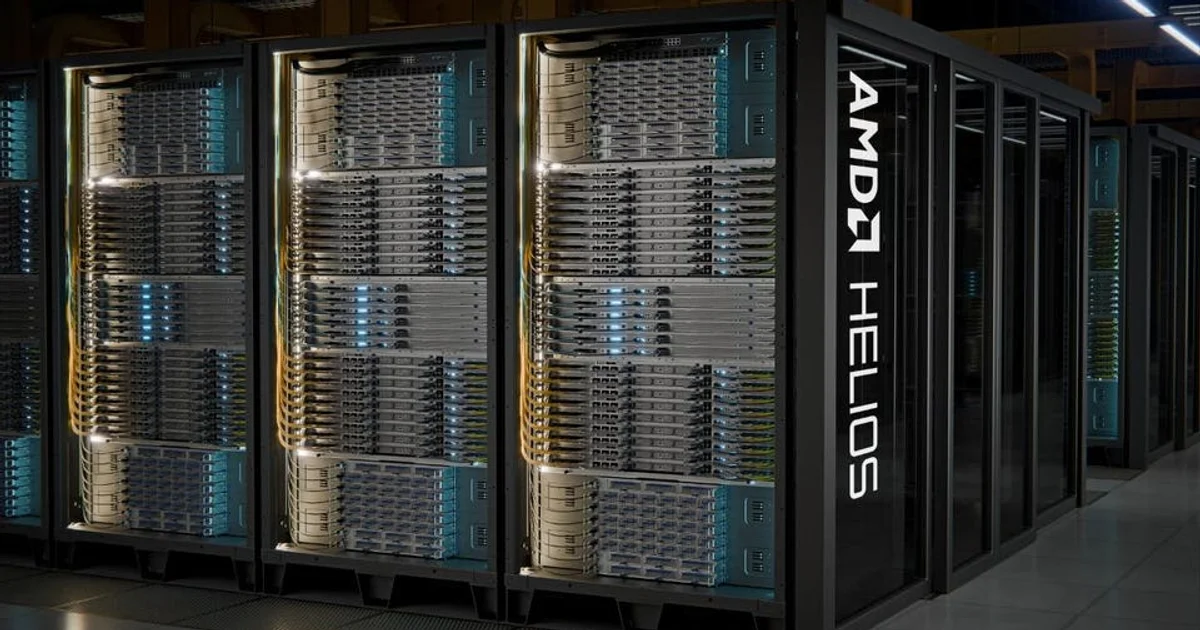
AMD used the Citi Global TMT Conference on September 8 to put fresh numbers around its AI ambitions.
CFO Jean Hu said the company now sees the total addressable compute market reaching approximately $2 trillion by 2030.
The opportunity spans several product categories, but AI is the primary force expanding demand simultaneously across accelerators, server CPUs, memory, networking and complete systems.
AMD also expects its data-center business to roughly double in 2027 to around $70 billion in revenue.
The strategy is no longer about selling an alternative GPU
For several generations, evaluating AMD's AI position mostly meant putting an Instinct accelerator beside NVIDIA's current GPU and comparing specifications.
That is no longer enough.
The largest AI customers do not simply purchase cards. They deploy tens or hundreds of thousands of accelerators connected through extremely high-bandwidth fabrics, fed by CPUs, cooled at rack scale and controlled by software capable of running rapidly changing models without months of custom engineering.
Helios is AMD's answer to that market.
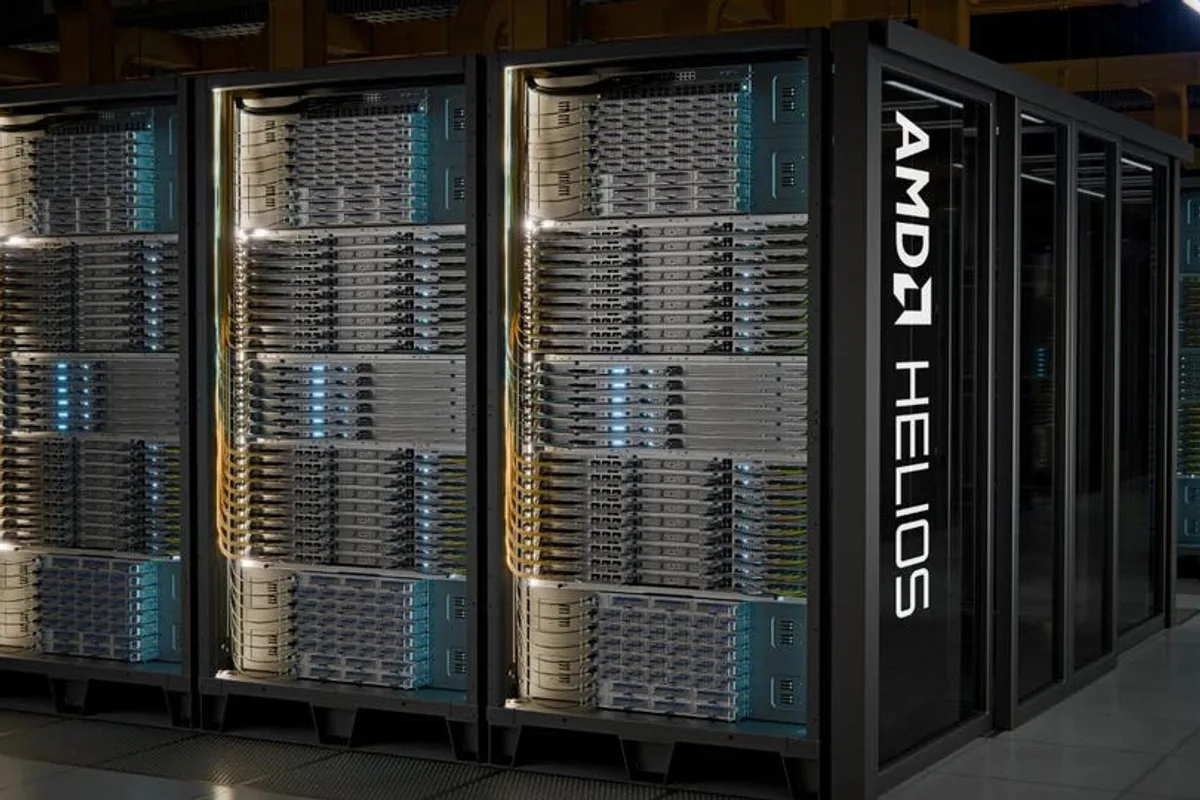
Helios puts 72 GPUs into a rack that makes no attempt to be subtle
Helios is AMD's first fully integrated rack-scale architecture designed specifically for large AI systems.
A complete configuration contains 72 Instinct MI455X accelerators and 18 sixth-generation EPYC processors, codenamed Venice.
Those components are distributed across 18 compute trays, each combining four MI455X GPUs with one EPYC CPU.
AMD adds Pensando networking and ROCm software so the rack can operate as one scale-up system rather than a loose collection of independent servers.
The physical machine is double-wide and weighs close to 7,000 pounds. At this level, an “AI accelerator” has very clearly stopped being something that simply gets installed into a conventional server.
Thirty-one terabytes of HBM4 changes the problem
AMD lists approximately 31TB of HBM4 memory across a full Helios rack and around 1.7PB/s of aggregate memory bandwidth.
Each MI455X provides 432GB of HBM4 with more than 23TB/s of local memory bandwidth.
That capacity becomes increasingly important for reasoning models, long contexts and inference workloads where keeping more parameters and KV cache close to the accelerators reduces slower movement through system memory.
Memory capacity has already been one of AMD's strongest arguments in selected workloads.
Helios now has to make that advantage work across an entire rack.
MI455X is an aggressive chiplet machine
The Instinct MI455X is based on AMD's CDNA 5 architecture and combines multiple types of silicon rather than relying on one enormous monolithic die.
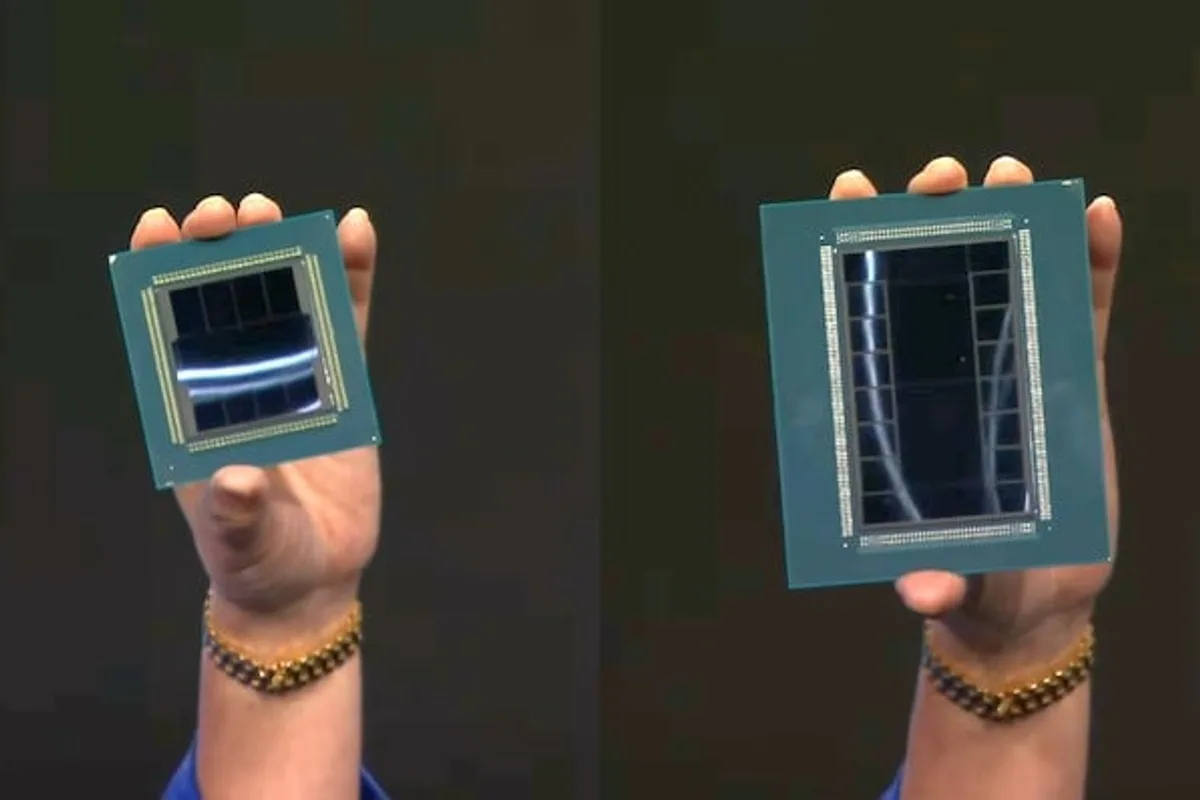
Compute silicon uses TSMC's 2nm process, while cache, fabric and I/O functions can use process technologies better suited to their own requirements.
That approach lets AMD reserve the most expensive manufacturing technology for the blocks that benefit from it most.
The resulting package is still enormous, with roughly 320 billion transistors and twelve HBM4 stacks surrounding an accelerator designed primarily to operate in large groups.
2.9 exaflops only tells part of the story
AMD advertises approximately 2.9 exaflops of theoretical FP4 AI compute for one Helios rack.
That is an enormous number, but a responsible comparison with NVIDIA Rubin cannot stop there.
Numeric formats differ, real models rarely sustain theoretical peak throughput and application performance depends heavily on interconnect behavior, memory, compilers and optimized kernels.
For a buyer, the useful question is not how many exaflops appear on a slide.
It is how many useful tokens a rack produces per dollar and per megawatt on the workload that actually matters.
That economic metric will decide the competition.
OpenAI is expected to start deploying Helios this year
AMD is entering this phase with customers rather than a rack intended only for demonstrations.
OpenAI expects to begin bringing Helios systems online in the fourth quarter of 2026 and accelerate deployments through 2027.
Microsoft has also announced Azure deployments, while AMD is working with Meta on infrastructure measured at gigawatt scale.
Those deployments matter more than a launch benchmark.
They test whether the hardware can actually be manufactured, installed and operated at the scale frontier-model companies require.
Anthropic has committed to as much as two gigawatts
Anthropic signed an agreement in July covering up to two gigawatts of Instinct MI450 Series GPUs deployed through Helios systems.
The first gigawatt is scheduled to begin deployment in the first half of 2027.
AMD also committed to a strategic equity investment of up to $5 billion in Anthropic.
The two companies are collaborating on software as well, including the use of Claude to accelerate ROCm development and workload optimization.
The relationship is circular in a very 2026 way: AMD supplies machines that run AI, then uses AI to improve the software controlling those machines.
The CPU is becoming important again inside a GPU-dominated story
Jean Hu also emphasized server processors.
AMD now estimates the potential data-center CPU market at roughly $220 billion by 2030, dramatically above older industry expectations.
The company expects particularly strong server CPU growth during the second half of 2026.
That helps explain why Helios integrates MI455X and EPYC Venice instead of treating the host processor as an interchangeable secondary component.
When customers buy complete infrastructure, one rack can generate revenue across several AMD product groups at once: GPUs, CPUs, networking and software.
ROCm cannot afford to be merely good enough
AMD can build excellent silicon and still lose deployments if developers encounter substantially more friction than they do with CUDA.
That is why ROCm now occupies nearly as much presentation space as the accelerators themselves.
The stack supports major frameworks and runtimes including PyTorch, JAX, TensorFlow, vLLM and Triton.
AMD also says ROCm can now support more than two million models available through Hugging Face out of the box.
The objective does not necessarily require reproducing every CUDA feature.
It requires making sure that choosing Instinct no longer means funding an extra engineering team just to maintain a special software branch.
Helios is competing with NVIDIA's ecosystem, not just Rubin
NVIDIA's advantage extends far beyond raw GPU performance.
CUDA, NVLink, specialized libraries, NVL systems, networking and years of optimization form a tightly integrated stack.
AMD is now answering with the same vertical logic: Instinct compute, EPYC CPUs, Pensando networking, ROCm software and Helios as the deployment unit.
The difference is that AMD continues to emphasize open standards such as Ultra Ethernet and Ultra Accelerator Link rather than building every connection around one proprietary environment.
That openness can be commercially valuable for customers trying to retain control of their infrastructure.
It can also make optimization harder if the different parts of the ecosystem do not advance together.
The $2 trillion figure is not an AMD revenue forecast
AMD's number needs to be read correctly.
The company is not predicting $2 trillion in its own annual revenue by 2030.
It is estimating the size of the total computing market addressable by the categories in which AMD participates.
That distinction matters because cloud companies are developing their own accelerators, NVIDIA remains dominant and a growing number of specialized companies are targeting inference.
The market can become enormous without its share automatically moving toward AMD.
2027 will show whether AMD has actually moved into another category
The next several quarters are primarily an execution test.
Helios has to move from production into large deployments. MI455X needs to ship in volume. Venice has to arrive alongside it. ROCm has to keep improving compatibility and performance while AI models continue changing faster than hardware generations.
If those pieces arrive together, AMD stops being merely the alternative supplier customers can use to negotiate against NVIDIA.
It becomes a credible second provider of a complete, hyperscale AI compute platform.
The $2 trillion market is the easy part to announce.
Helios is the machine that has to prove AMD can actually capture some of it.