 By Tsuky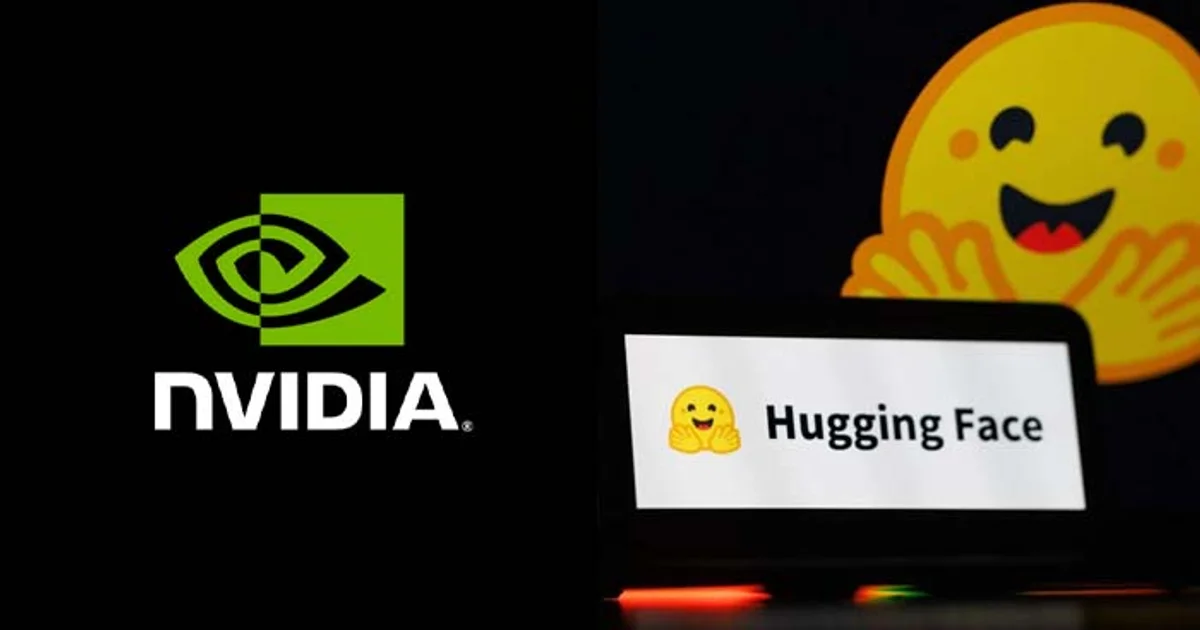
There is an important qualifier attached to the biggest AI deal story of the day. The Information says Nvidia has agreed to acquire Hugging Face for $12.9 billion, citing a person with knowledge of the agreement. Reuters subsequently reported the deal, but neither company had publicly confirmed it when this article was prepared.
That distinction matters more than usual for an acquisition of this size. Terms can change, regulatory reviews can follow and there is still no company announcement explaining what Hugging Face would look like under Nvidia ownership.
The asset is the workflow, not just the models
Hugging Face has become difficult to avoid in machine learning. Its Hub hosts models and datasets, while its wider ecosystem covers libraries, applications, collaboration tools and infrastructure used by researchers, independent developers and companies.
That is substantially more valuable to Nvidia than simply acquiring another AI model developer. Hugging Face sits between model creators and many of the people trying to run their work.
The two companies already know each other well. Nvidia participated in Hugging Face's $235 million funding round in 2023, when the startup was valued at $4.5 billion. That same year they announced a partnership that would bring Nvidia DGX Cloud computing into the Hugging Face platform for model training and tuning.
Their infrastructure relationship later expanded through Hugging Face Training Cluster as a Service and Nvidia's DGX Cloud Lepton ecosystem.
Open models can help Nvidia protect a hardware business
The Information reports that Nvidia sees successful open models as strategically useful because they can counterbalance closed AI developers that are increasingly trying to build their own server chips.
That is a more interesting rationale than simply adding software revenue. Nvidia's largest customers and some of the world's biggest AI companies have strong incentives to reduce their dependence on Nvidia accelerators. Google has TPUs, cloud providers have internal silicon programs, and competition is increasingly happening across entire computing stacks rather than between individual chips.
A major open-model platform gives Nvidia another way to remain close to developers even when Nvidia itself did not create the model they are using.
The reported valuation is doing a lot of future-looking work
Hugging Face generated roughly $150 million in annualized revenue, according to figures reported by The Information. The publication also says its number of paying subscribers doubled during the first half of 2026 and that CEO Clément Delangue recently described the company as close to profitability.
Against a reported purchase price of $12.9 billion, current revenue clearly cannot explain the transaction on its own.
Nvidia would instead be paying for distribution, developer relationships, software, data infrastructure and the possibility of making its computing platform more deeply embedded in the way open AI is built and consumed.
The price has moved quickly too. Reuters reports that Hugging Face rejected a $500 million Nvidia investment proposal in 2025 that would have valued the company at $7 billion. The acquisition figure being reported now is almost twice that valuation.
Vendor neutrality would immediately become harder to ignore
Hugging Face has utility partly because it is broader than any one hardware vendor. Models can be published there regardless of whether their users ultimately run them on Nvidia GPUs, AMD hardware, Intel systems, custom accelerators or cloud infrastructure.
Nvidia ownership would not automatically end that support, and there is currently no evidence that the company plans to restrict competing hardware. It would, however, put the platform under the control of a vendor with a direct economic interest in where AI workloads run.
That makes the unanswered details unusually important. Nvidia and Hugging Face have not yet publicly laid out the transaction, its timetable or what would change for developers. Until they do, the acquisition should remain described for what it currently is: a $12.9 billion agreement reported by The Information and subsequently carried by Reuters, rather than a completed or officially announced takeover.