
 By Adri
Signature 27 is official, but this is still a preview
Motorola unveiled Signature 27 on September 22 during Qualcomm’s Snapdragon Summit in Hawaii.
The company calls it its most advanced smartphone yet and says it will reach global markets before the end of 2026.
This is not the complete retail launch, however. Final pricing, an exact sales date and several major hardware specifications have not yet been published.
That distinction matters because ordinary flagship details such as battery capacity, charging power, full display specifications and memory configurations are still missing from Motorola’s public material.
It is the first announced phone with Snapdragon 8 Elite Extreme Gen 6
Signature 27 is primarily serving as an early showcase for Qualcomm’s new flagship mobile platform.
Motorola confirms the Snapdragon 8 Elite Extreme Gen 6, the most performance-focused version of the new Snapdragon generation revealed at the event.
Qualcomm is positioning the chip around heavier on-device AI, more advanced computational imaging and higher-end gaming.
The Extreme name does not establish a real-world performance lead on its own. Sustained speed will depend heavily on how manufacturers cool the silicon.
Motorola immediately answers that problem with ArcticMesh
Cooling is one of the areas Motorola is emphasizing most strongly.
The new ArcticMesh system combines diamond-infused thermal gel, liquid metal, copper mesh and a redesigned 3D vapor chamber.
Motorola also describes the cooling area as approximately 40% larger than the previous generation.
The diamond material is being used for thermal conductivity rather than decoration, helping move heat away from high-power components.
Independent testing will be needed to determine how effectively the system works during long gaming, video and AI workloads.
Cooling can matter as much as the processor name
Premium phone chips can already produce extremely high benchmark results for short periods.
The harder engineering problem begins when that load continues for ten, twenty or thirty minutes. Once temperature rises, a phone may have to reduce clocks dramatically.
That makes ArcticMesh potentially more relevant than another short benchmark record.
Signature 27 needs to show that it can retain a useful share of the Extreme chip’s performance without becoming uncomfortably hot during demanding workloads.
The main camera uses Sony’s 50MP LYTIA L910
Motorola confirms a 50MP Sony LYTIA L910 sensor for the primary camera.
Its Intelligent Video Enhancement Engine analyzes scenes during recording and adjusts color, exposure, highlights and shadows in real time.
Motorola specifically frames the technology around difficult changing light, such as concerts where stage lighting can shift dramatically from one second to the next.
The phone also combines Qualcomm image stabilization with optical stabilization hardware.
The periscope jumps to 200MP

The most obvious camera upgrade is a 200MP periscope telephoto.
Motorola has not yet disclosed every optical detail or the sensor size, but it clearly positions the module as the phone’s long-range camera.
Super Zoom Pro reaches up to 100x and uses generative AI to reconstruct additional detail once magnification extends beyond what the optics alone can deliver.
That distinction matters. A 100x result is not the same thing as a 100x optical zoom photograph.
The meaningful tests will be fine texture, moving subjects and low-light detail rather than a static demonstration target under ideal conditions.
Not every rear camera has been fully specified yet
Official images clearly show multiple camera openings across the back of the device.
Motorola has not yet published a complete technical specification for every one of those modules.
The confirmed headline hardware is therefore the 50MP LYTIA L910 main camera and the 200MP periscope telephoto.
Resolution and focal-length assumptions for the remaining cameras should wait for the full retail announcement.
Bang & Olufsen arrives on a Motorola phone for the first time
Signature 27 also introduces Motorola’s new global partnership with Bang & Olufsen.
The stereo speaker system carries Audio by Bang & Olufsen branding, with dedicated sound modes for music, movies, gaming and podcasts.
Motorola has not yet detailed enough of the acoustic hardware to determine how much of the collaboration concerns DSP tuning and how much involves physical speaker design.
For now, the B&O badge represents a tuning partnership rather than independent evidence of sound quality.
The new Snapdragon platform also becomes an AI showcase
Qualcomm’s latest platform gives Motorola more room for generative workloads running locally or partially on-device.
Demonstrated use cases include turning prompts, photos or footage into edited video and creating original music or soundtracks.
Signature 27 is also intended to work with newer Gemini experiences.
The important question will be integration. Adding more overlapping AI agents does not automatically make a phone easier to use.
Seven years of Android and security updates
Motorola promises seven years of operating-system upgrades and seven years of security updates.
That brings the Signature line into the same long-support conversation as recent Google and Samsung flagships.
Long software support matters particularly at this price level. A cutting-edge processor and expensive camera system are much easier to justify if the device remains current for most of its useful hardware life.
The rear design becomes much more distinctive
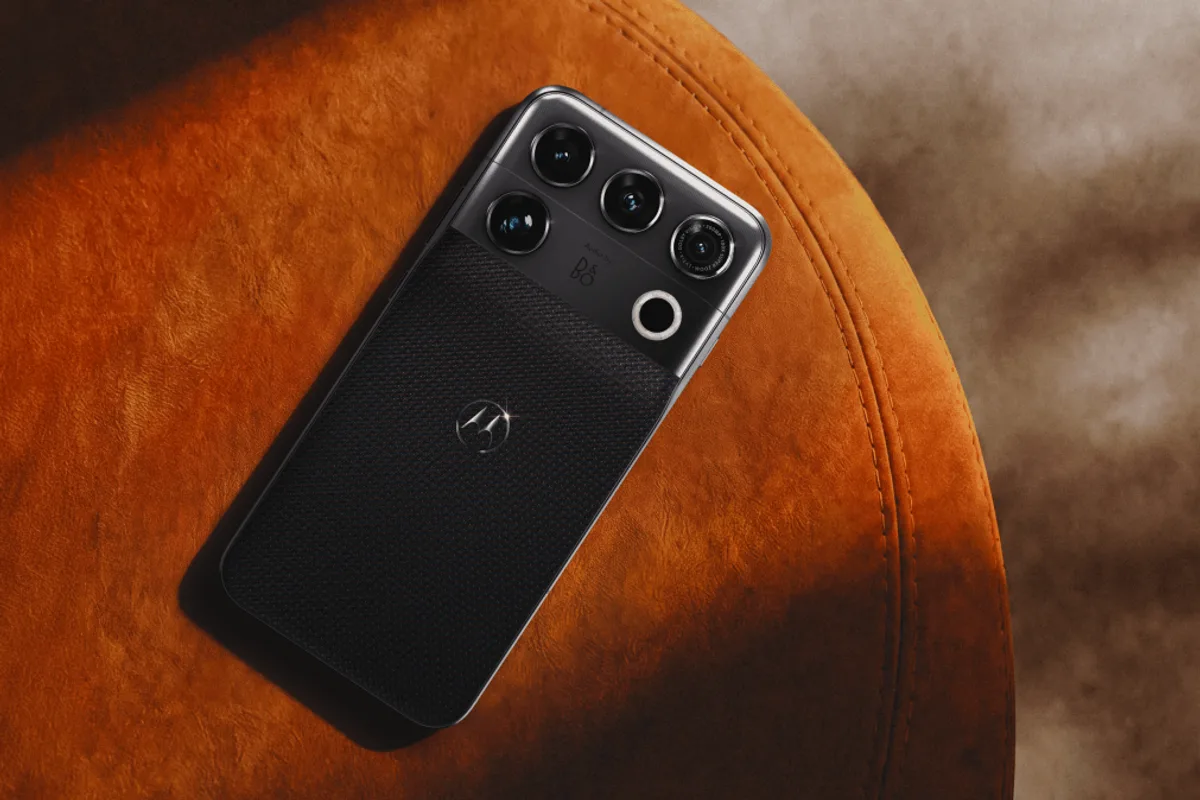
Signature 27 spreads its camera hardware across a broad upper section rather than containing everything inside a compact conventional island.
Motorola combines aerospace-grade aluminum with glass-ceramic elements around the design.
Two PANTONE finishes have been announced: Capulet Green and Coal Smoke.
Coal Smoke uses a Tactical Weave texture inspired by performance clothing and automotive materials, while Capulet Green takes a smoother brushed approach.
Motorola is continuing to use surface texture as a major design element rather than treating color as the only way to distinguish variants.
A new six-antenna layout targets faster connectivity
Motorola also describes a redesigned six-antenna architecture.
The company claims downloads can be up to twice as fast under selected conditions.
Actual results will depend on network quality, spectrum and local deployment, so that figure should not be treated as a universal speed multiplier.
The engineering direction still makes sense for a device increasingly dependent on cloud AI, media uploads and high-bandwidth services.
Price remains the biggest commercial unknown
Motorola confirms a global release during 2026 but has not announced retail pricing.
The original Signature launched around £899 in the UK, which provides context but not an official indication of Signature 27 pricing.
US availability is also not formally confirmed at retail level yet, despite Motorola having promoted Signature 27 through its American website.
A later commercial announcement should answer those questions.
Battery, charging and display details still need to wait
It would be easy to fill the missing specifications with leaks or numbers borrowed from the previous Signature.
That would be particularly risky here. Motorola has not yet officially detailed Signature 27 battery capacity, charging speeds or the complete display specification.
Those figures can materially change how attractive the product is. Extreme performance in a thin device means much less if battery endurance cannot support sustained use.
A complete specification sheet should therefore arrive before serious comparisons with upcoming Samsung, Xiaomi, vivo and OPPO flagships.
Signature 27 is already more technically aggressive than its predecessor
The first Signature leaned heavily on thinness, materials and a balanced premium specification.
Signature 27 changes the emphasis. Extreme-class silicon, elaborate cooling, a 200MP periscope and Bang & Olufsen audio create a much more demonstrative flagship.
Motorola appears to be moving beyond the role of stylish alternative and into the direct specification battle at the top of Android.
Too many important details remain missing for a final judgment.
The message from Snapdragon Summit is still clear: Signature 27 is being built to compete on performance, cooling and long-range imaging, not simply design.