
 By Kilam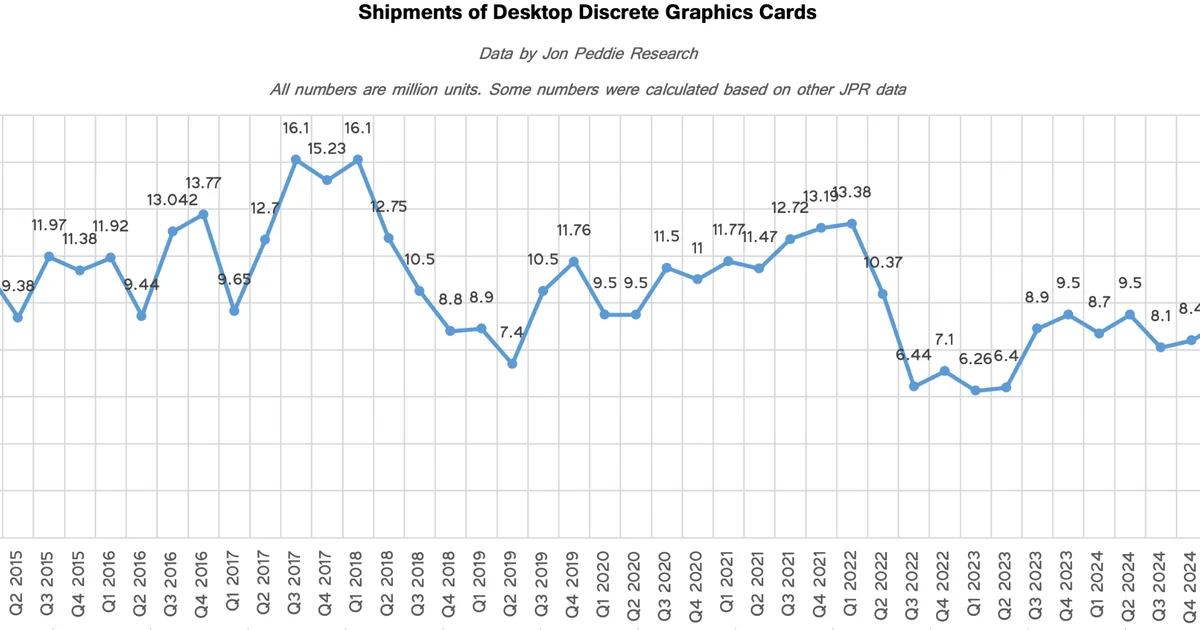
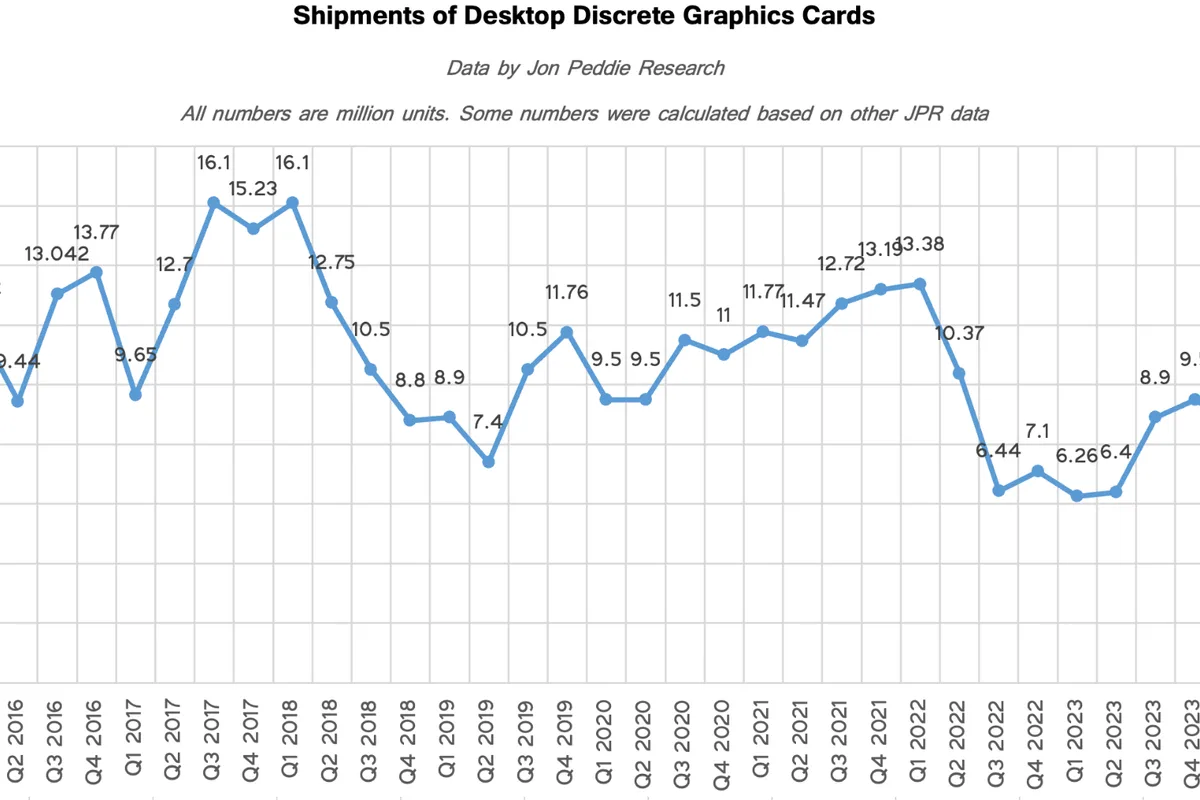
Jon Peddie Research estimates that the PC industry shipped 12.5 million desktop graphics add-in boards during the second quarter of 2026.
Its September 9 report puts shipments 10% above the previous quarter and 6.6% higher year over year. Q2 is normally a seasonally weaker period, making the increase particularly unusual.
Tom's Hardware's reconstruction of JPR's historical data places the quarter at the highest desktop AIB shipment level since Q1 2022.
The broader desktop PC market is not pulling graphics cards upward
Desktop CPU shipments tell almost the opposite story.
JPR reports roughly 14 million desktop processors shipped during the quarter, down 33% year over year and 10.5% sequentially.
Discrete graphics cards are therefore moving very differently from complete desktop-system demand.
JPR's AIB attach rate reached 89%, illustrating the unusually large relationship between graphics-board shipments and current desktop PC volume.
That does not mean 89% of every new PC necessarily contains a discrete graphics card. Standalone upgrade purchases count toward AIB shipments without creating a new desktop shipment.
That is part of what makes the quarter notable: a large number of GPUs are entering the channel independently of complete PC sales.
Nvidia still accounts for roughly nine out of every ten boards
Competition changed very little during the quarter.
JPR says AMD lost 0.16 percentage points of AIB share sequentially, Nvidia declined about 0.1 point and Intel gained 0.3 point.
The detailed figures reconstructed by Tom's Hardware put Nvidia at roughly 90%, AMD around 8% and Intel close to 2% of the desktop discrete market.
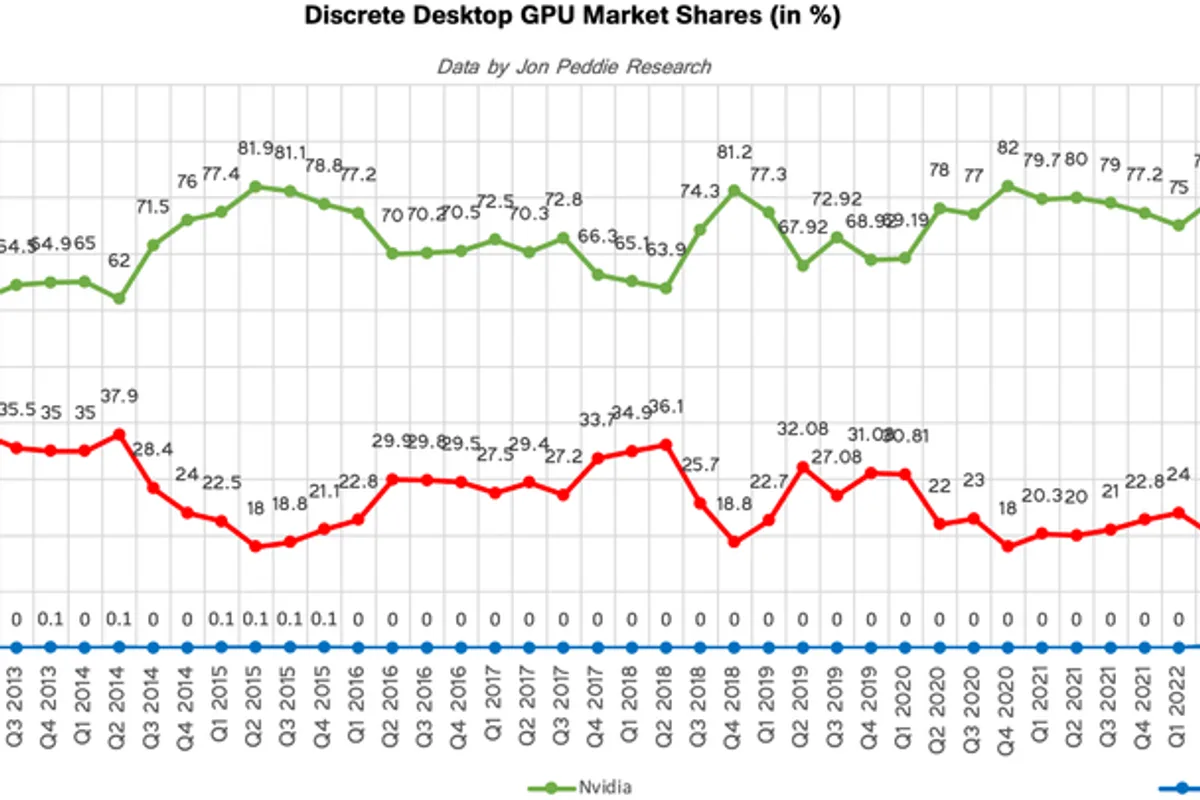
Against 12.5 million total boards, that translates to approximately 11.25 million Nvidia cards, around one million AMD boards and several hundred thousand Intel units.
For Nvidia, Tom's Hardware estimates that this was its strongest desktop discrete shipment quarter since Q3 2017.
AMD improved its unit volume compared with a year earlier but remains far from challenging Nvidia's position. Intel gained some ground, but its share is still small.
High-end sales rose while prices were rising too
That is the part JPR itself found counterintuitive.
In a normal market, rapidly increasing prices should eventually suppress unit demand or push more buyers toward cheaper products.
Jon Peddie says high-end AIB sales instead spiked as prices increased.
His explanation is explicitly a theory rather than a measured consumer survey: buyers may have rushed to purchase boards before expecting another round of price increases.
That looks like precautionary demand. The card has not necessarily become a better deal. The expected future deal simply looks worse.
A strong quarter can borrow demand from the next one
That creates the central paradox.
If someone who planned to upgrade in 2027 instead buys during 2026 because they fear future prices, today's shipment number improves at the expense of later demand.
The 12.5 million figure therefore does not prove that structural appetite for desktop graphics cards is entering a long-term expansion.
Some of the increase may be purchases pulled forward in time.
JPR's own longer-range forecast remains cautious, projecting a negative 2.5% compound annual growth rate for AIBs from 2025 through 2030.
It nevertheless expects an installed base of about 193 million discrete graphics boards by the end of that period.
Memory cost reaches the GPU before the board even launches
The graphics market is also operating inside a broader memory shortage.
Modern graphics cards use dedicated GDDR rather than system DRAM, but both exist in a memory industry increasingly focused on server and AI demand.
A GPU carrying 16GB, 24GB or 32GB is more exposed to memory-price inflation than older products that shipped with far smaller pools.
The effect can be even harsher at the low end. An extra few tens of dollars of memory represents a much larger percentage of a budget card's total manufacturing cost.
The total PC GPU market tells a different story
JPR separately tracks all PC graphics processors, including integrated graphics and GPUs inside notebooks.
That market reached 75.5 million units in Q2, up 10.4% sequentially and 1.1% year over year.
Notebook graphics shipments drove much of the increase, rising 16.8% quarter over quarter, while total desktop graphics declined 4%.
The two datasets should not be mixed. The 75.5 million figure includes integrated GPUs and notebooks. The 12.5 million number refers specifically to desktop AIB cards carrying discrete graphics processors.
Twelve and a half million shipments are not twelve and a half million new gamers
JPR tracks boards shipped into the market channel rather than Steam activations or the exact number of products installed by end users during the quarter.
A board can be shipped to a distributor, retailer or system integrator before it reaches its final owner.
There can therefore be a meaningful difference between shipment and sell-through.
That qualification does not remove the trend. Vendors genuinely placed more cards into the channel. It simply means 12.5 million shipments should not automatically be translated into 12.5 million consumers buying a new GPU during those three months.
2026 could become a strong sales year for uncomfortable reasons
The first half of the year already shows a substantial recovery from the weaker shipment periods of 2022 through 2024.
The unusual part is that this comeback is not being driven by especially consumer-friendly pricing.
Nvidia still holds roughly 90% of the market. Memory remains constrained. High-end cards are expensive, and future pricing looks uncertain enough that at least some buyers may prefer not to wait.
A market where consumers accelerate purchases because they are afraid of paying more later can produce excellent shipment numbers for a while.
It should not be mistaken for a return to abundant, inexpensive graphics hardware.