
 By Adri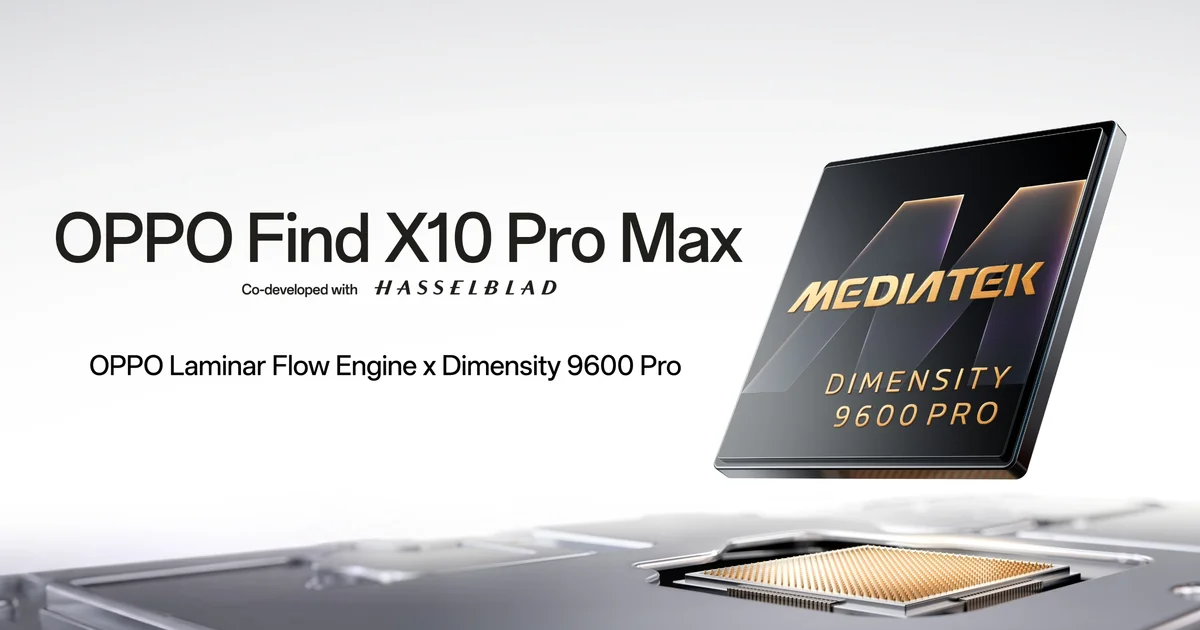
The Pro Max is officially leaving China
OPPO confirmed on September 15 that Find X10 Pro Max will be released in international markets. The announcement removes an important uncertainty around a Find family whose highest-end models have not always received identical global distribution.
The broader Find X10 lineup is scheduled for its China launch on September 22. OPPO has not yet provided a complete list of international countries, pricing or a global retail date.
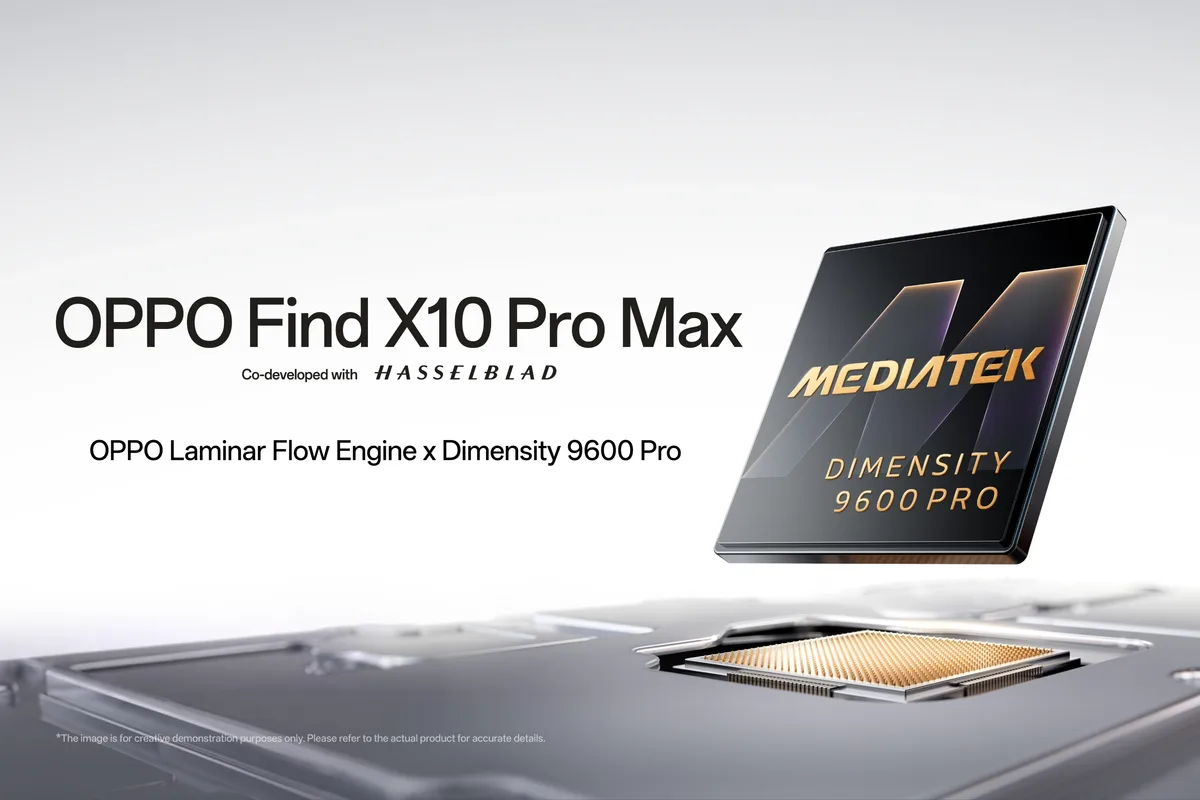
The processor is already settled. Find X10 Pro Max will be among the first smartphones built around MediaTek’s Dimensity 9600 Pro.
Two cores reach 4.55GHz, and there are still no conventional little cores
Dimensity 9600 Pro continues MediaTek’s All-Big-Core approach. Its CPU combines two Arm C2-Ultra cores running at up to 4.55GHz with six additional performance cores.
MediaTek specifies a 2+3+3 structure: two C2-Ultra cores at up to 4.55GHz, three C2-Pro cores reaching 4.35GHz and three additional C2-Pro cores at 3.1GHz.
Each core can adjust its frequency independently. OPPO intends to use that finer control to avoid waking more performance than a task actually needs.
The companies claim an overall CPU performance improvement of about 17%. Until commercial hardware is independently tested, that should be treated as a platform claim rather than a universal performance result.
The 2nm story is really about watts
The chipset is manufactured on TSMC’s N2P 2nm process. OPPO repeats one of MediaTek’s most striking efficiency claims: up to a 61% improvement in multi-core CPU energy efficiency compared with the previous generation.
That does not mean the finished phone will consume 61% less power. The display, modem, memory, cameras and thermal tuning all contribute heavily to total device consumption.
What it could mean is more useful than another short benchmark peak. Modern flagship phones are already extremely fast for a few seconds; maintaining that speed without turning power into excessive heat is the harder engineering problem.
Laminar Flow Engine sits between raw silicon and the experience
That is where OPPO’s new Laminar Flow Engine comes in. The company says it was jointly developed with MediaTek and will make its debut on Find X10 Pro Max.
The technology restructures parts of the rendering pipeline and coordinates them more closely with system scheduling. OPPO says this can improve app launch speed and maintain smoother content loading without simply holding the chipset at a high-power state.
Rapid photo browsing is one of the examples given by the company. Loading, decoding, rendering and displaying a stream of large images all need to happen at the right time, not merely as fast as possible.
That kind of system-level work is much harder to market than a benchmark score, but it can have a larger effect on how responsive a phone actually feels.
The GPU claims 27% higher sustained performance
Graphics are handled by the new G2-Ultra NX GPU. OPPO and MediaTek claim roughly 27% higher performance under sustained heavy workloads.
The architecture also expands ray tracing and neural graphics. MediaTek is moving toward the same broad idea that has become common on PCs and consoles: not every final pixel needs to be rendered entirely through traditional GPU work if neural reconstruction can produce a comparable result more efficiently.
That matters particularly on a smartphone, where a few additional watts have immediate consequences for battery life and surface temperature.
Actual usefulness will depend on software support. Fast ray tracing hardware is far less valuable if mobile game engines rarely enable it.
Two NPUs divide heavy AI from always-on AI
Dimensity 9600 Pro also separates AI workloads between two neural processors. A high-performance NPU handles demanding inference, while a Super Efficient NPU is designed for persistent lower-power tasks.
MediaTek claims 51% faster LLM prefill performance for the main NPU. Prefill is the phase in which a language model processes its context before beginning token generation.
The efficient NPU is claimed to use 40% less power for always-on AI workloads, allowing contextual features to remain active without constantly invoking the most power-hungry part of the chip.
MediaTek says the platform can support local models with up to 30 billion parameters. That figure is a capability ceiling, not a promise that every 30B model will run quickly or fit comfortably within a retail phone’s memory.
OPPO is already making long-duration performance claims
During its Chinese platform presentation, OPPO also disclosed a Glacier battery rated at 8,000mAh for Find X10 Pro Max and linked the battery to its new resource-management stack.
The company claims the phone can sustain selected games at 144Hz for up to eight hours and record 4K60 video continuously for up to six hours under its demonstration conditions.
Those are precisely the kinds of numbers that need independent verification. Screen brightness, ambient temperature, network activity and the particular game being tested can radically change both battery life and throttling behavior.
OPPO quotes battery energy density at 867Wh/L and says its silicon-carbon design and charging algorithms are intended to preserve battery health over a five-year period.
Global availability matters almost as much as 2nm
MediaTek is no longer trying merely to place a fast chip inside a China-only flagship. Dimensity 9600 Pro is being positioned directly against premium Qualcomm and Apple platforms in internationally sold devices.
Find X10 Pro Max gives it a particularly visible platform. OPPO is putting MediaTek’s newest silicon inside a phone explicitly described as an international flagship rather than reserving the configuration for a regional variant.
That does not establish that Dimensity 9600 Pro will beat its competitors on performance, thermals or battery life. It does show that OPPO considers the platform credible enough to make 2nm MediaTek silicon part of its global premium pitch.
September 22 still has plenty left to answer
OPPO has revealed much more about the engine than the complete vehicle. The Chinese launch still needs to fill in the commercial specification sheet, including display details, memory configurations, charging, dimensions and the full imaging system.
The company has already framed the Pro Max as the most complete imaging model of this Find generation, with additional camera announcements expected at launch.
The later international event will matter just as much. It will determine which Chinese-market features survive globally, how much OPPO charges for them and where the company intends to put its 2nm flagship directly against Samsung, Xiaomi, vivo and Apple.