
 By Adri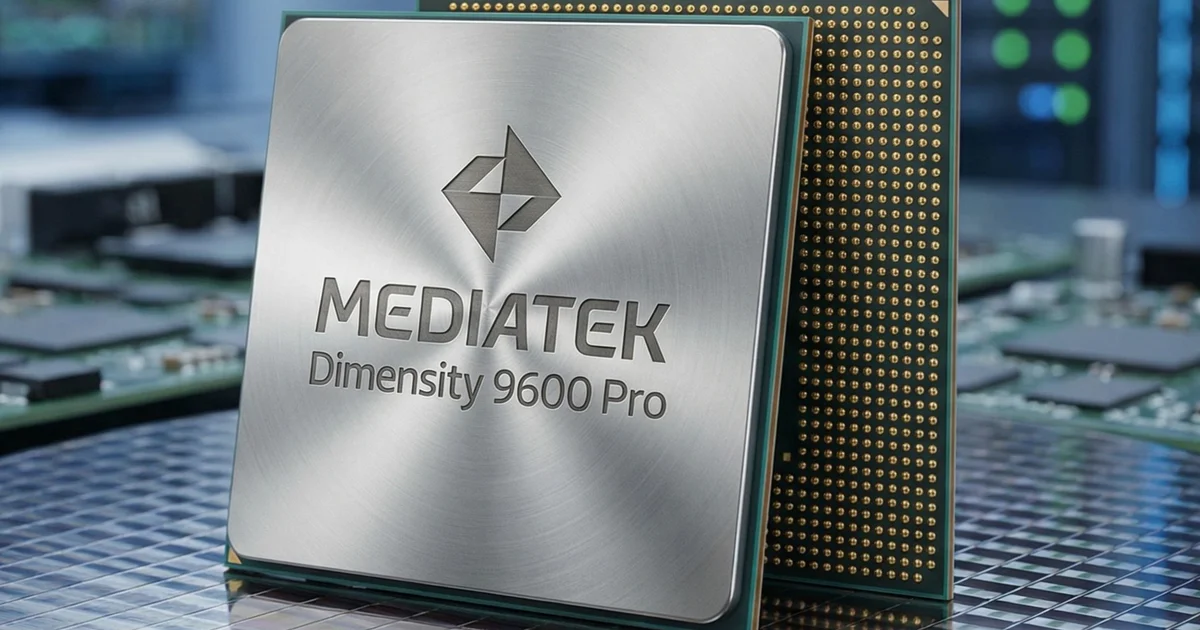
Eight big cores, with two reaching 4.55GHz
The Dimensity 9600 Pro continues MediaTek’s All Big Core strategy. Its CPU uses a 2+3+3 layout with two Arm C2-Ultra cores running at up to 4.55GHz, three C2-Pro cores at 4.35GHz and another three C2-Pro cores at 3.1GHz.
MediaTek claims up to 17% higher single-core performance and 15% higher multi-core performance than the previous generation. The cache hierarchy has also grown, with the full platform carrying 34.5MB of cache according to the company.
Using no conventional efficiency cores sounds aggressive for a phone. MediaTek’s argument is that the 2nm process, scheduling logic and power management let larger cores operate efficiently enough at lighter loads that a separate low-performance cluster is no longer necessary.
2nm is being sold as an efficiency story
The headline efficiency claim is a reduction of up to 61% in multi-core CPU power consumption. MediaTek explicitly states that its performance metrics come from internal testing on demo hardware.
That means the figure should not be treated as a promise that a retail phone will suddenly use 61% less energy. Voltage curves, cooling systems, OEM tuning, memory configuration and workload behavior all matter.
The direction is still important. Flagship phones increasingly have more peak performance than many users need, so being able to sustain that performance without burning through battery or thermal headroom can matter more than another benchmark record.
The GPU claims 27% more peak performance
Graphics move to the G2-Ultra NX GPU. MediaTek says peak performance improves by up to 27%, while power consumption at peak performance drops by 24%.
Ray-tracing performance is claimed to be 18% faster, and the platform supports gaming at up to 185fps when the display, game engine and thermal envelope allow it.
MediaTek is also coupling the GPU more closely with its AI hardware. Its Neural Graphics Architecture lets neural processing assist rendering tasks such as reconstruction and super-resolution.
That is increasingly familiar territory from PC and console graphics. Rendering fewer native pixels and reconstructing a higher-quality image can be particularly attractive in a phone, where every additional watt becomes heat in a very small enclosure.
One NPU does the heavy work, another stays awake
The 9600 Pro uses a dual-NPU design. The NPU 1090 handles heavier AI workloads, while the second-generation Super Efficient NPU is designed for continuous background tasks and always-on agents.
MediaTek claims 51% higher LLM prefill performance, 55% more token generation per watt and 40% lower power consumption for always-on AI workloads.
The chip supports on-device models with up to 30 billion parameters as well as Mixture-of-Experts architectures. That does not mean every 30B model will run quickly or fit comfortably into a retail phone. Quantization, memory capacity and actual token throughput remain major constraints.
The practical goal is to make more personal AI processing possible on the device rather than sending every request and piece of private context to a cloud server.
LPDDR6 and UFS 5.0 matter more as AI gets larger
The new platform adds support for LPDDR6 memory and UFS 5.0 storage. MediaTek says LPDDR6 can provide 33% greater effective memory bandwidth at the same frequency, while UFS 5.0 can double read and write speeds compared with the previous generation.
Those improvements are especially relevant for local AI. A fast NPU still spends time waiting if model weights and context cannot be delivered quickly enough from memory.
The same problem exists in gaming, where increasingly powerful CPU and GPU blocks can still run into memory-bandwidth limits.
The ISP adds native 4K at 240fps
The Imagiq 1290 image signal processor supports native direct-output 4K240 ultra-slow-motion video. MediaTek also lists 4K120 cinematic log, AI-assisted 4K60 True Color Tone and 17EV imaging.
A chipset capability is not the same thing as a phone feature. Camera sensor readout speed, storage, cooling and OEM camera software all have to support the same workload.
Manufacturers can therefore ship a Dimensity 9600 Pro phone without exposing every function MediaTek lists on the platform.
The first phones are due this quarter
MediaTek says the first smartphones using the Dimensity 9600 Pro and Dimensity 9600M are expected to launch during the current quarter.
Oppo has already confirmed the Dimensity 9600 Pro for its upcoming Find X10 Pro Max. Other brands with established MediaTek flagship relationships are also expected to adopt the platform.
The 9600M sits below the Pro and keeps much of the new AI and multimedia architecture while trimming some of the flagship features.
Thermals will matter more than the launch slides
On paper, the Dimensity 9600 Pro looks exactly like a late-2026 flagship SoC should: a 2nm process, high-frequency CPU cores, a faster GPU, local AI acceleration and next-generation memory support.
The more meaningful question is whether those features stay fast after several minutes of load. A chipset that wins a short benchmark but throttles hard is less useful than one that holds slightly lower peak performance with much better efficiency.
MediaTek’s own footnote confirms that the current numbers were measured on demo devices in its laboratories.
Retail phones will show whether 2nm mainly makes the Dimensity 9600 Pro faster, or makes it possible to stay fast for longer.