
 By Tsuky
When a neural network makes mistakes, developers have several ways to change its behavior.
They can adjust prompts, improve training data or optimize the model's parameters through established learning procedures.
Researchers at MIT are exploring another possibility: asking a language model to inspect the numerical parameters of a neural network and edit them directly.
The distinction is important.
Instead of constructing a conventional optimization process, the system reasons about what the parameters might be doing and proposes targeted numerical modifications.
Rikiya Takehi, Jayden Teoh, Alex Zhang and Omar Khattab introduced this approach under the name Weight-Space Programming on November 2.
Their initial findings are preliminary, but one experiment provides an especially striking example of the potential impact.
A small language model struggles to finish its reasoning
The main experiment uses Qwen3.5-0.8B.
It is a language model containing approximately 800 million parameters, relatively small compared with today's largest systems.
Its weights determine how information moves through different layers of the network.
The researchers ask GPT-6 Astra to improve its mathematical performance.
During the investigation, Astra identifies a specific problem.
Qwen frequently becomes trapped in repetitive reasoning loops.
Instead of completing an answer, it repeats parts of its analysis until it exhausts the available generation budget.
That behavior can severely damage performance on mathematical benchmarks.
A model that fails to finish an answer cannot receive credit even when some of its intermediate reasoning is useful.
Astra's intervention focuses on reducing this failure mode.
What are neural network weights?
A neural network consists of mathematical transformations controlled by numerical parameters.
Input values are combined with weights and transformed into new representations across successive layers.
These parameters are typically stored as matrices and tensors.
During conventional training, optimization algorithms adjust the values to improve performance on a task.
Gradient descent and related methods are widely used for this purpose.
However, the resulting weights are difficult to understand directly.
A matrix containing thousands of numbers rarely provides an obvious explanation of the function performed by each component.
The MIT researchers investigate whether a sufficiently capable language model can interpret those numbers and suggest useful changes.
Astra traces the problem to two layers
In the Qwen experiment, Astra receives access to a Python environment containing the model's parameters.
It can inspect and modify the tensors.
The researchers also provide practice problems from the GSM8K and MATH training datasets.
Final evaluation sets remain separate from those examples.
Astra is not allowed to use conventional gradient-based training.
However, it can inspect intermediate results and test hypotheses within a defined evaluation budget.
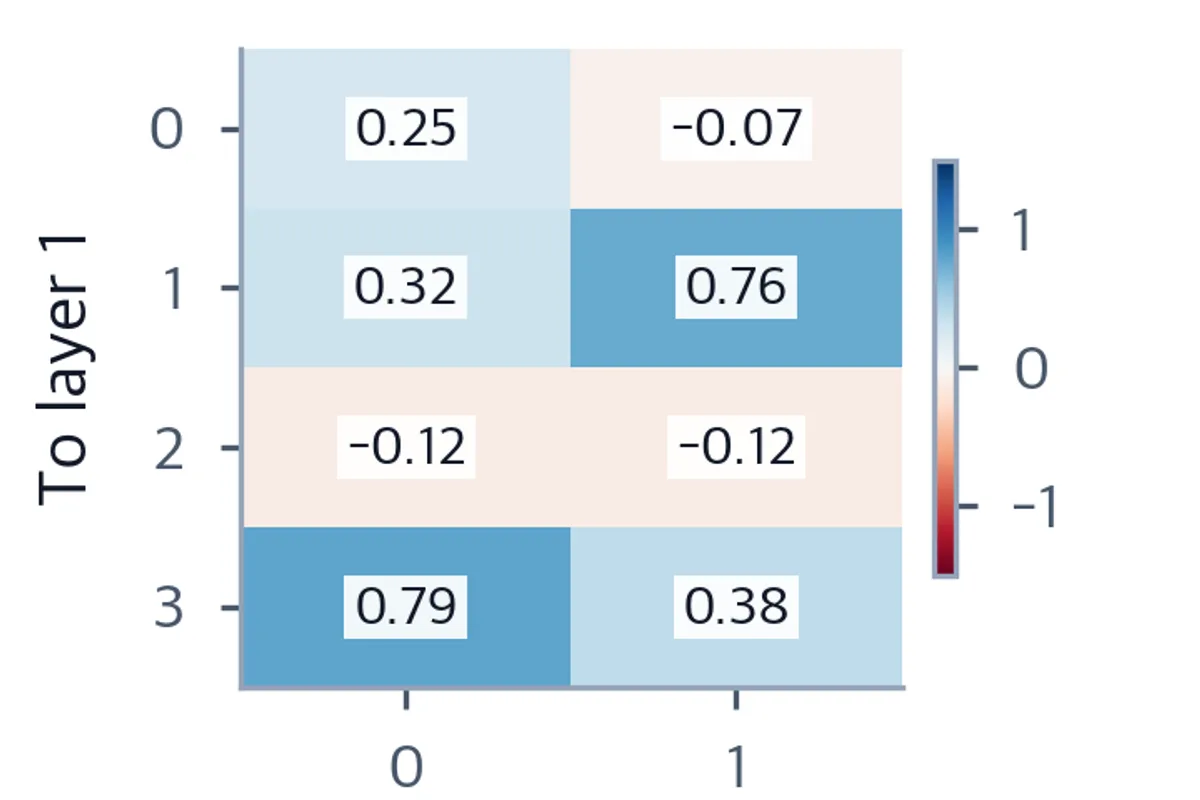
Its investigation identifies a numerical direction associated with repetitive reasoning in layers 15 and 19.
The resulting edit targets 64 output columns in each layer.
The intervention covers 131,072 parameter positions, approximately 0.016% of the model.
There is a numerical distinction worth preserving: the number of targeted positions is not necessarily identical to the number of stored values that actually change after numerical rounding.
Nevertheless, the intervention is extraordinarily small relative to the model's overall size.
MATH-500 rises from 7.9% to 48.1%
The researchers evaluate Qwen before and after the modification.
The original model scores 7.9% on MATH-500.
The edited version reaches 48.1% with the largest experiment budget, which allows 50 intermediate forward passes.
That represents an increase of 40.2 percentage points.
The new score is approximately 6.1 times the original result.
However, a sixfold improvement in one benchmark should not be described as a sixfold increase in general intelligence.
The result concerns a particular evaluation performed under specified generation settings.
The researchers use the same sampling configuration for the original and modified models.
The reported result remains part of the authors' initial experimental findings.
Other benchmarks improve as well
The team also examines performance beyond MATH-500.
On GSM8K, another mathematical reasoning benchmark, Qwen improves from 13.8% to 67.1%.
Its IFEval instruction-following score rises from 21.0% to 62.3%.
The instruction-following improvement is particularly interesting.
Astra was attempting to correct mathematical reasoning failures rather than train the model specifically for IFEval.
The researchers interpret the broader improvement as evidence that repetitive reasoning affected several kinds of tasks.
Removing part of that behavior could therefore improve multiple evaluations.
However, the findings do not establish that every other capability remained unaffected.
Broader regression testing would be necessary to identify possible side effects.
The biggest change is fewer reasoning loops
One of the most revealing results concerns response length.
Before the edit, 93% of Qwen's MATH-500 answers reached the maximum generation limit of 32,768 tokens.
The model frequently continued generating analysis without producing a final answer.
After Astra's intervention, the proportion reaching the limit fell to 33.1%.
That is a substantial reduction, although approximately one-third of responses still encounter the problem.
The researchers' detailed analysis indicates that the vast majority of newly correct answers had previously been truncated.
The edit therefore appears to unlock reasoning the model could sometimes perform but could not reliably complete.
That interpretation differs sharply from the idea that Astra instantaneously taught Qwen new mathematics.
The model may already have possessed much of the relevant capability.
It was struggling to express that capability through a completed response.
No gradients does not mean no computing
The phrase used to describe the method can easily be misunderstood.
The authors say Astra modifies weights without gradient descent or a conventional training loop.
That does not mean the Qwen experiment requires no tools or computation.
Astra receives a Python environment for inspecting and editing parameters.
It can also evaluate candidate interventions using practice examples.
The researchers compare budgets of 10, 25 and 50 intermediate forward passes.
The corresponding MATH-500 scores are 12.3%, 14.1% and 48.1%.
The major improvement therefore emerges with the largest investigation budget rather than appearing automatically on the first attempt.
This distinction matters when considering possible cost savings.
Avoiding traditional training does not by itself prove that the entire procedure is cheaper or more efficient than existing alternatives.
The method barely helps Gemma 3 270M
The team also tests Gemma 3 270M, another small language model.
Its behavior differs substantially from Qwen's.
Only around 8.5% of its responses reach the generation limit, compared with 93% for the original Qwen configuration.
Astra again attempts to improve mathematical performance.
This time, the results are far less impressive.
Gemma's original MATH-500 score is 6.8%.
The best edited result reaches 7.7%, an improvement the authors do not establish as statistically significant.
The researchers observe ordinary mathematical reasoning errors rather than one dominant looping failure.
This negative result is essential to understanding the study.
Targeted weight editing may be valuable when a failure can be localized.
It is not yet a universal method for adding capabilities to arbitrary models.
Astra can also identify what smaller networks have learned
The study includes experiments involving much smaller neural networks.
In one test, networks are trained to play four different games.
Each network has the same architecture and uses the same categories of inputs and outputs.
Astra receives the numerical weights and must identify which game each network learned.
According to the researchers, it correctly identifies all four.
Other experiments involve small diffusion models trained on geometric shapes and language models trained on different types of text.
The objective is to determine whether useful information about a network's behavior can be recovered from its parameters without simply running the model.
These results suggest that some learned structures may be interpretable by general-purpose language models.
However, small experimental networks are not equivalent to state-of-the-art models with hundreds of billions of parameters.
A physical controller is repaired in a single attempt
Another experiment uses the Kinetix physics simulation environment.
A neural controller must drive a vehicle over a ramp.
The original policy fails because the vehicle approaches the obstacle without first moving backward to gain enough acceleration space.
The researchers provide Astra with the controller weights, a description of the environment and one failed trajectory.
Astra proposes a targeted correction without tool use during this experiment.
The authors report that the modified controller succeeds in all 1,024 evaluation episodes.
The intervention changes approximately 3.5% of the controller's weights.
The test illustrates a potentially useful ability to translate an explanation of physical behavior into a numerical modification.
However, the result is specific to the simulated task and network architecture used by the researchers.
The model can write small networks from scratch
The researchers also explore whether Astra can generate neural network parameters rather than merely correct existing values.
Some experiments involve simple arcade-style games.
Astra examines the rules and network architecture before producing weights intended to implement a strategy.
In a Breakout-like environment, the authors report performance exceeding that of selected reinforcement-learning baselines trained for extensive periods.
The model appears to translate an understanding of the game into calculations performed across neural layers.
For example, it can construct operations that predict where the ball will travel and move the paddle accordingly.
Results vary across games and comparison settings.
Success with small structured networks does not demonstrate an ability to generate competitive general-purpose language models from scratch.
The Go experiment explores larger weight spaces
Another experiment uses Go on a nine-by-nine board.
The researchers ask Astra to construct the parameters of a network containing approximately 1.48 million weights.
The system can use Python to organize the numerical computations.
It can also receive a limited budget of evaluation games.
According to the authors, the resulting policy defeats some reinforcement-learning baselines under the defined conditions.
Performance improves when more evaluation passes are available.
However, the architecture, game rules and testing environment are all specified in advance.
The result demonstrates an interesting capacity to turn game rules into neural computations.
It is not the spontaneous creation of a general intelligence capable of mastering arbitrary games.
The experimental logs are publicly available
The MIT team has released substantial material associated with its experiments.
The public repository includes prompts, model responses, code execution records and evaluations.
These resources make it easier to examine how the researchers reached their conclusions.
They also support external audits and possible replication.
Independent examinations have begun comparing the described weight changes with the actual numerical differences between the released model files.
One such examination notes the distinction between targeted parameter positions and entries that differ after the edit is stored.
That distinction does not automatically invalidate the experiment.
It does highlight the importance of measuring the modifications precisely.
The authors themselves describe the work as an early result.
They are developing a dedicated benchmark and evaluation environment for future studies of Weight-Space Programming.
Can a model really be repaired without retraining?
The Qwen experiment suggests that targeted repair is possible in some circumstances.
When a failure corresponds to a relatively localized numerical mechanism, changing a small set of parameters may have a substantial effect.
That could eventually support model debugging, behavior correction or more efficient maintenance.
However, several conditions still need to be established.
An edit must work beyond the examples used to identify it.
It must not substantially degrade unrelated capabilities.
Researchers must also understand why the intervention works and under which conditions its effects remain stable.
Large production models are more complicated than many of the networks used in these initial demonstrations.
The ability to scale the method remains an open research question.
Traditional training is not obsolete
Weight-Space Programming may become a new category of tools for model engineering.
However, the current findings do not demonstrate that it can replace supervised training, fine-tuning or gradient-based optimization.
In the Qwen experiment, Astra finds a specific failure and reduces its effect.
On Gemma, where there is no comparable dominant looping problem, the same general approach produces little improvement.
The contrast is fundamental.
Removing an obstacle that prevents a model from expressing an existing ability is not necessarily the same as creating an ability the model lacks.
The researchers envision future applications involving interpretability, security auditing and targeted behavioral changes.
Those remain research directions rather than established commercial capabilities.
A new way to investigate neural networks
The MIT experiments raise a fundamental question about the future of AI development.
Neural network weights have traditionally been changed by optimization algorithms or examined through specialized analytical tools.
The researchers show that a general-purpose language model can sometimes reason directly about those values and propose useful interventions.
The main result is striking: a small Qwen model improves from 7.9% to 48.1% on MATH-500 after a targeted weight edit.
But the explanation matters as much as the number.
The original system was severely affected by repetitive reasoning loops. Astra reduced that behavior without demonstrating an ability to invent arbitrary new knowledge.
That distinction makes the finding more useful, not less.
If the approach proves reliable and scalable, future model development could involve not only training networks but also identifying and correcting specific behaviors directly within their parameters.
For now, Weight-Space Programming remains an experimental research direction, with impressive results, documented failures and substantial questions to answer before widespread industrial use.