 By Tsuky
Customer-service automation has spent decades trying to reduce the amount of work handled by human representatives.
Traditional telephone systems relied on recorded menus and rigid decision trees. Chatbots subsequently moved many interactions into websites and messaging applications.
Generative AI promises a different experience.
Instead of selecting from a fixed menu, a customer can explain a problem in ordinary language while a system interprets the request and attempts to resolve it.
The telephone is becoming an important part of that transformation.
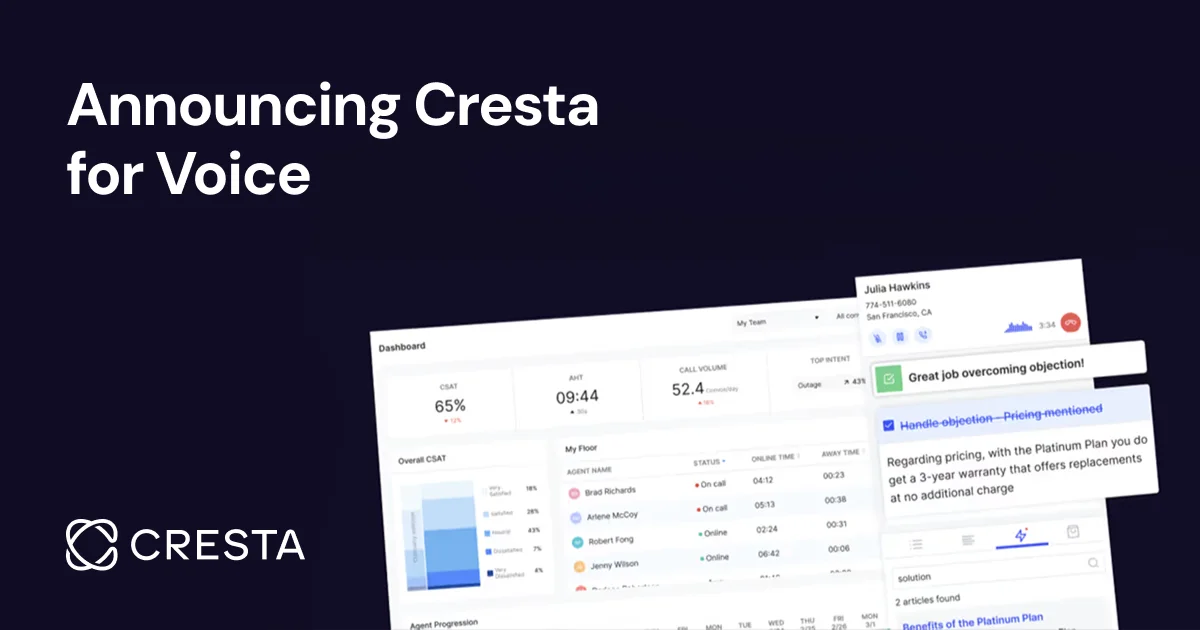
Salesforce has signed a definitive agreement to acquire Cresta, a company specializing in AI-driven contact-center technology.
The acquisition would strengthen Salesforce's ability to connect live customer conversations with the data and operational systems that businesses already manage.
An agreement has been signed, but the acquisition is not complete
Salesforce confirmed the agreement on November 2.
The transaction is expected to close in the first quarter of Salesforce's fiscal year 2028.
That corresponds to February through April 2027.
Completion remains subject to regulatory approval and customary closing conditions.
Until then, the companies remain separate businesses.
Cresta's existing products can be evaluated and purchased according to their current arrangements, while Salesforce continues to offer its own service and AI software.
The announcement does not establish a launch date for a newly integrated Salesforce-Cresta product.
That distinction matters for organizations planning software investments around the acquisition.
The reported price is $2.7 billion
Salesforce did not disclose the financial terms of the transaction.
The Information reports that the company agreed to pay approximately $2.7 billion for Cresta, citing a person familiar with the deal.
The figure is therefore reported rather than officially confirmed.
The public announcement does not establish the precise payment structure.
It is not possible to determine from Salesforce's statement alone how the consideration would be divided between cash, shares or other arrangements.
Cresta had previously reached a valuation of $1.6 billion following a funding round in 2022.
That earlier valuation illustrates the level of investor interest in the company.
However, it should not be treated as directly equivalent to the reported acquisition price without knowing the transaction's financial structure.
Cresta does more than automate phone conversations
Cresta's product portfolio covers several related functions.
Its voice agents are designed to handle certain customer calls directly.
They interpret spoken requests, generate responses and can interact with business tools when appropriate integrations are configured.
The company also provides real-time assistance to human representatives.
During a conversation, the software can suggest information, highlight relevant procedures or provide guidance.
A third category focuses on conversation intelligence.
Businesses can examine interactions, identify recurring problems and evaluate service quality.
These capabilities share a common objective: turning conversations into useful information and, ultimately, action.
Voice AI faces challenges that text chat can avoid
A chatbot user may tolerate a short delay before receiving a written answer.
During a telephone conversation, the same delay can feel awkward.
Voice agents must handle interruptions, changes of subject and incomplete information in real time.
Customers may begin by asking about an order and then introduce a billing issue or a change of address.
The system needs to maintain context while identifying the appropriate next action.
Cresta says its agents can conduct natural conversations, handle interruptions and operate at enterprise scale.
Salesforce highlights those capabilities as an important reason for the acquisition.
However, vendor claims should be distinguished from independently measured performance in every deployment.
A successful demonstration does not guarantee identical resolution rates across different organizations and customer populations.
The CRM record is the missing piece
Consider a customer calling a telecommunications provider to dispute a bill.
A voice agent may understand the complaint and explain general billing policies.
But resolving the issue requires access to the correct account, payment history, subscription details and permitted adjustments.
Salesforce wants to connect that operational context with Cresta's understanding of live conversations.
Service Cloud is designed to help organizations manage customer cases, interactions and service workflows.
Combining these capabilities could allow an agent to connect what the customer says with the information needed to act.
Salesforce describes the intended outcomes in terms of issue resolution, customer retention and revenue.
That is a more substantial proposition than simply producing a natural-sounding voice.
A successful conversation should lead to a correct answer and, when appropriate, an authorized business action.
Knowing when to ask a human remains essential
Automating every interaction is not necessarily desirable.
Some situations require additional verification, an exceptional commercial decision or human approval.
Cresta's platform includes supervision and handoff capabilities designed for such cases.
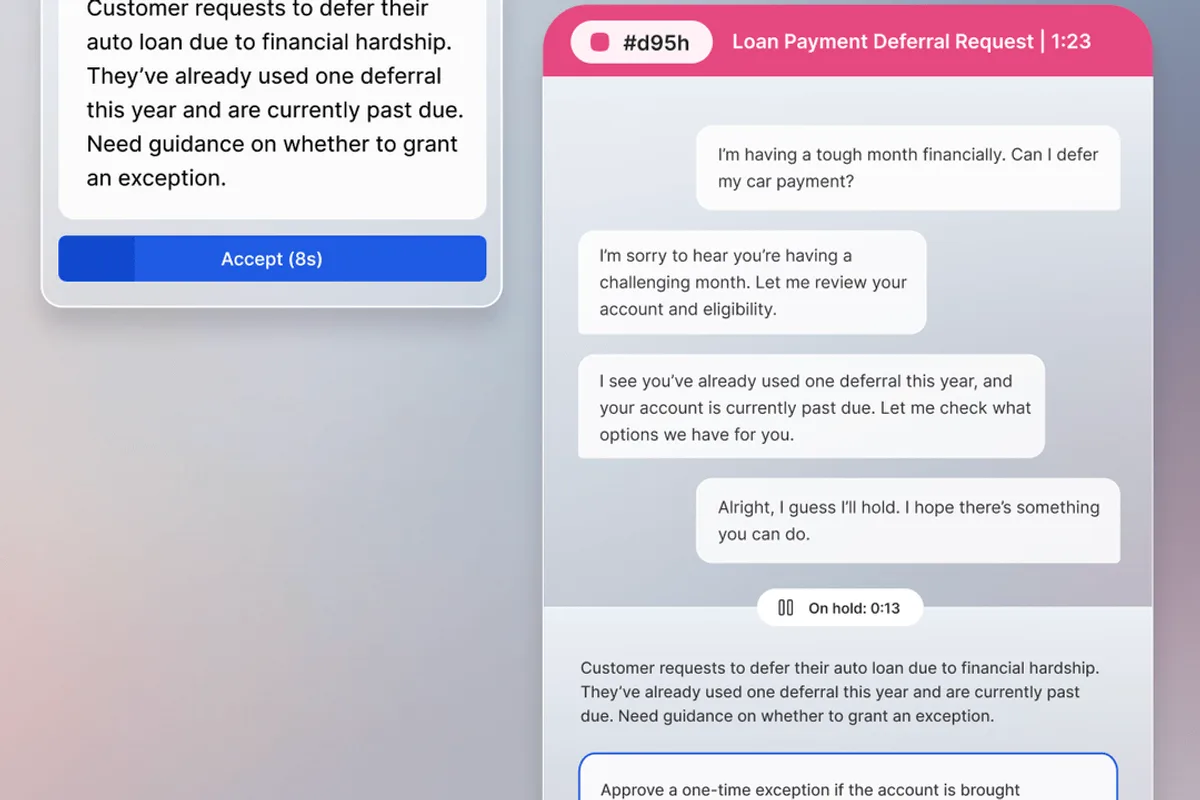
One official demonstration shows an AI agent handling a request to defer a payment when the customer's account already contains relevant restrictions.
The system can collect information and identify available options.
However, approving an exception may require intervention from an authorized human representative.
The challenge is determining when escalation is appropriate.
Transferring every call defeats much of the purpose of automation.
Refusing to transfer difficult cases creates the opposite risk: allowing software to make decisions beyond its authority.
Effective hybrid supervision is therefore an important part of Cresta's approach.
Human representatives remain part of the strategy
Cresta also develops tools intended specifically for contact-center employees.
These systems can surface relevant information during calls and help representatives follow business procedures.
The goal is to reduce time spent searching across multiple applications.
For organizations, the potential benefit is a combination of automation and assistance.
Some requests can be handled by AI agents, while more complex cases reach humans equipped with better information.
However, Salesforce's acquisition announcement does not include a plan to eliminate human customer-service teams.
Future workforce effects will depend on decisions made by individual customers, call volumes and the actual performance of the technology.
Major brands already use Cresta technology
Salesforce identifies Marriott, Comcast and Alaska Airlines among the companies using Cresta's technology.
These examples illustrate its relevance to industries with substantial customer-contact operations.
Hotels, telecommunications providers and airlines deal with highly varied requests.
Some concern reservations or account changes. Others involve disruptions, payments or technical problems.
Many require access to operational systems rather than generic answers.
However, Salesforce's announcement does not provide a complete description of each customer's deployment or independently verified performance figures across all applications.
The existence of a customer relationship should not be confused with proof that every advertised capability is operating at the same level in every environment.
Supervising AI agents becomes a new management task
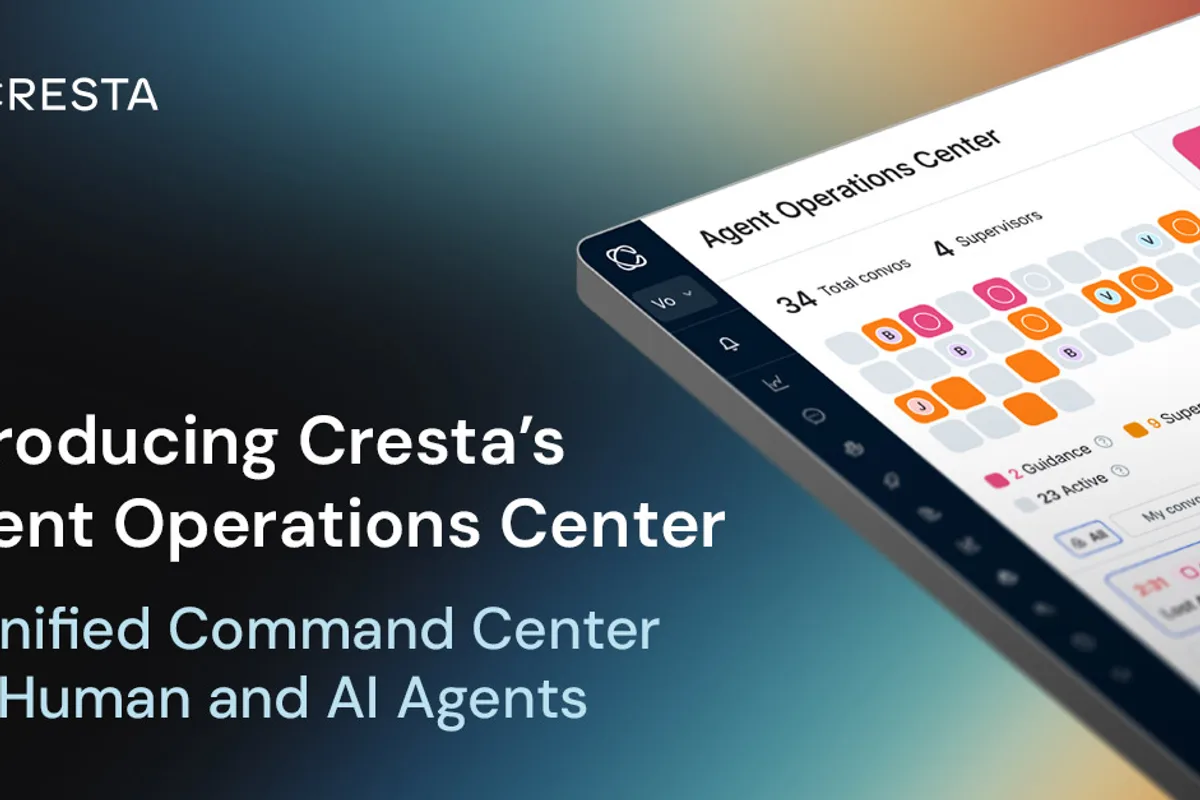
Cresta offers an Agent Operations Center designed to provide oversight of both human and AI-led customer interactions.
Supervisors can monitor activity, review alerts and intervene when conversations require additional attention.
That addresses a growing operational challenge.
As automated agents take responsibility for more customer interactions, businesses also need ways to evaluate their decisions.
Quality assurance, policy compliance and escalation handling apply to software agents as well as employees.
Cresta aims to provide a shared operational view rather than manage the two groups through entirely separate systems.
That does not imply identical capabilities or performance between humans and AI.
It means organizations can apply more consistent monitoring and review processes across their customer-service operations.
Salesforce promises continued support for other telephone platforms
One important detail concerns Cresta's existing integrations.
Salesforce says Cresta will continue supporting the leading contact-center and telephony platforms its customers currently use after the acquisition closes.
This matters because many businesses rely on multiple technology vendors.
An organization might use Salesforce to manage customer records while relying on another supplier for its calling infrastructure.
Replacing an established telephone system can be expensive and operationally disruptive.
Maintaining support for those platforms could preserve the value of Cresta's existing customer relationships.
However, the announcement does not specify every future licensing condition or guarantee identical integration terms indefinitely.
Businesses will need to clarify those details contractually.
The agreement follows Salesforce's acquisition of Fin
Salesforce's move into voice AI is part of a wider acquisition strategy.
In September 2026, the company completed its acquisition of Fin, another developer of customer-service AI agents.
The Information places the value of that transaction at approximately $3.6 billion.
Cresta adds a stronger focus on telephone conversations and real-time conversation analysis.
Both transactions reinforce Salesforce's ambition to connect AI agents more closely with enterprise applications.
However, the company has not explained the final technical architecture that will combine every acquired product.
It would therefore be premature to assume that Fin, Cresta and all Salesforce services will immediately operate as one unified system.
The practical value of the acquisition strategy will depend on the products and integrations Salesforce eventually delivers.
Agentforce and Service Cloud provide the intended foundation
Salesforce already offers tools for developing AI agents and managing customer-service processes.
Agentforce allows organizations to build agents connected to data, knowledge and controlled actions.
Service Cloud provides customer-case management and operational service workflows.
Cresta would contribute specialized expertise in live voice interactions.
Together, the technologies could support a sequence in which an AI agent understands a spoken request, retrieves customer context and completes an authorized task.
However, common ownership does not eliminate the challenges of integrating enterprise software.
Organizations will still need to manage data quality, permissions, legacy systems and operational procedures.
The precise design and release timetable of the combined offering remain unannounced.
Call privacy and data governance will be critical
Telephone conversations can contain highly sensitive information.
Customers may disclose personal identities, financial circumstances or details of their accounts.
Conversation intelligence systems can convert those interactions into transcripts and structured information.
Connecting that information to CRM records creates operational opportunities, but also privacy responsibilities.
Businesses must control who can access calls, how long recordings are retained and which automated systems can process the information.
Organizations operating in the European Union must also account for applicable personal-data protection requirements.
Automated decisions and human review procedures may require additional governance.
Salesforce has not detailed every privacy control that will apply to its future integration with Cresta.
The acquisition announcement should therefore not be interpreted as proof of universal regulatory compliance across every deployment.
Success will depend on more than call automation rates
Automating customer interactions can potentially lower operating costs.
However, reducing the number of calls transferred to humans is not sufficient evidence of better service.
Businesses also need to know whether customers' problems are actually resolved.
An AI agent may respond fluently while providing incorrect information.
It may also end an interaction without completing the required operation.
Useful performance indicators include first-contact resolution, repeated contacts, error rates, customer satisfaction and handling time.
The economics must also account for model usage, telephone infrastructure, system integration and human supervision.
Salesforce's stated goals include stronger retention and commercial outcomes.
Those remain strategic objectives rather than demonstrated results of a future integrated product.
Competition is shifting from conversation to execution
Salesforce faces competition from established contact-center software vendors and newer AI startups.
Some companies specialize in voice calls, while others focus on messages, email or broader omnichannel automation.
The market is moving beyond the ability to generate natural language.
Customers increasingly need systems that can retrieve accurate information, execute approved actions and demonstrate reliable results.
Cresta brings Salesforce experience in voice technology and supervision.
The question is whether that experience can be integrated effectively enough to create a meaningful advantage over competing platforms.
What businesses can expect now
As of November 3, 2026, the key development is that Salesforce has signed an agreement to acquire Cresta.
Cresta continues to offer its existing products, while Salesforce maintains its established Service Cloud and Agentforce services.
No newly integrated offering has been announced as immediately available as a result of the transaction.
The reported $2.7 billion price remains unofficial, and future commercial terms have not been disclosed.
Organizations evaluating either platform should distinguish existing capabilities from integrations promised after the transaction closes.
They should also seek clarity about telephony compatibility, data handling and long-term support arrangements.
Salesforce's strategic objective is clear: bring AI closer to the moment when customers actually explain their problems.
But meaningful progress will not simply mean replacing a human voice with a synthetic one.
It will mean understanding the request, accessing the correct information and delivering a reliable resolution without creating more transfers or additional complexity.