
 By Camille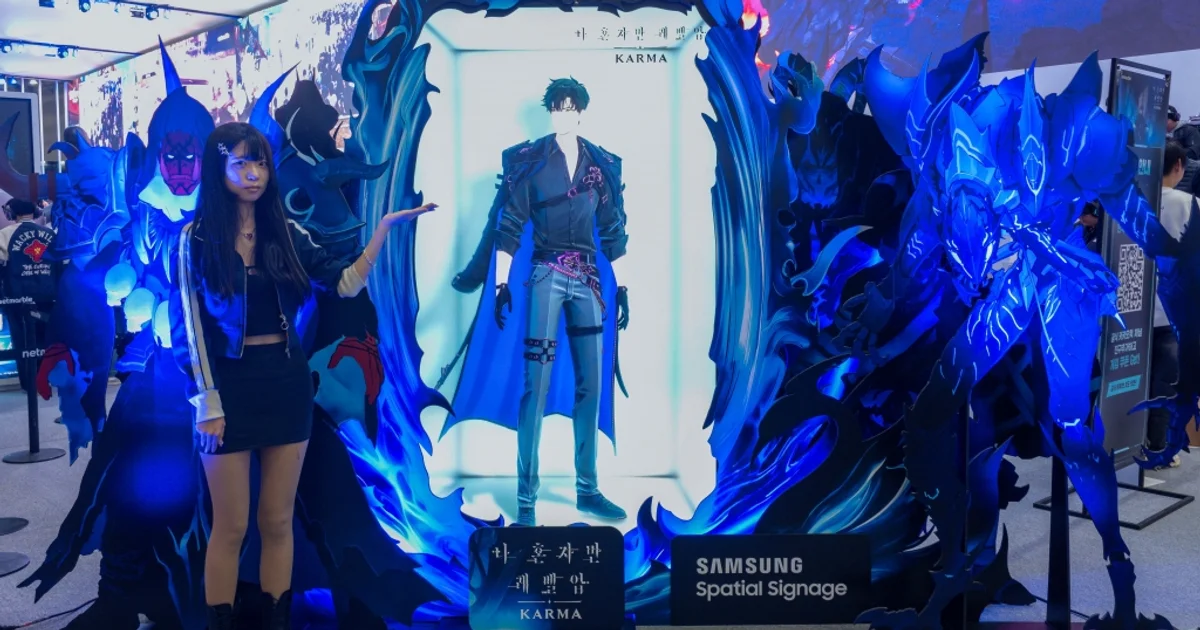
A screen disguised as part of the world
NC built the main 85-inch Spatial Signage display into an elevator-themed entrance based on Astrae Oratio. Characters appeared inside the virtual space at close to human scale, using Samsung's 3D Plate technology to create perceived depth without requiring viewers to wear 3D glasses.
The 85-inch commercial display has a 2,160-by-3,840 4K UHD panel in a portrait 9:16 orientation. Despite the depth effect, Samsung lists the hardware at just 52mm thick. The company launched that model globally in February 2026.
Samsung also uses a Quantum Processor for 4K UHD upscaling, 16-bit color mapping and dynamic HDR refinement. An anti-glare treatment is intended to keep the image readable in bright public environments, an obvious requirement for hardware expected to live on show floors rather than in controlled home theaters.
The smaller displays reveal the more interesting use case
The giant entrance display was the obvious photo opportunity, but NC also placed 32-inch Spatial Signage units in waiting areas and along the route through its booth. Samsung lists those compact units at 49.4mm deep.
That changes the job of the technology. A single giant 3D installation can be a spectacle. Thin displays distributed through a venue can become infrastructure. Visitors waiting to play Astrae Oratio continued encountering its characters rather than staring at conventional posters or unrelated queue signage.
Entertainment venues are full of exactly these transitional spaces. Theme parks have queues, cinemas have lobbies, conventions have corridors and festivals have merchandise areas. A display that adds spatial depth without requiring every passing visitor to put on equipment fits those environments rather differently from a consumer 3D television.
Samsung is not trying to restart the old 3D-TV cycle
Spatial Signage is commercial hardware. Samsung explicitly positions it for retail, museums, exhibitions and entertainment environments rather than as a new mass-market living-room format.
That distinction also changes what counts as success. A home display has to justify hours of viewing and a hardware purchase by the consumer. A venue display may only need to hold someone's attention for a minute, make a character feel present or turn otherwise dead waiting time into part of an attraction.
Samsung has already pointed to deployments outside Tokyo Game Show. Everland Safari World in South Korea has used Spatial Signage in an attraction queue, while the Governors Ball Music Festival in the United States used an 85-inch unit around merchandise. At CinemaCon, Samsung demonstrated the same technology for cinema lobbies and promotional content.
Games already have the raw material
Gaming is an unusually natural match for this idea because publishers already work with digital characters and 3D environments. Astrae Oratio, developed by Dynamis One and published by NC, gave the Tokyo installation an existing fictional world to extend into the booth.
That is more compelling than treating 3D as a generic visual filter. The display becomes another surface for an IP: a character can appear in a queue, a lobby or a themed installation without requiring the visitor to enter VR or AR.
Industry publication invidis argues that live experiences may be a stronger commercial fit for today's glasses-free 3D than previous waves of consumer displays. That remains an industry assessment rather than evidence that 3D signage is about to become ubiquitous. Cost, content production and the economics of large deployments still matter.
The best trick may be making the technology disappear
Tokyo Game Show offered a useful demonstration because the displays were not treated only as products to admire. The large one was an elevator. The smaller ones became part of the waiting experience. Hardware, content and booth design were working toward the same illusion.
That suggests a more modest but potentially more practical future for 3D entertainment. Instead of asking audiences to change how they watch everything, glasses-free displays can add depth to places where fictional worlds already spill into physical ones. For theme parks, game events, cinema lobbies and exhibitions, that may be enough to make 3D useful again.