
 By Kilam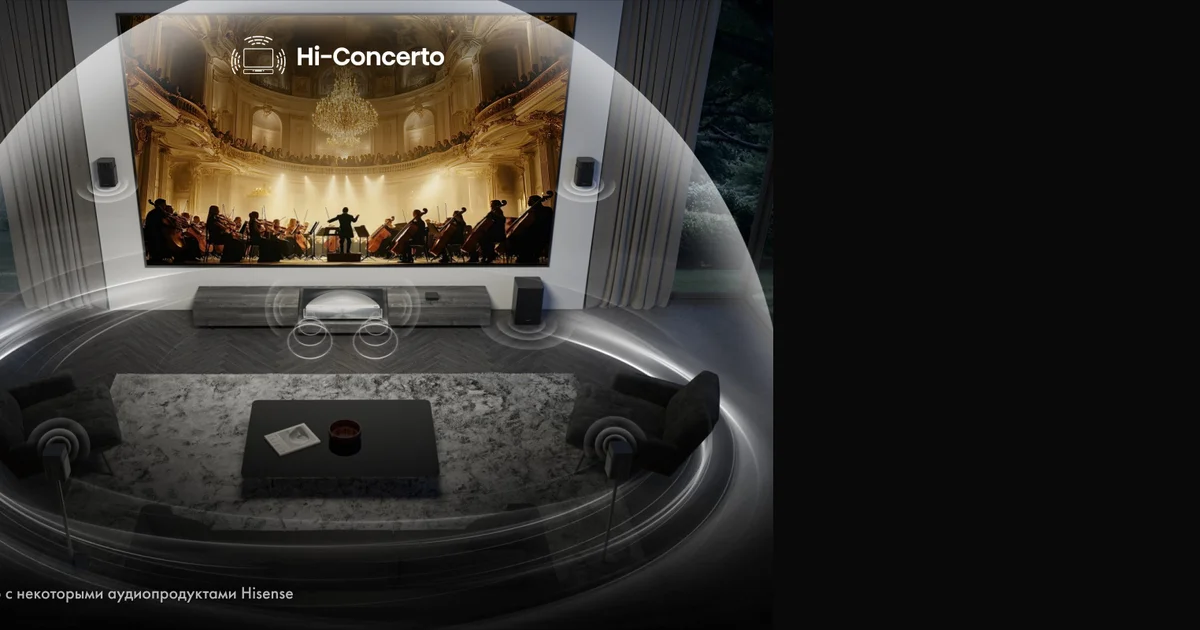
Another 500 lumens without changing the basic UST formula
PX4 Pro remains an RGB triple-laser DLP ultra-short-throw projector. It sits close to the screen rather than behind the audience and can produce images ranging from 80 to 200 inches.
Maximum claimed brightness increases from 3,000 lumens on PX3 Pro to 3,500 ANSI lumens. Hisense attributes the increase to its Digital Laser Engine 3.0.
Extra light is particularly useful when a UST projector is being asked to behave like an everyday television in a room that is not completely dark.
It does not remove the value of a proper ambient-light-rejecting UST screen. Once the image becomes very large, screen material and room lighting still have an enormous effect on perceived contrast.
A seven-step iris tackles the black-level problem
One of the most important additions is a precision iris adjustable across seven levels, working with Hisense’s CineBlack Pro processing.
The company now claims contrast as high as 6,500:1, a substantial increase over the previous model’s specification.
The iris can reduce light output during darker material instead of leaving the optical system behaving identically in every scene.
Independent testing has found noticeably deeper blacks and greater image depth. It still does not turn a DLP projector into an OLED display, particularly in a fully dark room.
Three lasers cover a claimed 118% of BT.2020
TriChroma uses separate red, green and blue laser sources. Hisense claims 118% BT.2020 color-volume coverage and color accuracy reaching a ΔE below 0.9 under its reference conditions.
Dolby Vision, HDR10, HDR10+, HLG and IMAX Enhanced are supported, along with Filmmaker Mode.
That is an unusually complete HDR list for a projector and gives the PX4 Pro access to both major dynamic-metadata formats.
Projector HDR still operates under very different physical constraints from a bright Mini LED television, however. Thousands of lumens spread across a 100- or 150-inch screen cannot create the same peak luminance.
The picture can grow all the way to 200 inches
The ultra-short-throw ratio is around 0.2:1, allowing a very large picture without mounting a projector several metres behind the seating position.
Hisense specifies an 80-to-200-inch image range.
A 200-inch picture is physically possible, but it also spreads the available light across a much larger surface.
The maximum size is therefore better understood as optical flexibility than a recommendation that every owner should immediately build a 200-inch screen.
Devialet replaces Harman Kardon
PX3 Pro used a Harman Kardon audio system. PX4 Pro switches to tuning developed with Devialet.
Six integrated speakers create a 4.0.2-channel layout rated at a combined 66W, including two upward-firing drivers.
Dolby Atmos and DTS:X are supported.
That matters more on an ultra-short-throw projector than on many conventional models because UST systems are frequently sold as television replacements rather than components for dedicated projection rooms.
Built-in sound is better, but physics still wins
Early reviews describe a more substantial presentation than is typical from a projector, with useful scale and presence.
Six small drivers inside a 54cm-wide chassis still cannot duplicate dedicated speakers positioned around a room.
Bass extension, physical stereo width and genuine rear effects remain limited by the enclosure.
For buyers who refuse to add a soundbar or speaker system, though, the Devialet setup makes the PX4 Pro a much more credible standalone product.
The 240Hz headline needs its resolution attached
Hisense is making a much stronger gaming pitch this generation. PX4 Pro is promoted as the first FreeSync Premium-certified UST Laser Cinema projector in the range.
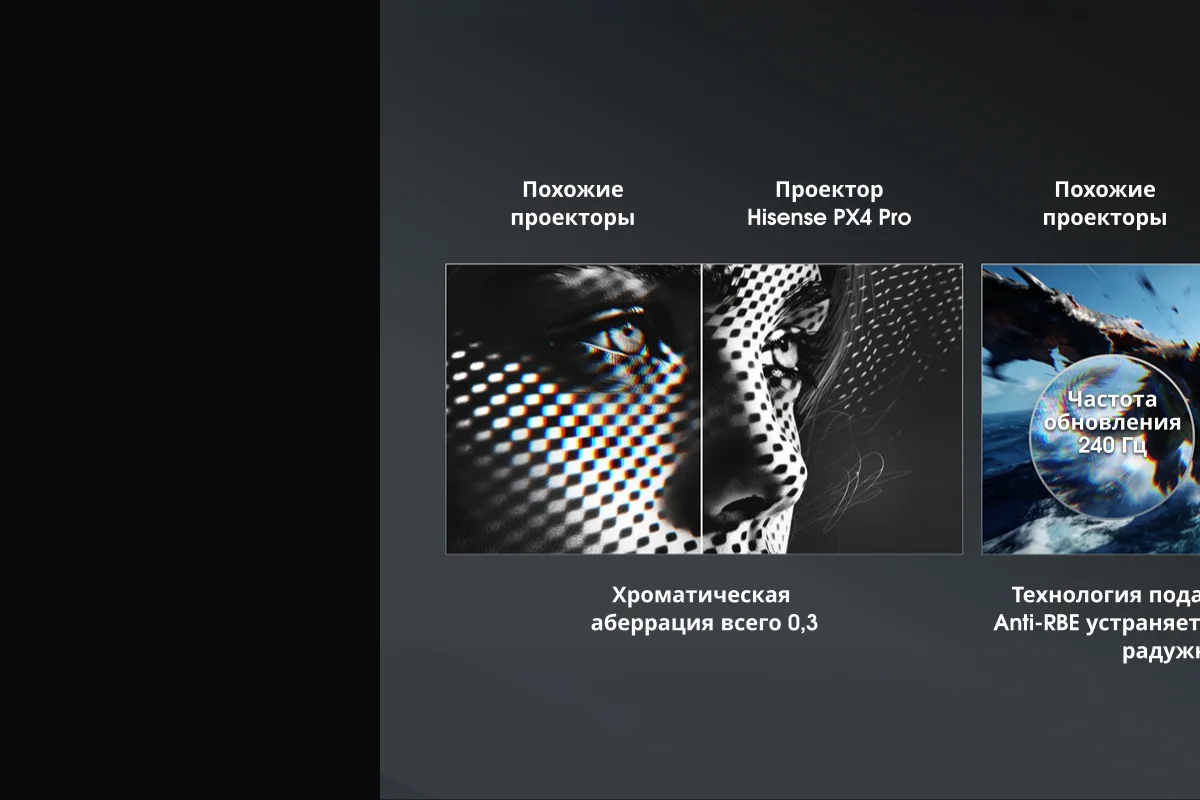
VRR and ALLM are also supported, while high-speed modes reach 240Hz with latency claimed as low as 1ms.
The important qualifier is resolution. The fastest modes operate at 1080p or 2K depending on the signal and terminology being used, not at 4K/240Hz.
September testing has also highlighted the absence of the straightforward 4K/120Hz experience now common on premium gaming televisions.
HDMI 2.1 does not automatically equal 4K/120
PX4 Pro provides four HDMI connections, with two identified as HDMI 2.1 on major regional specifications.
That label can easily create the expectation of the same 4K/120Hz operation offered by current PlayStation, Xbox and PC-focused TVs.
The projector’s actual display modes are more nuanced. Reaching its highest refresh rates requires dropping resolution.
For competitive games where low latency matters more than pixel count, 1080p/240Hz is genuinely attractive. Players who specifically want 4K and 120Hz simultaneously have a less ideal fit.
DLP rainbow artifacts have not completely disappeared
PX4 Pro uses a 0.47-inch DLP device and produces its 4K image through high-speed pixel shifting rather than a native 3840-by-2160 imaging panel.
Hisense has introduced optical and processing work under names such as ChromaFix to reduce chromatic artifacts.
Review testing still notes occasional rainbow-effect flashes for viewers who are sensitive to them.
That sensitivity varies dramatically. Some people barely notice the effect, while others immediately see brief red, green and blue separation around bright objects on dark backgrounds.
VIDAA U9 keeps the television-replacement idea alive
Smart features run on VIDAA U9, with major streaming applications available according to market.
Connectivity includes Wi-Fi 7, Bluetooth 5.4 and Gigabit Ethernet.
Hisense is also integrating Xbox Cloud Gaming into VIDAA in supported territories, potentially allowing games to run without a local console.
Control4 support and Hisense smart-home integration round out the system side.
Pricing varies dramatically by market
Hisense has announced a €3,499 recommended price in France, where broader availability is expected during the fourth quarter of 2026.
The UK launch price is £2,499, matching the previous model’s original price there.
In the United States, PX4 Pro is already shipping at roughly $3,999, around $500 above PX3 Pro’s original U.S. launch price.
That keeps it firmly in premium territory while leaving considerable distance to Hisense’s more expensive L9Q.
A discounted PX3 Pro may be the new model’s hardest competitor
On specification, PX4 Pro improves almost every relevant area: brightness, claimed contrast, maximum image size, VRR support and built-in audio.
That does not automatically make PX3 Pro irrelevant. Previous-generation projectors can receive substantial discounts once replacements reach stores.
If the price gap remains modest, the iris and better audio make the PX4 Pro easy to justify. A heavily discounted PX3 Pro creates a much harder decision.
Hisense has upgraded the parts that actually needed work
PX4 Pro is not a new projector concept. It is still a box under the screen using three lasers and DLP to create an enormous picture.
The changes are intelligently targeted. More brightness improves daytime flexibility, the iris addresses contrast, and Devialet tackles one of the previous model’s clearest weaknesses.
Gaming is the more complicated success. At 240Hz and around 1ms in the right mode, this is an unusually fast projector.
For now, maximum speed and full 4K resolution simply do not arrive together.