
 By Camille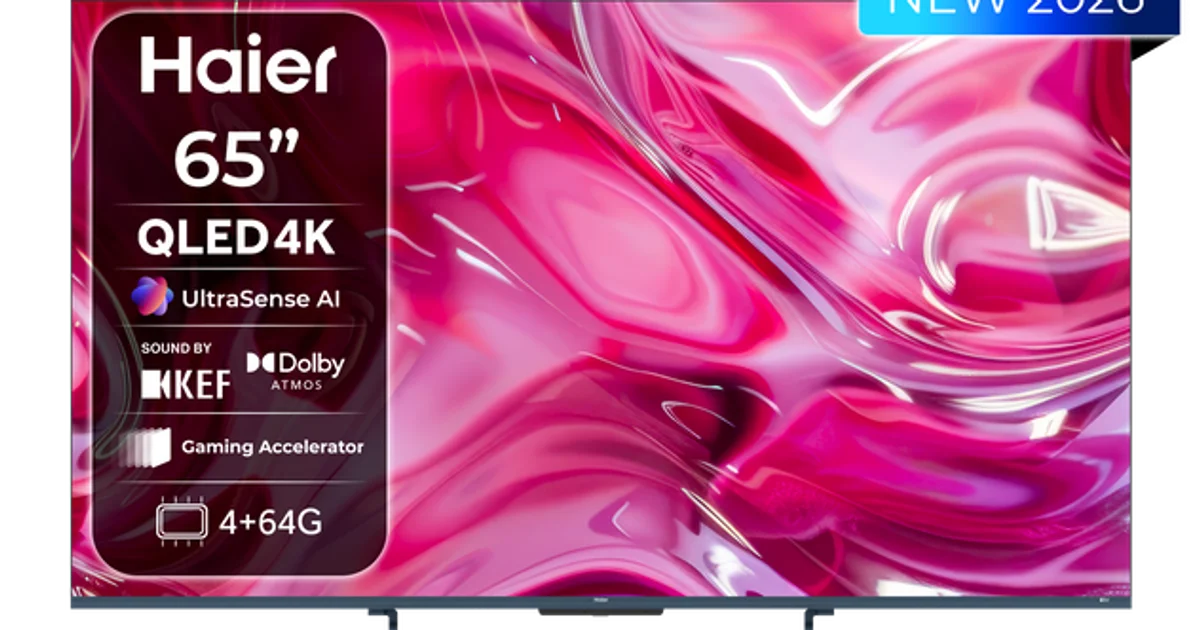
Haier is not suddenly discovering televisions
The distinction matters. Haier has manufactured and sold TVs in various regions for years. What is changing in 2026 is the scale and positioning of its push into European markets, particularly France and the UK.
The company returned to French retail in the spring with a broader lineup spanning QLED, Mini LED, QD-Mini LED and OLED. After IFA Berlin, European executives made clear that the next step is to establish Haier further up the premium segment.
This is therefore less a story about a first television and more about a major appliance company trying to be considered alongside established picture specialists.
KEF is one of the clearest points of differentiation
The most recognizable part of that strategy is the Sound by KEF partnership. KEF says it is bringing more than 60 years of acoustic engineering experience to selected Haier televisions.
Haier already uses KEF-developed audio systems in higher-end QLED Mini LED models. Some OLED models use Harman Kardon audio instead, depending on market and product family.
The logic is straightforward. Modern TV picture quality has improved enormously while sound remains constrained by ever-thinner enclosures. Putting KEF engineering behind the speaker system gives Haier something to discuss beyond brightness and local-dimming-zone counts.
A badge is not a guarantee, of course. Physics still limits what speakers inside a thin television can do compared with a dedicated sound system.
The M96 shows what Haier means by premium
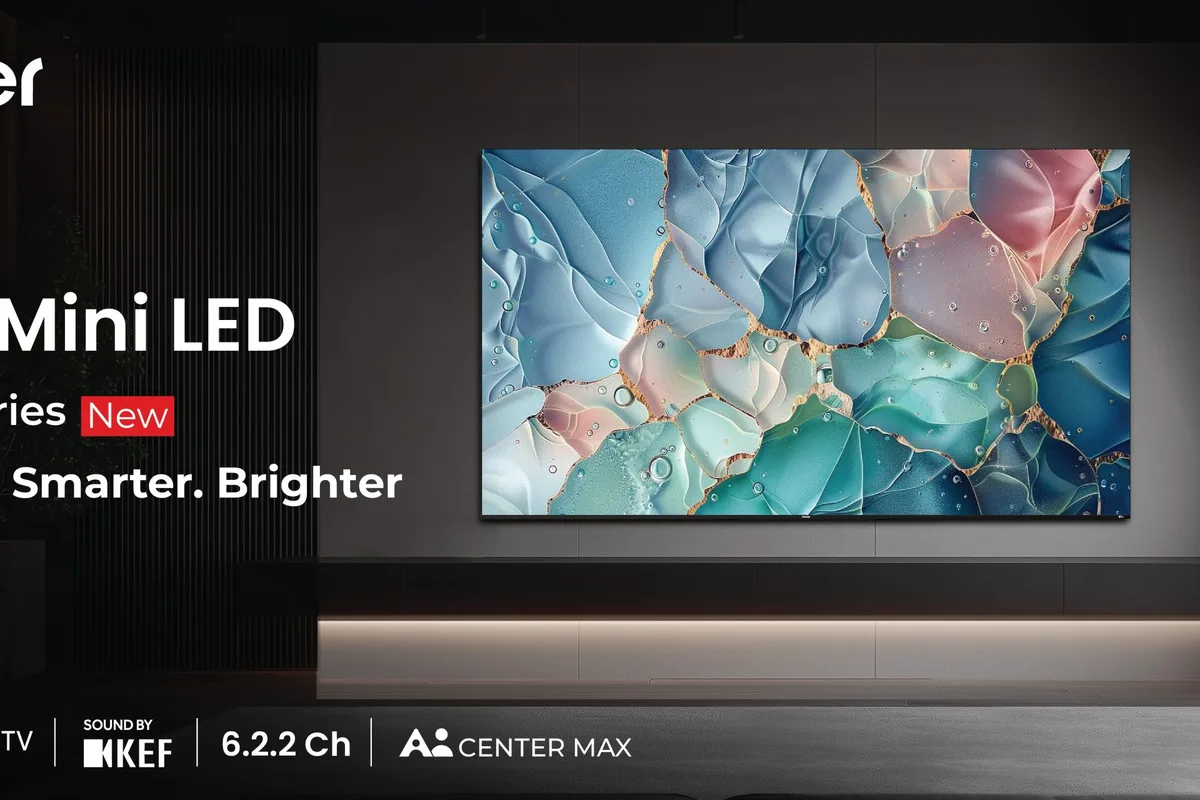
M96 is one of the more ambitious examples of Haier’s approach. Depending on market, the QD-Mini LED family extends into 100-inch-class screens and beyond, with integrated multichannel Sound by KEF audio.
A 100-inch configuration sold in some regions advertises a 6.2.2-channel speaker system alongside Google TV, Dolby Atmos and Haier’s UltraSense AI processing.
High-refresh-rate gaming features and dynamic image processing are also part of the pitch. Haier is trying to make these large displays cover cinema, sport and gaming rather than treating them as conventional living-room televisions.
Size itself becomes a retail weapon. A 100-inch screen is difficult to ignore in a showroom where another 55-inch television can disappear into a wall of nearly identical rectangles.
UltraSense AI also works on dialogue and volume
Haier groups several picture and sound systems under the UltraSense AI name. Image processing adapts parameters to content, while audio processing includes voice separation designed to make dialogue easier to understand.
Automatic volume management is intended to reduce abrupt changes between different sources or types of content.
Those are relatively practical applications of machine learning. Poor dialogue intelligibility is a much more common living-room problem than needing a television to generate pictures.
Independent testing will still be necessary to establish how effective Haier’s processing is compared with long-established systems from Samsung, LG, Sony and other premium competitors.
Haier does not want to compete with TCL and Hisense on price alone
Haier’s TV leadership has described the need for an identifiable edge if the brand is going to survive in a highly competitive market.
That problem is particularly obvious when looking at TCL and Hisense. Both companies already attack Mini LED, large-screen sizes and aggressive pricing in Europe, and both have spent years building recognition in the category.
Haier cannot simply arrive with another slightly cheaper 65-inch panel. KEF audio, very large sizes, in-house processing and design are all attempts to create a different reason to choose the product.
The strategy looks more like a gradual premium push than an immediate race for maximum volume.
OLED remains part of the plan
Haier is not limiting itself to LCD-based displays. Its European portfolio also includes OLED, and the company intends to maintain several display technologies rather than betting everything on one panel type.
That creates range but also complexity. Samsung, LG and Sony already have highly recognizable premium lineups and years of category-specific reputation.
Offering QLED, Mini LED and OLED can address many buyers. The challenge is making model names, technical differences and pricing equally easy to understand at retail.
The KEF partnership is moving outside the TV
IFA 2026 provided another sign that the relationship is expanding. Haier showed the HSM990, a dedicated 7.1.4 soundbar developed with KEF.
The system uses 15 drivers and is intended as a genuine Dolby Atmos home-cinema product rather than a simple stereo bar carrying a hi-fi logo.
That changes the meaning of the partnership. KEF is no longer being used only to improve small speakers inside selected televisions; Haier is starting to build a separate home-cinema ecosystem around the collaboration.
If HSM990 receives broad European distribution at a competitive price, it may also provide an easier way to judge what KEF engineering contributes when it is not constrained by a television chassis.
The biggest obstacle may still be the Haier name
Haier has one enormous advantage: millions of European consumers already know the brand through refrigerators, washing machines and other household appliances.
That familiarity cuts both ways. Buying a Haier washing machine and spending several thousand euros on a premium Haier television rely on different brand associations.
Sony can sell a TV on decades of image and cinema heritage. LG has years of OLED leadership. Samsung is almost unavoidable at the premium end of retail. Even TCL and Hisense now have clear identities around Mini LED and large screens.
Haier still has to build that same mental shortcut for television.
KEF can open the door, but it cannot do every job
The audio partnership is therefore a smart choice. KEF gives Haier immediate credibility in a field that would take much longer to establish independently.
A premium television is still a complete system, though. Backlight control, motion handling, color accuracy, HDR tone mapping, operating-system quality, HDMI behavior, input lag and long-term software support all matter alongside audio.
That is what makes Haier’s European push interesting. The company is trying to combine the manufacturing scale of an appliance giant with the language and partnerships of a premium AV brand.
KEF can help make that ambition audible. Haier now has to make the picture equally convincing.