 By Tsuky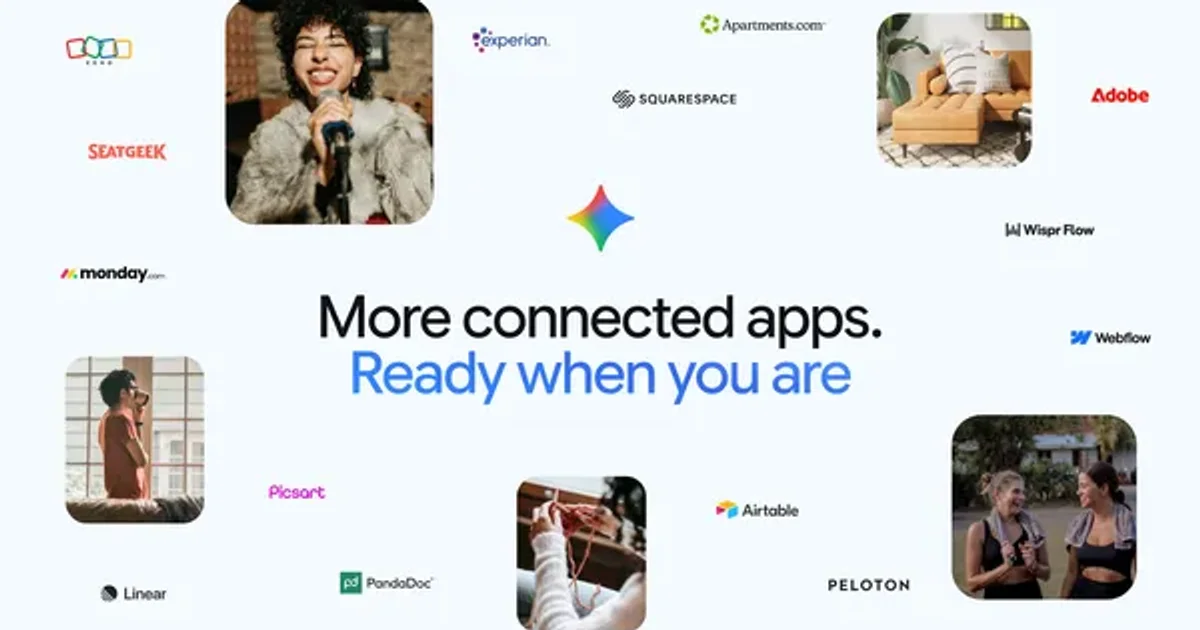
Google announced a new wave of Gemini Connected Apps on September 23. The list spans several very different categories: Airtable, Linear, monday.com, PandaDoc, Wispr AI and Zoho for productivity; Adobe, Picsart, Squarespace and Webflow for creative work; and Apartments.com, Experian, Peloton and SeatGeek for housing, credit, fitness and events.
The rollout began on the day of the announcement. Eligible users can connect an app in Gemini settings, invoke it with an @ mention, or simply ask Gemini to use it. The point is to make third-party tools part of the normal conversation rather than a separate collection of integrations users have to hunt down.
Connected does not mean the same level of control
The capabilities vary considerably. Airtable can search and query workspaces and databases while also managing tables, records, pages and automations. PandaDoc can create, update, send and archive documents. Webflow can modify visual design, responsive layouts, structural elements, CSS properties and CMS content.
Other integrations are more focused on retrieval or planning. Experian can expose a user's FICO score and credit-report factors through Gemini. Peloton can find and schedule classes or build multi-day training plans. SeatGeek can search ticket listings and provide a link to complete the purchase on SeatGeek.
There is therefore no single autonomy level attached to a Connected App. Depending on the partner, Gemini may read information, organize it, write back to the service, create something new or stop before the final transaction.
The 14-app headline comes with a patchwork of availability rules
Google's announcement does not spell out every regional restriction, but its support documentation does. Airtable, Linear and PandaDoc are listed for personal Google Accounts belonging to users aged 18 or older, in English and in the United States. Squarespace and Webflow carry similarly narrow requirements.
monday.com is broader: Google lists personal, work and school accounts and availability wherever both Gemini Apps and monday.com are supported, although the integration is still English-only. Wispr AI is available across territories where both services operate. Several Zoho integrations documented by Google are currently limited to India and English.
That matters because “rolling out now” does not mean all fourteen integrations are immediately available to every Gemini user. Eligibility can depend on location, language, account type, device and the Gemini experience being used, including regular chat, Gemini Spark or Gemini Live.
Gemini is becoming the interface in front of other software
Google has been expanding this model throughout 2026. Gemini already works with Google's own services and has gained third-party connections including Canva, Dropbox, Instacart, OpenTable, Ticketmaster and Zillow in different products and modes.
This new batch is more consequential for work software. Linear, monday.com, Airtable, PandaDoc and Webflow are not merely databases to search. They are places where users create and modify real work. Once a natural-language command in Gemini can create a document, move a project item or change a website, Gemini becomes the interface sitting in front of the application.
That can remove a surprising amount of interface knowledge from everyday work. Users may not need to remember every menu or workflow when part of the operation can be expressed as a request. The practical value will depend on how deep those actions go, how reliably they execute and how much confirmation users retain before consequential changes are made.
Permissions matter as much as the partner list
Google says users must connect participating apps and can disconnect them through Connected Apps settings. Its documentation also separates supported account types, modes and actions for individual services.
Those differences become more significant once Gemini can write rather than only read. Looking up a Linear project and creating an issue are not equivalent permissions. Searching SeatGeek and changing Airtable records are not equivalent either.
The September 23 rollout makes Google's direction fairly clear: Gemini is being built not only to answer questions alongside other applications, but increasingly to become the place from which those applications are operated.