
 By Adri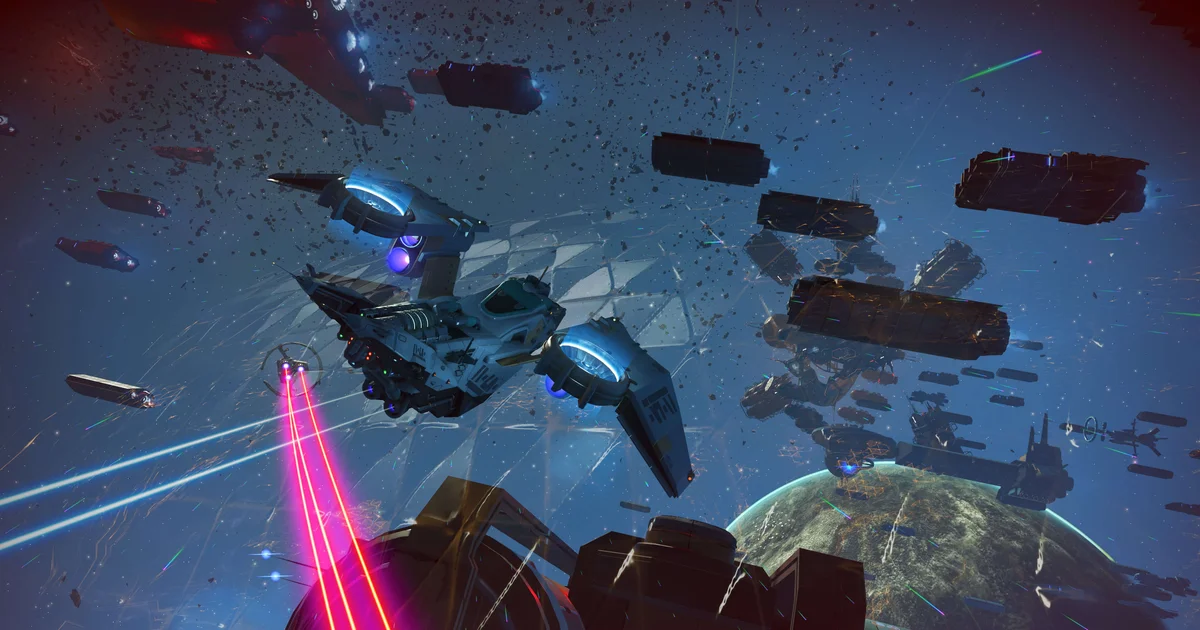
Cosmos completely changes the function of space, but its rendering patch notes are nearly as substantial.
Terrain detail, particles, volumetric effects, orbital cloud rendering and asteroid generation have all been revised.
PC players also receive another generation of neural upscaling and frame-generation technology.
Asteroid generation has been rewritten
That work directly supports Cosmos' new spatial design.
Asteroids now form denser rock and ice belts that function as destinations with resources, NPC traffic and combat rather than simply appearing as scattered mining objects.
Hello Games says it completely reworked their generation to improve visual distribution, draw distance and performance.
Some formations are now large enough to land on, walk across and use as foundations for orbital bases.
Planetary terrain gets another detail pass
The terrain renderer has received improved tessellation with greater surface detail and enhanced textures.
Planet shapes as viewed from space have also been improved.
That matters to a game whose signature technical transition is still the uninterrupted journey from the ground, through atmosphere and into orbit.
Cosmos is changing both sides of that transition at once.
Transparent effects now participate more fully in lighting
Particles and transparent objects can respond to dynamic lights more convincingly.
Hello Games specifically highlights the way a Multi-Tool torch now illuminates smoke, mist and other atmospheric effects.
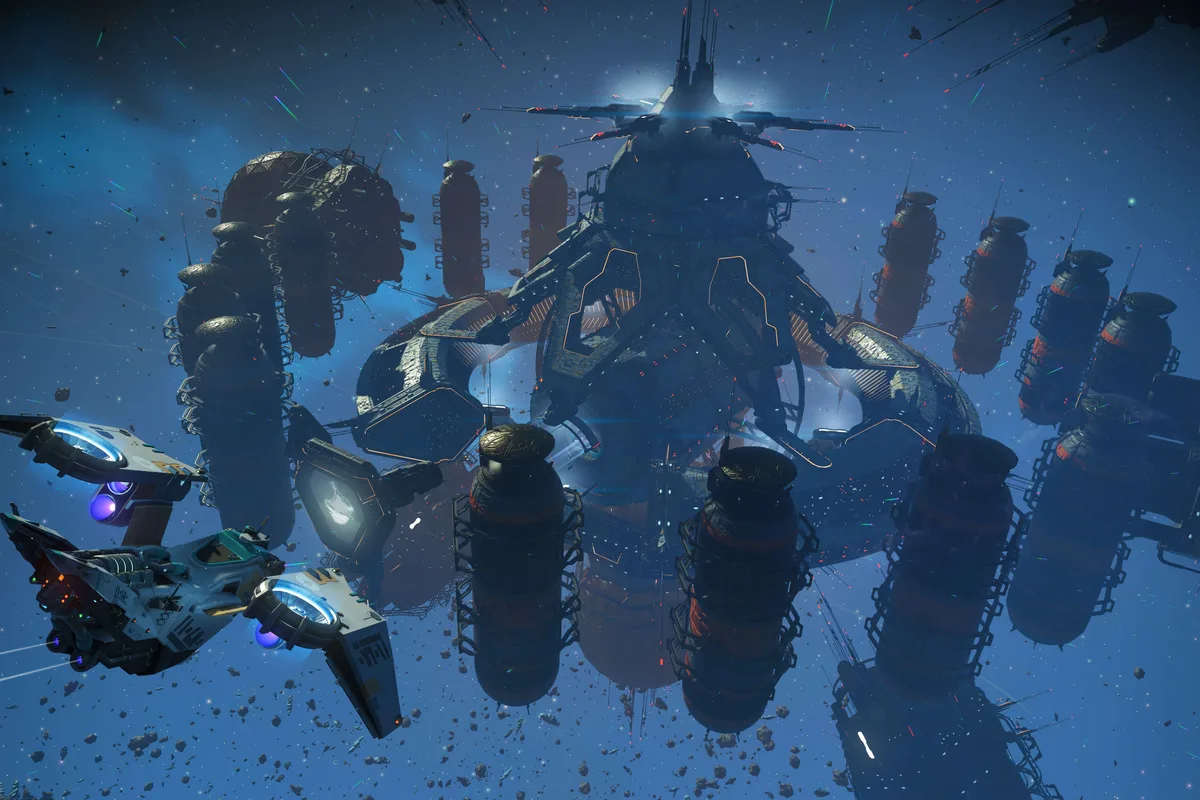
New volumetric fog systems are used around deep-space hulks, while clouds seen from orbit receive upgraded textures, lighting, ambient tint and shape detail.
Individually, those are modest rendering changes. Together, they attack one of the hardest visual problems in No Man’s Sky: maintaining continuity while the player crosses enormous differences in scale without a traditional level transition.
DLSS 4.5 brings 5x and 6x Frame Generation
Cosmos adds NVIDIA DLSS 4.5 support on compatible hardware.
Hello Games specifically lists 5x and 6x Frame Generation modes.
Those multipliers require some context.
They do not mean the game engine suddenly renders six times as many native frames. The technology generates additional intermediate frames from a smaller number of traditionally rendered ones.
Image quality, base frame rate and latency therefore remain important when judging whether the highest multipliers are useful in practice.
Intel XeSS 3 is supported too
Intel's XeSS 3 also joins the renderer.
That broadens the reconstruction options available to PC players and highlights just how long No Man’s Sky has remained attached to the moving PC graphics ecosystem.
The game launched in the same year as NVIDIA's Pascal generation.
A decade later, the same executable lineage is still being updated for neural rendering technologies that did not exist when its original requirements were written.
Procedural texture compression has been rewritten
One of the less marketable changes may be particularly relevant to a procedurally generated game.
Hello Games says it completely rewrote the BC compression encoder used for textures generated at runtime.
The new implementation is intended to reduce artifacting and color banding across procedural models.
Because No Man’s Sky generates such a large proportion of its world dynamically, improving the pipeline can affect enormous classes of content rather than a fixed collection of manually selected assets.
PC VR gets eye-tracked foveated rendering
Cosmos also adds foveated rendering support for PC VR systems with eye tracking.
Rendering resources can be concentrated around the user's current gaze while reducing detail in peripheral regions where the eye is less sensitive.
Actual support naturally depends on the headset and eye-tracking hardware.
It is another reminder of the range Hello Games is maintaining simultaneously: traditional PC, several console generations, handheld Nintendo hardware and multiple VR environments all share the same evolving game.
Update 7.01 arrived almost immediately
The first Cosmos hotfix went live on Steam on September 10.
Patch 7.01 addresses geometry issues in the new construction pieces, missing station decorations, map problems, excessive NPC spawning in asteroid fields and several outpost bugs.
It also fixes the Grave of the Ocean King appearing around 600 times smaller than intended.
Other platforms are scheduled to receive the fixes after certification.
No Man’s Sky is still functioning as an R&D platform
Hello Games has said that technology developed across its projects can be shared with Light No Fire.
That gives Cosmos a second technical purpose.
The studio is maintaining No Man’s Sky for an active audience, but it is also able to test new rendering ideas, multiplayer structures and procedural systems inside an enormous live environment.
Few commercial games remain technically fluid enough to receive rewritten generation systems and current-generation rendering features a decade after release.
No Man’s Sky stopped being merely a long-supported game years ago.
It is now an engine that has never really stopped moving.