
 By Adri
A laptop webcam may appear to be a straightforward component. It captures images, transfers them to the operating system and makes them available to video conferencing applications.
The underlying technology can be considerably more complicated.
Several hardware and software components may sit between the image sensor and the application, handling frame capture, image formats, processing and memory transfers.
On some modern Intel laptops, this architecture has historically created challenges for Linux compatibility.
A machine might have fully functional processing, graphics and networking capabilities while its integrated camera remains difficult to use.
The addition of Intel IPU8, IPU7 and IPU7.5 support to Linux 7.4 development is therefore a meaningful step.
It also prepares for future laptops based on Intel's Nova Lake platform.
IPU8 support arrives before Nova Lake laptops
Phoronix reported on October 26 that the Linux 7.4 media subsystem updates had been merged.
The most notable addition is Intel IPU8 support.
This Image Processing Unit is part of Intel's next generation of integrated camera controllers for mobile systems.
The development process began months before the latest merge.
The relevant code has now reached the mainline development branch of the kernel.
That represents a significant milestone for upstream hardware enablement.
However, the announcement requires an important timing distinction.
It does not mean that all Nova Lake laptops are already available commercially.
Nor does it mean that a stable Linux 7.4 release is already installed across major distributions.
This is preparatory software support for upcoming hardware.
What an Image Processing Unit actually does
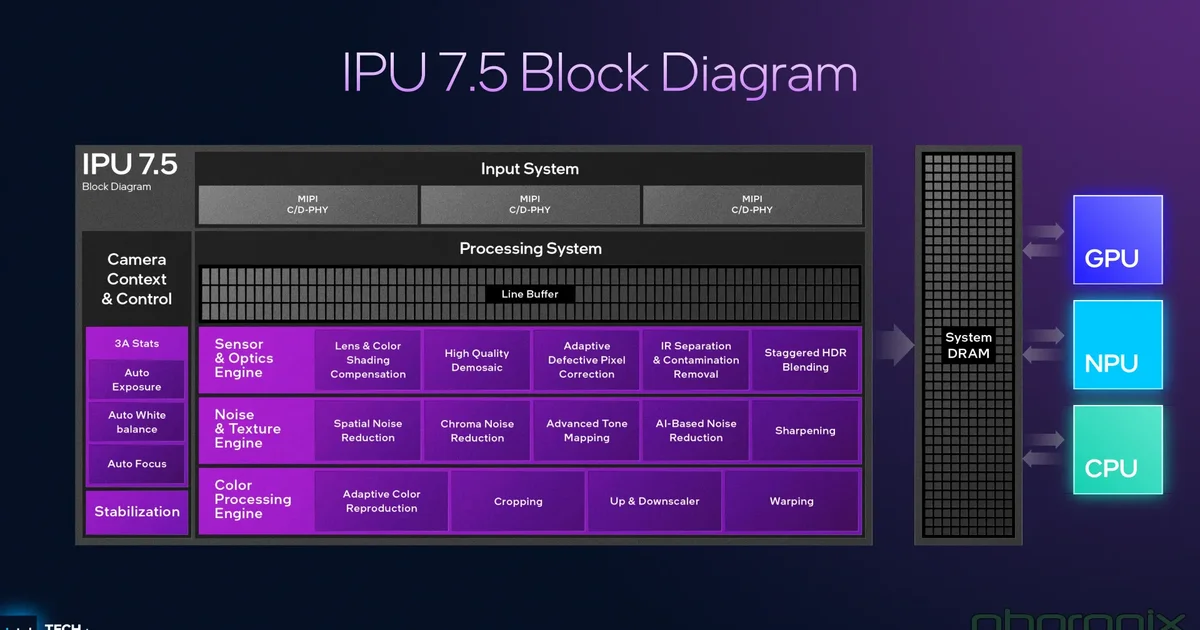
An IPU is a specialized hardware component involved in image acquisition and selected processing operations.
In a modern camera system, the sensor converts incoming light into digital data.
That data must then be transported, organized and potentially processed before applications can use it.
The hardware pipeline may include MIPI CSI-2 interfaces, capture engines, memory access mechanisms and image processing functions.
An IPU plays a role in coordinating those operations.
It is not the same as the GPU, which primarily handles graphics and parallel computing, or an NPU used for selected artificial intelligence workloads.
All three may contribute to modern multimedia applications, but they serve different purposes.
For Linux systems, the appropriate IPU driver is essential when the integrated camera depends on that controller.
Without it, the operating system may be unable to initialize the image capture pipeline correctly.
Intel is bringing several generations into one driver
The Linux 7.4 changes do more than recognize a new hardware product.
Intel is extending the unified IPU6 driver to support IPU7 and IPU7.5.
That may sound counterintuitive: why should a driver named after IPU6 support newer generations?
The answer lies in how the software is organized.
These hardware generations share enough technical characteristics to reuse portions of the existing driver infrastructure.
Rather than maintain completely separate implementations, developers can consolidate common functions.
That does not make the hardware identical.
Each generation retains specific identifiers, registers and operating parameters.
The driver must account for those differences while avoiding unnecessary duplication.
Panther Lake also benefits from the changes
IPU7.5 support is associated with Intel Panther Lake.
That platform has its own camera controller, with some characteristics differing from IPU8.
A separate IPU7 driver had previously been integrated into the staging area of the Linux kernel.
The latest work therefore does not represent the first attempt to support those hardware generations.
Instead, it brings their support into a shared driver architecture in the mainline media subsystem.
That arrangement can simplify maintenance.
When a correction applies to shared functionality, it may be easier to implement within one common codebase.
However, developers must still check that changes do not introduce regressions on older hardware.
Seven patches prepare the new controller
The technical work is documented in a seven-patch series published on October 1 by Intel engineer Divyamani Tripathi.
The series extends the IPU6 driver to accommodate several IPU8-specific characteristics.
It updates interfaces used for communication with the controller firmware.
It introduces hardware identification, adapts certain register settings and adds the PCI identifier needed for device detection.
Other changes address memory management and power sequencing.
One particularly important detail is that differences from IPU7 were discovered through testing on physical hardware.
The developers needed to adapt the messages used during firmware startup.
Without the change, the controller could not complete its initialization properly.
This demonstrates why supporting a new component often requires considerably more than adding a device identifier.
IPU8 firmware requires a specific message format
Intel's patch documentation describes an InSys ABI 1.0.14 interface for IPU8.
An ABI, or Application Binary Interface, defines the structure of certain exchanges between software components and firmware.
To initialize the controller, the driver must send information in a format the firmware recognizes.
Incorrect structures or version numbers can cause communication failures.
Intel observed a firmware boot rejection associated with an incompatible message version.
The new changes implement the requirements of IPU8.
Other adaptations concern hardware register layouts and memory-management tables.
These details are invisible to the end user.
They are nevertheless essential because a webcam cannot operate correctly when its controller fails during initialization.
Two OV13B10 sensors were used for real hardware testing
The patch series provides specific information about validation.
Intel engineers tested a physical IPU8 platform with two OmniVision OV13B10 image sensors.
The tests confirmed that the driver recognizes the hardware and that the acquisition subsystem firmware boots.
Both sensors also appear correctly in the media controller topology.
The CSI-2 interfaces and capture nodes are enumerated as expected.
These results matter because they are based on physical hardware rather than a successful software compilation alone.
They demonstrate that important initialization stages are functional.
However, the tests do not validate every possible laptop webcam configuration.
Additional work is needed to verify the sensors selected by PC manufacturers, platform-specific firmware and different video applications.
ISYS and PSYS represent different parts of the camera pipeline
Intel camera controllers involve several subsystems.
ISYS primarily handles image acquisition from camera sensors.
PSYS concerns image processing capabilities.
The patch series explicitly identifies ISYS as its primary objective.
That is also the component validated on real hardware.
The patches include PSYS-related elements, such as memory-management tables and power sequencing.
However, Intel states that the unified driver still lacks a consumer for a complete PSYS processing pipeline.
In other words, the code prepares certain hardware functions without providing every image-processing feature required for a complete user-facing solution.
Describing the work as fully finished webcam support would therefore be premature.
Why an upstream driver does not guarantee a working webcam
An integrated laptop camera depends on more than its IPU controller.
The system must also recognize the image sensor and the components connecting it to the processor.
It must configure image formats, timing and transfer paths correctly.
Required firmware must be available and compatible.
Applications must then be able to access the resulting video stream through supported interfaces.
On some platforms, raw capture and image processing require additional software components.
A camera can therefore appear in the kernel's media topology without immediately functioning in every video conferencing application.
This distinction explains why upstream IPU8 support is important but does not guarantee complete compatibility.
The final outcome will also depend on the sensors and hardware configurations selected by individual laptop manufacturers.
A practical issue for Linux laptop owners
Hardware compatibility is an important consideration when choosing a laptop intended to run Linux.
A system can offer strong processor performance, functional Wi-Fi and good battery endurance while still being inconvenient if its webcam does not work.
For people who regularly attend video meetings, that is not a minor issue.
It may require an external USB camera or platform-specific software workarounds.
Integrating drivers before the hardware reaches the market can reduce these difficulties.
It also gives Linux distributions more time to prepare their testing and packaging.
However, no current result establishes that every Nova Lake laptop will have fully functional camera support immediately at launch.
Compatibility will still need to be verified for each commercial model.
Linux 7.4 adds support for more camera sensors
The media subsystem update also includes several new image sensor drivers.
The list includes Sony IMX576, Samsung S5KJN5 and Himax HM1246.
Three OmniVision sensors are also mentioned: OS02G10, OV05C10 and OG0VA1B.
These additions expand the range of imaging components supported by the kernel.
They are not necessarily limited to laptop cameras.
Depending on their implementation, some sensors may be used in other device categories.
Having an upstream driver can facilitate integration into compatible systems.
However, it does not establish that any particular commercial product will use the component.
The importance of these changes is best understood across the broader Linux hardware ecosystem.
Rockchip, NXP and Qualcomm receive multimedia improvements too
The Linux 7.4 media updates extend beyond Intel technology.
They include a MIPI capture driver for Rockchip RK3576.
Other additions cover the NXP i.MX95 CSI pixel formatter.
Qualcomm gains a driver for certain CSI-2 D-PHY interfaces.
The STM32MP25 platform also receives additions for its DCMIPP controller.
These components serve different hardware markets, often beyond conventional consumer laptops.
They may appear in embedded systems, industrial equipment and products requiring camera capture capabilities.
Their inclusion in the same subsystem update illustrates the breadth of current Linux multimedia driver development.
Video4Linux2 receives additional improvements
Video4Linux2, commonly known as V4L2, is also receiving changes.
V4L2 provides interfaces used by drivers and applications to manage video devices under Linux.
The updates improve internal interfaces for media subdevices.
They also correct information associated with the P010 format and add information for Y12.
These changes may appear less significant than support for a new Intel hardware generation.
However, they contribute to the reliability of video pipelines.
Incorrect format descriptions or interface behavior can cause compatibility problems between drivers and the software that uses them.
Maintaining this infrastructure is therefore important for webcams and many other image capture devices.
Linux 7.4 does not automatically improve webcam image quality
The addition of IPU8 could create expectations of better video quality on future Intel laptops.
The technical sources do not support that conclusion by themselves.
Image quality depends on factors including sensor design, optics, exposure, noise reduction, HDR processing and application software.
The acquisition driver does not determine all of those characteristics.
The verified Intel patches mainly address hardware initialization and frame acquisition.
They provide no comparative image quality benchmarks or battery consumption measurements.
It would therefore be incorrect to promise sharper video, improved HDR or longer battery life solely because the IPU8 driver has been merged.
Those aspects will need evaluation once compatible laptops reach the market.
Why hardware companies prepare Linux drivers so early
Adding a component to the Linux kernel requires several stages.
Developers prepare code, submit it for review and respond to technical feedback from subsystem maintainers.
Patches must then be tested and merged into the appropriate development branch.
Afterward, Linux distributions must decide when and how to include the changes in their releases.
Starting the process before commercial hardware launches can reduce the delay between product availability and practical Linux support.
That is the value of the IPU8 development work.
Intel is not announcing a standalone webcam that consumers can purchase.
It is preparing the software infrastructure required by future computers using its platform.
Users will be able to judge the results properly when compatible systems become available for testing.
An important step, but not the end of Linux webcam challenges
IPU8 support in Linux 7.4 represents concrete preparation for future Intel Nova Lake laptops.
The inclusion of IPU7 and IPU7.5 in the unified driver also improves how support for previous generations is organized.
The work goes beyond a simple compatibility declaration: Intel documented testing on actual IPU8 hardware with two image sensors.
However, those results primarily validate initialization and image acquisition.
Complete image processing, firmware availability and application integration remain separate requirements.
For Linux users, the development is encouraging because support for the next generation of Intel laptop cameras is progressing before the computers arrive in stores.
The real test will come with commercial hardware and stable software releases, when users can determine whether that preparation translates into webcams that work without additional configuration.