
 By Camille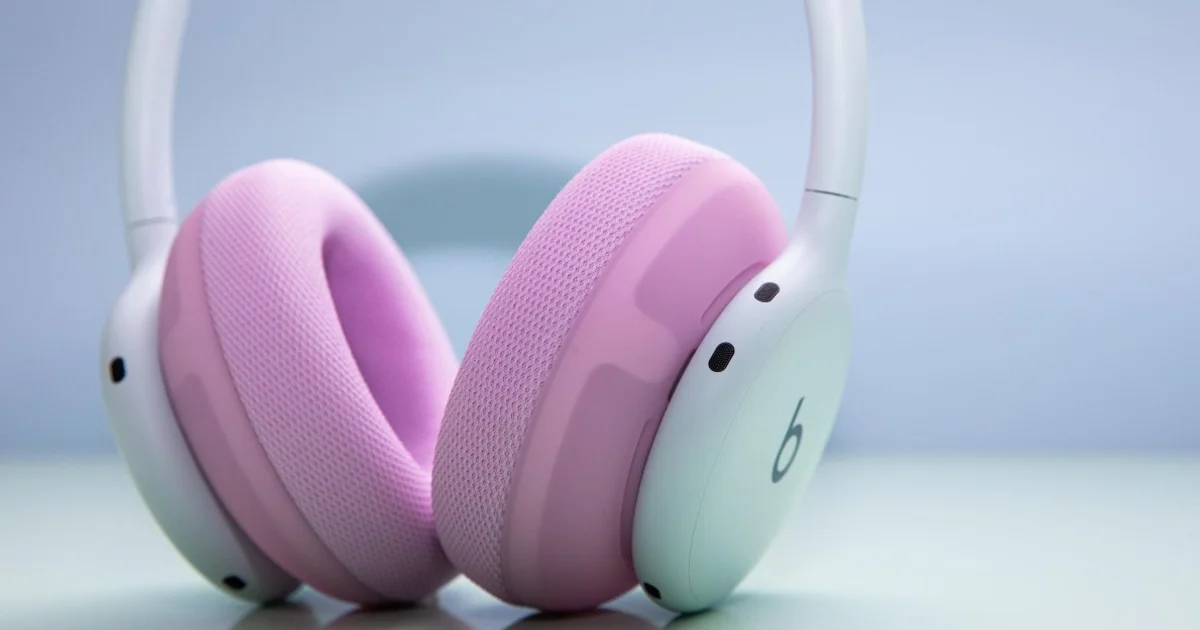
The most interesting feature is mechanical, not software
The defining change is the interchangeable cushion system. Both earcups and the padded section of the headband can be detached, with each Beats 360 shipping with Performance Knit memory-foam cushions intended to be more breathable during activity.
Beats also sells additional Performance Knit sets in multiple colors and UltraPlush cushions intended for softer everyday use. That makes the system more than a styling exercise. A sweaty set can be removed and cleaned while another is fitted for commuting, travel or desk use.
The headphones themselves come in Black, Cloud, Pink and Sky. They weigh 294.5 grams and fold flat by rotating the earcups. The included carrying solution is a woven ripstop bag rather than the hard protective case some buyers may expect at this price.
IPX4 formalizes the workout use Beats owners were already attempting
The other major practical change is IPX4 sweat and water resistance. Beats calls the 360 its first officially sweat- and water-resistant over-ear headphone.
IPX4 does not make the product waterproof, and Beats explicitly notes that resistance can decrease with wear and that the headphones should not be charged while wet. It does, however, give active users a level of protection that Beats' previous full-size models did not officially provide.
Early testing suggests the distinction is meaningful without repealing the laws of sweaty over-ear headphones. The Verge found that the Performance Knit cushions handled moisture reasonably well but were still wet after longer workouts. Fit was secure during controlled strength exercises, with more adjustment needed during sprints and movements involving aggressive head motion.
That makes removability much more useful than a cosmetic gimmick. Beats has not stopped sweat from reaching the cushions; it has made the components most exposed to it substantially easier to separate from the rest of the hardware.
Thirty-two hours with ANC, plus a noise-cancelling number that needs context
Beats rates the 360 for up to 32 hours of playback with Active Noise Cancelling enabled. Fast Fuel charging is advertised to provide up to one hour of listening from a five-minute charge.
Eight microphones are used to analyze acoustic conditions inside and outside the earcups. Beats claims up to 1.75 times more total noise cancellation than the Beats Studio Pro. That is a manufacturer comparison between two Beats products, not a claim that the 360 cancels 1.75 times more noise than every Sony or Bose rival.
Early independent impressions show why that distinction matters. The Verge found the ANC highly effective for normal use but still behind the strongest Bose implementation. Les Numériques was more reserved about the amount of isolation it measured. The 360 can therefore be a substantial upgrade over Studio Pro without that figure settling the wider ANC competition.
Transparency mode is also included, while Adaptive EQ operates when ANC and Transparency are switched off. Personalized Spatial Audio with dynamic head tracking remains available with compatible content and devices.
The acoustic platform is new, but this is emphatically a wireless headphone
Beats describes the acoustic system as a new architecture designed for higher output, strong bass and detail across the frequency range while keeping distortion low. The launch messaging is noticeably different from the exaggerated low-end identity associated with much older Beats headphones.
Initial listening reports are broadly favorable without being identical. 01net praised the energetic, detailed presentation and spatial performance. Les Numériques also found the sound clear with substantial bass but identified a brighter treble balance. The Verge liked the low end and much of the high-frequency presentation while finding parts of the midrange less separated.
One omission is harder to ignore at this price. Unlike Studio Pro, Beats 360 is fundamentally a wireless listening product and does not provide conventional wired audio playback. Early testing from 01net and 9to5Mac confirms there is no USB-C audio path or analog headphone input. The USB-C port is for charging.
Beats still treats Android more seriously than most Apple hardware
Apple ownership has not turned the Beats 360 into an iPhone-only accessory. Apple devices get one-touch pairing, automatic switching, Find My, Audio Sharing and Siri features. On Android, Beats supports features including Fast Pair, compatible device switching and Google's Find Hub.
Physical controls remain on the earcups for volume, playback, calls, power and listening modes. Everyday operation therefore does not depend entirely on touch gestures or opening an app.
Beats announced the 360 on September 22, with retail availability beginning September 24 in initial markets. French pricing is €349.95. Studio Pro remains in the lineup at a lower official price, making this a new branch of the Beats range rather than a direct successor removing the older model.
That distinction explains the product better than any single specification. Beats did not simply build a cheaper AirPods Max or add a little more ANC to Studio Pro. It looked at something people were already doing — wearing large headphones to train, commute and travel — and made the parts most likely to absorb that daily abuse easier to replace.