
 By Camille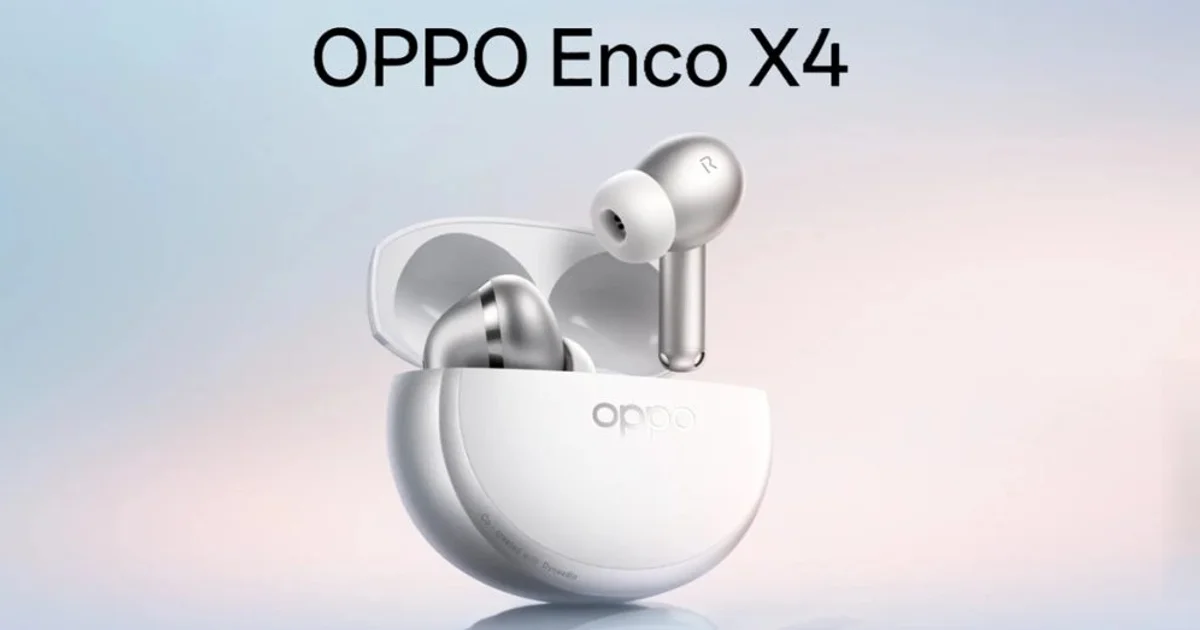
Two drivers and two DACs handle different parts of the spectrum
Enco X4 continues the basic idea behind OPPO’s premium X-series earbuds: divide the acoustic workload rather than asking one driver to reproduce everything.
The fourth-generation coaxial design developed with Dynaudio combines an 11mm dynamic bass driver with a separate 6mm high-frequency driver.
Each section is driven through its own DAC before crossover and amplification.
OPPO claims 50% more low-frequency driving force and 20% lower full-range distortion than Enco X3. Those are laboratory claims from the manufacturer rather than independent measurements.

Dynaudio contributes more than a logo
The Dynaudio collaboration continues with several tuned listening profiles.
Dynaudio Original Sound and Dynaudio High-Resolution sit alongside profiles emphasizing vocals, treble or bass.
OPPO therefore presents the partnership as part of both the acoustic development and final tuning rather than a simple branded EQ preset.
The real result will still depend on fit, sealing and how well the two drivers integrate across the crossover region.
Wireless throughput reaches 2.3Mbps
OPPO supports lossless-oriented LHDC transmission at up to 2.3Mbps with 48kHz/24-bit audio on compatible hardware.
The company describes this as up to a 400% transmission-rate increase compared with the previous generation.
Bluetooth 6.1 is supported along with SBC, AAC, LHDC and LC3.
Lossless playback still requires the entire chain to cooperate. A high-bandwidth codec cannot restore information that was already removed from the original source.
The processing platform moves from 12nm to 6nm
OPPO has replaced the previous generation’s 12nm audio platform with a new 6nm chip.
The company claims up to an eightfold increase in hardware processing capability for noise and voice-related tasks.
That additional compute is used for environmental analysis, adaptive noise cancellation, voice separation and smart features running in real time.
A more efficient process is equally important in a true-wireless earbud, where the entire device is powered by a battery measured in tens of milliamp-hours.
The 99.8% ANC figure needs context
OPPO claims Enco X4 can suppress up to 99.8% of selected everyday environmental noise.
It also quotes twice the overall noise-cancellation capability and 250% stronger voice-noise suppression compared with Enco X3.
Those percentages should not be read as a promise that virtually every external sound disappears in every environment.
ANC typically performs best against steady lower-frequency noise and has a much harder job with nearby speech, impact sounds and rapidly changing environments.
An adaptive mode automatically varies ANC and transparency intensity according to the detected surroundings.
The ear tips are part of the noise-control system
OPPO uses new foamed-silicone tips designed to improve passive isolation.
Four sizes are included, with a fit test available through the companion software.
That matters because good passive sealing can reduce the amount of work the active system needs to perform.
OPPO claims roughly 5dB better passive isolation between 3kHz and 10kHz compared with the previous generation.
Calls combine conventional microphones and bone vibration
Voice pickup uses conventional microphones alongside neural processing and a VPU bone-conduction microphone.
The VPU can detect vibrations associated with the wearer’s own speech rather than relying exclusively on microphones exposed to surrounding noise.
OPPO claims clear calling in environments reaching 110dB and with wind speeds up to 15m/s under its test conditions.
Those are extreme laboratory figures. A normal call on a windy street will provide a much more useful measure of performance.
Real-time translation covers 24 languages
The most visible AI feature is live conversational translation.
OPPO lists 24 commonly used languages and supports scenarios where one person listens through the earbuds while another reads translated text on the phone.
The goal is to remove the need to hold a handset between two people for every sentence.
The service is not entirely on-device, however. Information published for the Chinese version describes cloud processing and a monthly allowance of 5,000 minutes.
A neural processor inside the earbuds therefore does not mean the entire translation pipeline works offline.
Conversation detection can lower music automatically
Enco X4 can detect when the wearer begins a conversation and temporarily change playback and transparency behavior.
Voice commands can control music, volume, calls and translation without touching the phone.
Head gestures provide another control layer: nodding can accept a call, while shaking the head can reject it.
These less dramatic smart features may prove more useful than translation if they work reliably enough not to trigger accidentally.
The earbuds can become stereo microphones for video
OPPO also allows the Enco X4 microphones to be used during vlog and live-video recording.
Compatible devices can use the earbuds for stereo and Dolby-oriented recording workflows.
For a creator standing several metres from a phone, microphones worn close to the mouth can provide a much stronger voice signal than the handset’s built-in microphones.
The feature also strengthens the role of Enco X4 as a companion to the Find X10 phones launched alongside them.
Thirteen-hour battery life requires the simplest listening mode
OPPO rates the earbuds for up to 13 hours on one charge and 53 hours with the case when ANC is disabled and AAC is used.
With ANC enabled in AAC, that falls to about six hours from the earbuds and 26 hours including the case.
Using ANC and LHDC reduces the figures again to approximately 5.5 and 22 hours.
The difference neatly illustrates the energy cost of premium features: high-bitrate transmission and active noise cancellation both consume significant power.
A ten-minute charge can provide up to 4.5 hours of listening under OPPO’s stated conditions.
Wireless charging joins USB-C
Each earbud contains a 65mAh battery, while the case carries 576mAh.
Charging is available over USB-C and wirelessly.
OPPO lists approximately 55 minutes for the earbuds themselves and 65 minutes for a wired case recharge.
Wireless charging takes roughly two and a half hours.
Each earbud weighs 5.6 grams
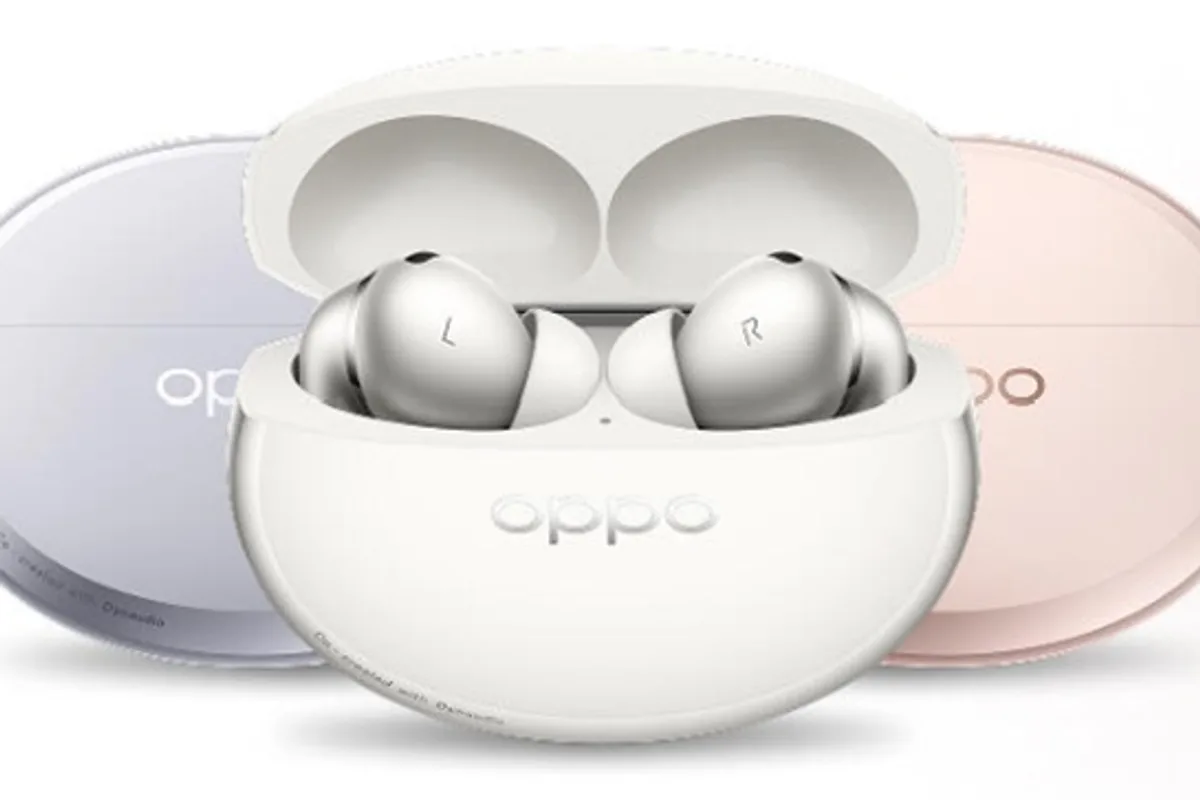
The earbuds weigh approximately 5.6g each, while the charging case is 41.8g and the complete set around 53g.
The stems are shorter than the previous generation and the three finishes are Soft White, Pink Gold and Titanium Gray.
IP55 protection covers dust and water exposure appropriate for workouts and light rain.
It is not an immersion rating.
Gaming latency can drop to 39ms on compatible hardware
OPPO claims full-path latency as low as 39ms through its LE Audio implementation.
That target is primarily aimed at mobile gaming, where a noticeable delay between an action and its sound can affect the experience.
The figure should not be assumed for every phone or codec configuration.
Reaching the minimum latency depends on compatible hardware and software across the connection.
Chinese pricing starts at CNY 1,199
The regular Chinese price is CNY 1,199, with an introductory offer of CNY 1,099.
Retail sales begin on September 24.
That places Enco X4 firmly in premium Android-earbud territory while remaining below some of the most expensive flagship products from Apple, Bose and specialist audio brands.
The more important comparison will be how much the dual-driver architecture and new ANC actually improve real listening and call performance.
European launch activity has already started
OPPO has not yet published every final European list price, but Enco X4 already appears in official campaigns surrounding the international Find X10 launch.
OPPO promotions in markets including the UK and Spain reference a 30% discount coupon for Enco X4 as part of the launch program.
That makes European availability considerably more concrete than a certification leak alone.
Exact retail timing and standard pricing still need to be confirmed market by market.
The most interesting feature may still be the least fashionable one
Enco X4 can translate speech, notice when someone starts talking, react to head movements and serve as microphones for video.
Its most ambitious engineering remains much older-fashioned: two dedicated drivers, two DACs, higher-bandwidth transmission and serious attention to passive and active isolation.
That is probably healthy for a premium earbud.
AI may make Enco X4 smarter. Music, windy phone calls and a few hours on an aircraft will determine whether it is actually better.