
 By Adri
Low-poly is not a hidden compromise, it is the visual language
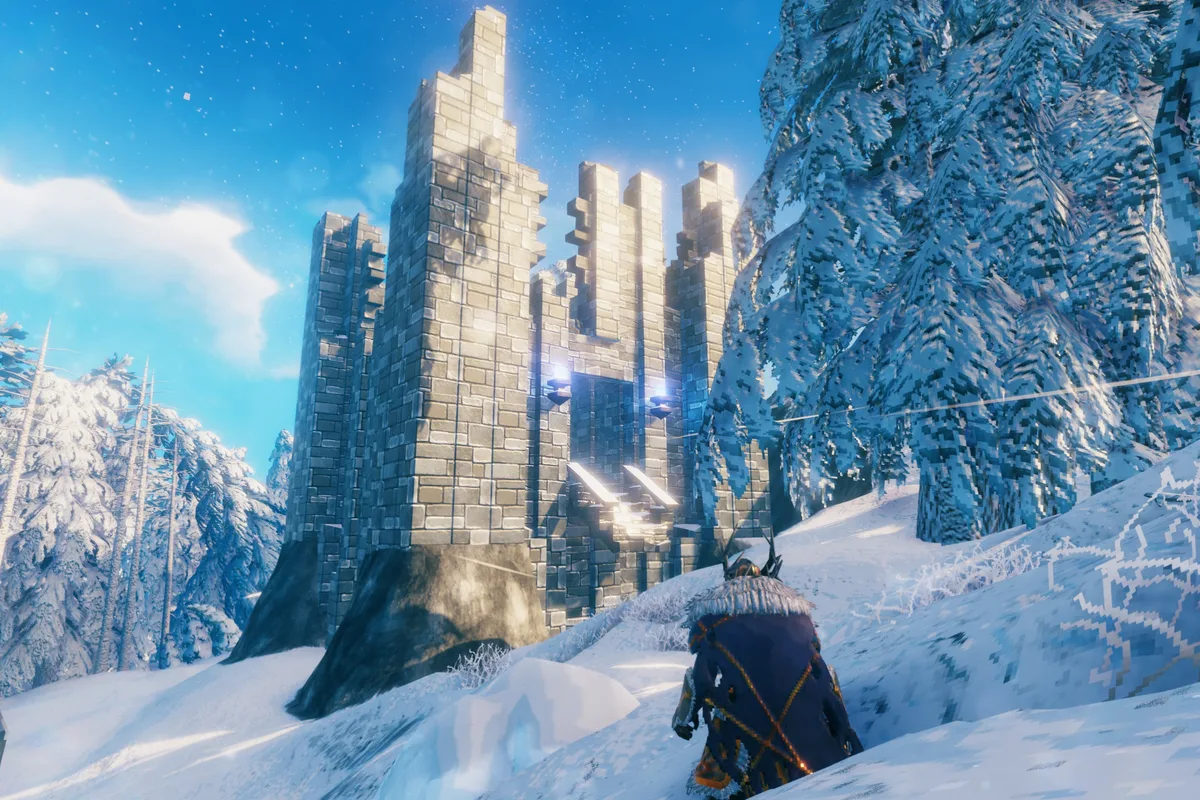
Valheim combines extremely simple models and intentionally coarse textures with much more modern lighting. Viewed closely, an individual tree can look decades old. Once sunlight cuts through the forest, fog rises or a storm rolls across the ocean, the entire impression changes.
That contrast has been one of the game's defining technical strengths since its earliest reviews and remains prominent in 1.0 coverage. Very little rendering budget is spent on microscopic asset detail; much more is spent on atmosphere, silhouette and lighting.
The result is a set of biomes with strong visual identities without the cost structure of photorealism.
A huge world inside a remarkably small install
Procedural generation performs much of the structural work. A new world produces a giant disc of oceans, continents and biome distribution without requiring the download to contain an enormous pre-authored map.
PC requirements remain modest for the scale involved. Steam still lists a GTX 1060 or Radeon RX 580 in the recommended specification alongside 16GB of RAM, while storage requirements are measured in only a few gigabytes.
In 2026, there is something almost novel about a game capable of supporting hundreds of hours without occupying a meaningful percentage of a modern SSD.
Building simulation stops before it becomes engineering software
Construction is not purely cosmetic. Pieces transmit structural stability, different materials have different limits and smoke requires ventilation.
It is not a realistic structural simulation, nor should it be. The system supplies just enough physics to make another floor, a large roof or a chimney into spatial problems.
Greater realism would risk turning every longhouse into civil-engineering homework. Iron Gate stops where simulation still produces useful decisions.
Unity has changed underneath the game
Five years of Early Access forced Iron Gate to keep evolving a project that became dramatically larger than its initial scope. Version 1.0 includes another Unity engine upgrade, a new draw-distance option and additional optimization work.
Earlier in 2026 the studio had already revised Steam Deck presets, including a Performance mode capable of targeting 60fps under suitable conditions, better native-resolution handling and battery improvements. Valve continues to list the game as Steam Deck Verified.
That scalability is as meaningful to Valheim's technical success as its visual style.
Players can build workloads no developer would sensibly author
The procedural wilderness is not always the hardest thing to render. Giant settlements packed with lights, smoke, crops, animals and hundreds or thousands of building pieces can create scenes far heavier than the natural environment.
That is a familiar sandbox problem. A developer can optimize a forest. It cannot predict how many torches somebody will place inside a cathedral connected to three kitchens and a boar farm.
Reviews and player reports still note heavier performance in ambitious builds. Version 1.0 improves the situation without eliminating the underlying reality.
The interface shows more age than the graphics
Usability has had a harder time absorbing five years of expansion. New pieces, foods, recipes, crafting stations and equipment categories have accumulated on interfaces originally designed for a much smaller game.
Iron Gate overhauled portions of the building menu for 1.0, but the complete toolset can still feel crowded.
Missing conveniences are increasingly conspicuous as well. Crafting directly from nearby storage has become routine elsewhere in the genre, making its continued absence feel more historical than necessary.
1.0 mostly proves how sensible the foundation was
The game leaving Early Access in 2026 remains unmistakably the game that appeared in 2021. It contains far more systems, content, platforms and completed biomes, but its technical identity has not been replaced.
Iron Gate made a smart allocation decision: spend less on details that age quickly and more on systems that make a world feel alive.
Valheim is not a graphics benchmark.
It is an efficiency benchmark.