
 By Adri
Technically, the review corpus is far less divided than it is on story or mechanical depth. Marvel's Wolverine is consistently described as one of the more visually impressive PS5 releases, with dense animation, fast transitions and generally stable performance.
Push Square reviewed the game on PS5 Pro and reports an excellent Performance Pro experience at 60fps, with only a few bugs requiring checkpoint restarts. Shacknews likewise highlights minimal loading and strong presentation in both Performance and Fidelity configurations.
The 60fps mode does not look like the compromised option
That is one of the clearest strengths of the PS5 Pro version.
Performance Pro targets 60fps while retaining visual quality close to the standard Fidelity presentation and using PSSR to reconstruct the image. Push Square specifically praises facial rendering and the ability to maintain detail while the screen fills with combat effects.
Fidelity Pro trades that fluidity for a 30fps target with more advanced ray-tracing features. Base PS5 players receive the more familiar choice between performance and image-quality priorities.
Sony's official material also confirms PSSR support on PS5 Pro.
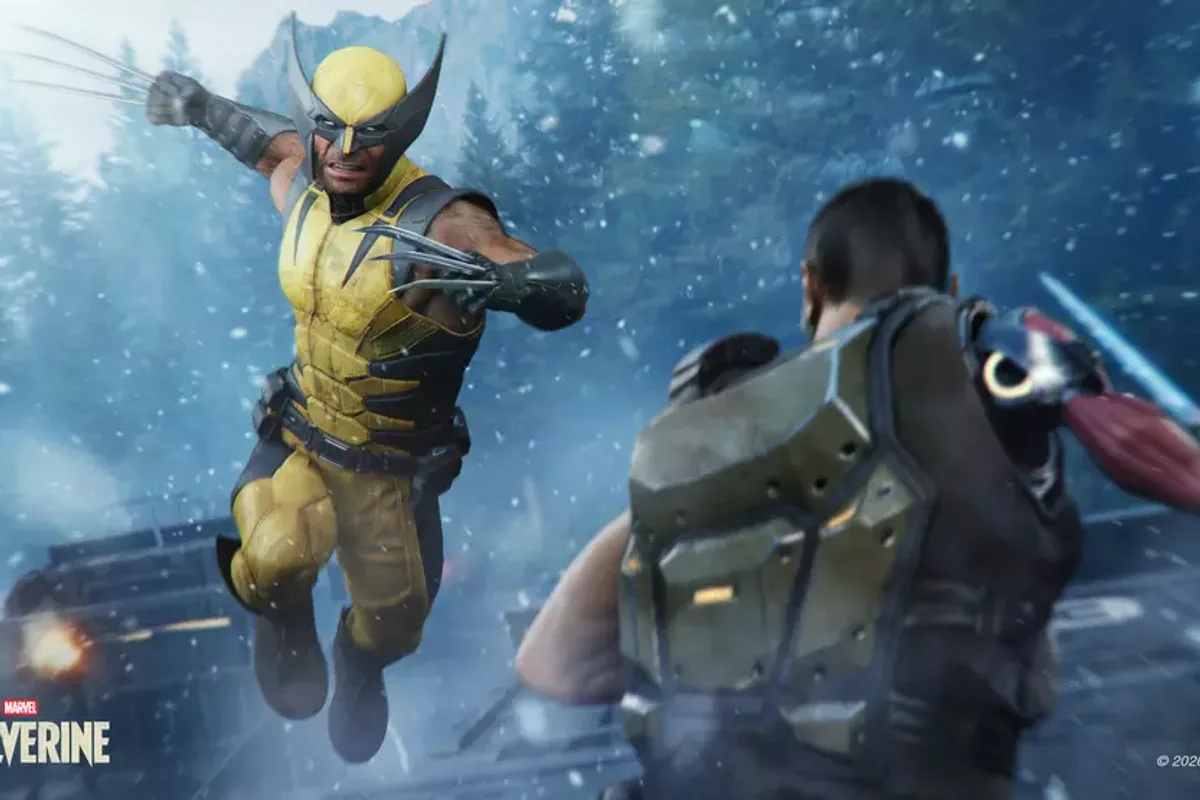
The gore is also a rendering workload
Wolverine's battles generate a large amount of persistent visual information: blood, dismemberment, bodies, environmental damage and highly authored finishing animations.
Reviewers repeatedly note that the game keeps pace with that chaos.
This matters because much of the spectacle happens during active play rather than being isolated inside cinematics. The transition from normal control to execution animation and back again needs to feel immediate or the entire combat rhythm would suffer.
The SSD is used to hide interruption
Shacknews calls out minimal loading and points to the Nightmare Cabins as another example of Insomniac using the PS5 storage architecture to move quickly between spaces and contexts.
Checkpoint restarts and scene transitions are fast enough that a linear campaign can maintain a near-continuous cinematic rhythm.
The technology is not calling attention to itself with loading demonstrations. It mostly succeeds by removing waiting.
The seams show in level boundaries instead
Where the illusion breaks is usually not raw performance.
Push Square encountered frequent invisible walls and inconsistent traversal rules. Wolverine can make enormous jumps when a sequence expects him to, then fail to climb over mundane scenery elsewhere.
Some areas fade out or reset the player for moving beyond the intended route.
Those are design constraints rather than rendering failures, but they are particularly visible in a game whose character is presented as physically unstoppable.
DualSense support is useful rather than transformative
Haptics and adaptive triggers add texture to claw attacks and major moments, and the official feature set also includes 3D audio support.
The implementation receives positive but not extraordinary notice in the available reviews.
That fits the broader technical profile. Wolverine is less about introducing a new PS5 trick than about combining familiar console strengths with unusually polished execution.
A polished showcase with relatively few launch scars
The most impressive element is consistency across very different locations and set pieces.
The game shifts between Canada, Japan and Madripoor, quiet close-ups and effects-heavy fights, yet the critical corpus does not identify major launch-day performance problems as a defining issue.
There are bugs, but not enough to dominate the technical verdict.
Marvel's Wolverine demonstrates how mature Insomniac's PS5 pipeline has become. Animation, asset streaming, facial rendering and graphics modes work together with little friction.
When the game feels constrained, it is usually the authored level structure showing through rather than the hardware running out of room.