
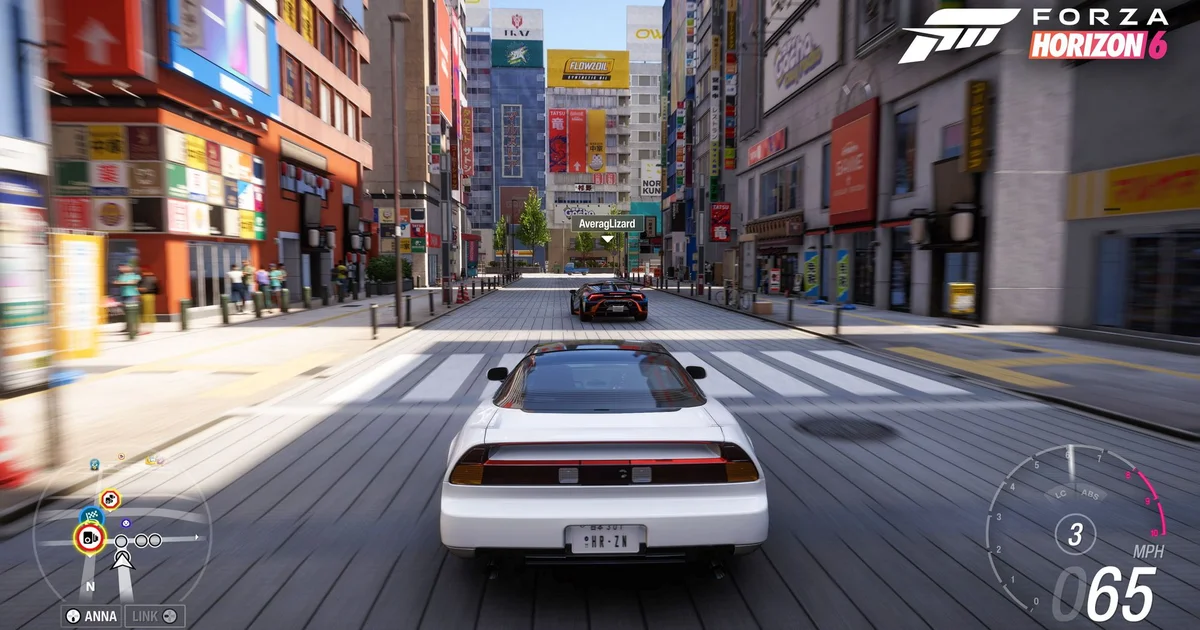
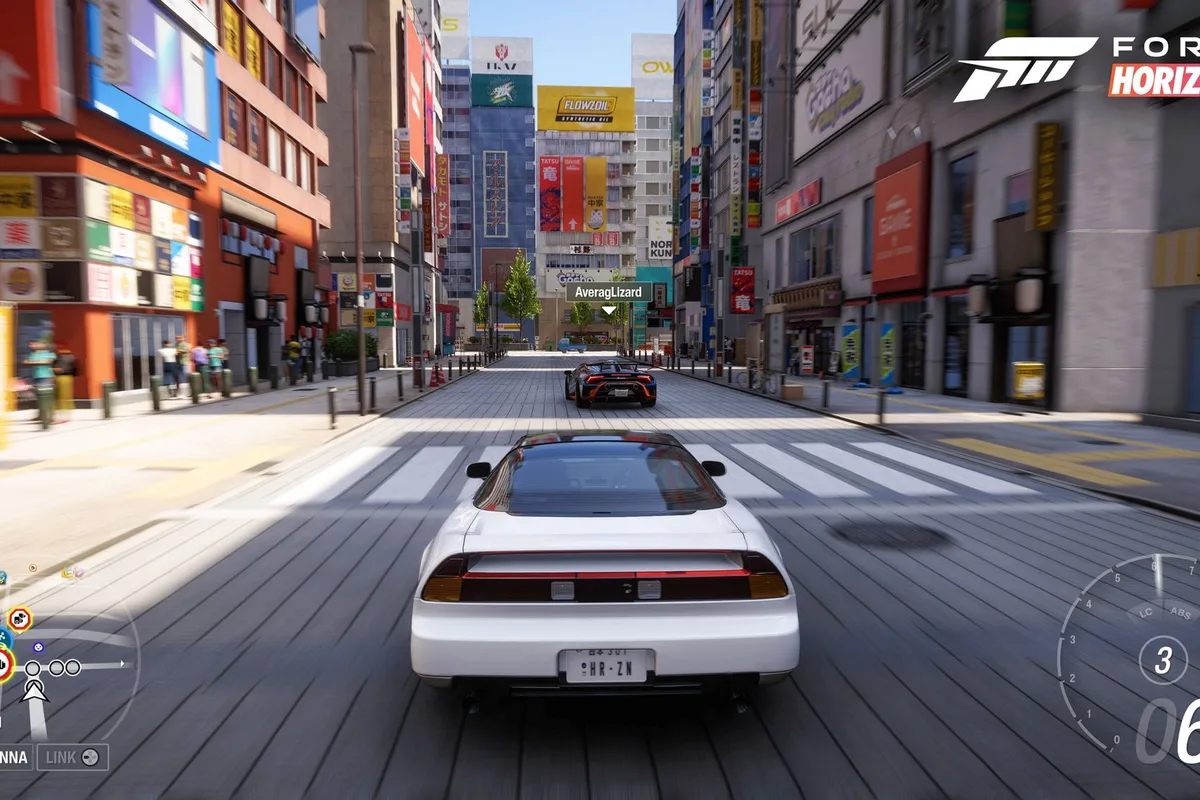
Forza Horizon 6 can cross Tokyo at extreme speed, leave the expressway, stream a dense forest and keep Mount Fuji visible in the distance without the world obviously assembling itself around the car.
Digital Foundry identifies that stability as one of the engine's central strengths.
Series X offers a straightforward choice
Quality mode runs at native 4K and 30fps. Performance mode targets a 4K output using dynamic resolution scaling to maintain 60fps.
IGN and Digital Foundry both report exceptionally stable performance. Detail is reduced in places compared with Quality mode, but the additional responsiveness is an obvious fit for racing.
Series S retains 60fps as well
The smaller console targets 1440p at 30fps in Quality mode and 1080p at 60fps in Performance mode, with dynamic resolution involved.
Clarity and distant detail take larger reductions, but the frame-rate target survives demanding urban and racing scenes.
PC receives the more substantial visual upgrade
Digital Foundry is considerably more excited by the PC ray-tracing suite than by console-side refinements.
RTGI changes indirect lighting across streets, tunnels and natural environments, while ray-traced reflections improve cars, glass and other reflective surfaces.
Those reflections are especially relevant in a game where polished car bodywork occupies so much of the screen.
Console priorities are different
Xbox rendering remains much closer to the established Horizon 5 pipeline during active driving rather than reproducing every PC ray-tracing feature.
The trade makes sense when stable 60fps and long draw distances are priorities.
Streaming is cleaner than before
Technical analysis reports reduced visible pop-in compared with Horizon 5.
That matters in Japan's combination of dense vegetation, highways, urban skylines and mountain views, all of which have to remain convincing at extreme traversal speed.
Audio receives its own technology upgrade
Playground introduces updated acoustic modelling alongside Triton Acoustics, an object-based spatial reverb system.
Engine recordings and surface interaction have also been improved, making tunnels, open roads and enclosed urban spaces respond more distinctly.
PC settings scale extensively
Digital Foundry's PC analysis covers separate controls for car detail, textures, environmental geometry, reflections, global illumination, shadows, terrain deformation, particles and volumetric fog.
This provides useful optimisation room across a broad range of hardware.
The storage requirement is enormous
Steam lists 167GB of available space and requires an SSD. Minimum graphics begin with a GTX 1650, RX 6500 XT or Intel Arc A380 alongside 16GB RAM.
Recommended hardware rises to an RTX 3060 Ti, RX 6700 XT or Arc A580.
The engine's greatest trick is disappearing
Forza Horizon 6 is not a generational revolution on Xbox. Digital Foundry correctly describes many console improvements as refinements.
But an open-world racing engine has an unusual job: maintain geometry, traffic, vegetation, lighting and simulation while the camera crosses the landscape at extraordinary speed.
Playground Games remains exceptionally good at making that difficulty invisible.