
 By Kilam
Dune: Awakening asks Unreal Engine 5 to solve one of its more difficult workloads: continuously stream an enormous environment while the player moves through it at high speed.
An ornithopter therefore functions almost like a benchmark with wings.
Software Lumen and Nanite carry the PC renderer
ComputerBase identifies Unreal Engine 5.2 as the foundation, with Nanite, Software Lumen for lighting and reflections, and Virtual Shadow Maps.
The reviewed PC build does not rely on hardware path tracing.
That makes sense for a persistent environment containing player structures, vehicles and broad sightlines rather than tightly controlled scenes.
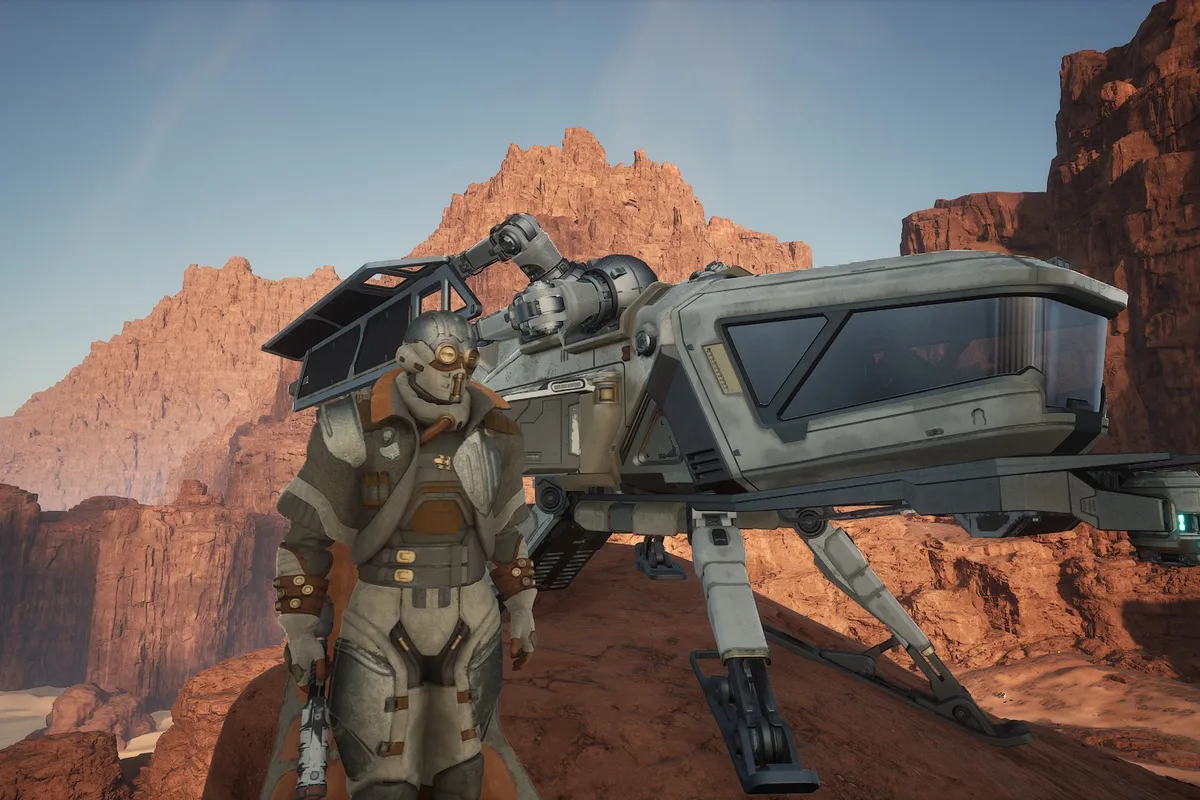
Shader compilation is handled better than many UE5 releases
DSOGaming reports no shader-compilation stutter during its launch analysis.
Traversal hitches do remain as world data is streamed, but avoiding major first-use shader pauses is an important achievement for this engine.
1440p at 60fps already expects capable hardware
Using Quality upscaling, ComputerBase reaches its 2560x1440 60fps threshold around the RTX 4070/5060 Ti and RX 7700 XT/9060 XT class.
3440x1440 pushes the requirement further, while 4K60 moves into RTX 4080/5070 Ti and RX 7900 XTX/9070 XT territory in its tests.
Upscaling is therefore part of the expected rendering budget rather than an optional rescue feature.
DLSS provides the strongest reconstruction
ComputerBase prefers DLSS among the integrated technologies and recommends the newer Transformer model available through Nvidia's application.
The advantage is particularly visible in motion, where desert particles, foliage and distant detail can otherwise become soft or unstable.
XeSS is also a viable alternative, including through its DP4a path on Radeon hardware.
FSR 3.1 is significantly weaker
ComputerBase reports temporal instability, disocclusion artifacts and severe degradation in some particle effects.
The tested version lacks FSR 4, leaving recent Radeon owners with an awkward situation where Intel's XeSS may provide cleaner reconstruction.
Frame generation is useful only after the base frame rate is healthy
Nvidia, AMD and Intel frame-generation technologies are supported, with Multi Frame Generation available on compatible RTX hardware.
DSOGaming records very high numbers on top-end GPUs but also visible ghosting that becomes worse during rapid camera movement.
Generated frames amplify an already good experience. They do not repair a fundamentally slow one.
Launch performance was not universally clean
GameSpot reported enough frame-rate drops, stutter and crashes during launch to publish a dedicated optimisation guide.
Funcom subsequently issued repeated client and server stability patches, and June 2026 patch notes still included additional performance optimisation.
The live build has therefore matured beyond the exact software benchmarked in June 2025.
Scale is more impressive than individual assets
ComputerBase considers the visual quality merely average beside the strongest UE5 releases.
Viewed one texture at a time, that criticism makes sense.
Viewed from an ornithopter crossing player structures, enormous Nanite cliffs, weather systems and networked activity without a loading transition, the technical achievement becomes easier to appreciate.
Console claims still require final testing
PlayStation 5 and Xbox Series X|S launch on September 22, 2026 with Performance and Quality modes.
Funcom says base PS5 will target 60fps in Performance mode using frame generation, while PS5 Pro will target 60fps without generated frames.
Those are official pre-release specifications, not a substitute for independent final-build analysis. This score therefore concerns the released PC version.
The next major build is not live yet either
Version 1.5.1 has entered the Public Test Client and is scheduled to accompany the September release, including full single-player support and broader character-focused changes.
As of August 28, that should not be treated as part of the ordinary live PC experience.
Arrakis is demanding but structurally sound
Dune: Awakening is not the prettiest or lightest Unreal Engine 5 game. High frame rates depend heavily on reconstruction and some traversal hitching remains.
Its technical achievement lies elsewhere: a huge connected world, no major shader-compilation stutter, convincing long-distance traversal and enough scalability to make a complex online survival environment workable across a broad PC range.