
 By Adri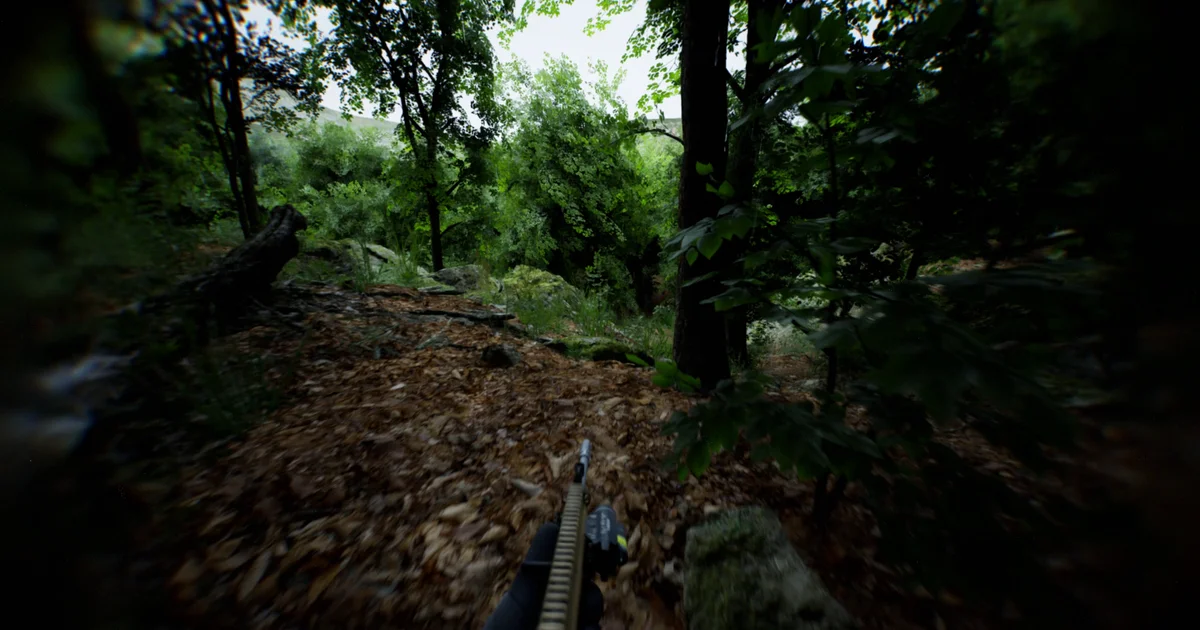
Bodycam is often reduced to photorealism. That description is understandable and slightly misleading.
The technically interesting part is not simply Unreal Engine 5 material quality or lighting. It is how much deliberate imperfection Reissad Studio inserts between the rendered scene and the player.
Chromatic aberration, lens distortion, blown highlights, poor low-light visibility and body-mounted camera movement are all designed to make the image resemble a physical sensor rather than a perfectly clean viewport into a 3D engine.
The photorealism works because the image is allowed to become worse
Many games chase perfect clarity. Bodycam frequently does the opposite.
Bright lights can overwhelm the sensor. Darkness removes useful detail. The edges distort. The camera lacks the supernatural stability of a conventional first-person view.
Those imperfections are why individual scenes can look uncannily close to compressed real-world footage.
The compromise is immediate: the same choice that strengthens the illusion can damage competitive readability. An enemy genuinely disappearing into darkness is both an aesthetic success and a possible gameplay problem.
True Body matters more than another shader
Locked & Loaded formalizes the physical side through Reissad's True Body technology. Arms, torso, legs and weapon behave as a more coherent connected operator.
The gun therefore does not simply float in front of the camera. It carries inertia relative to where the player is looking.
Procedural reload behavior extends that approach, with calm and stressed states designed to make weapon manipulation less perfectly repeatable.
The boundary between simulation and frustration remains thin, but technically it is far more interesting than adding another layer of surface detail.
Audio has become another simulation layer
Reissad has also rebuilt much of the audio technology around propagation, occlusion, reverb and spatial positioning.
That matters because a game that intentionally hides visual information needs sound to provide reliable alternatives.
Launch coverage already praised the frightening force of Bodycam's gunfire. The current system aims to make that force more spatially informative as well.
The GPU is still doing serious work
Steam currently recommends an RTX 3060 with 12 GB of VRAM or Radeon RX 6600 XT with 8 GB alongside 16 GB of system memory.
Those specifications cannot describe every workload. Dense environments, dynamic lighting and camera processing produce noticeable variation depending on map, resolution and chosen settings.
Recent versions broaden upscaling and frame-generation support, which can substantially improve output on compatible modern hardware.
The flip side is that the most convincing version of Bodycam remains expensive to render.
Trenches demonstrates a better use of scale
The Trenches map is useful technically because it moves beyond the small-room photorealism that defined many early impressions.
Tight trench networks create close-range combat while surrounding open ground introduces longer sightlines.
That contrast stresses lighting, visibility and physical movement in different ways and gives the rendering technology more than interior detail to show off.
Networking remains the less glamorous weak link
The multiplayer backend still attracts criticism around host quality and inconsistent sessions.
Reissad also had to patch a networking vulnerability shortly after Locked & Loaded that allowed a malicious session host to crash connected clients. The studio says it fixed the confirmed issue in under 24 hours and found no evidence that it could be escalated into remote code execution.
The response was appropriately fast. The incident still underlines that Bodycam's networking stack belongs to an evolving Early Access product.
The technology is becoming a system rather than a showcase
The difference from 2024 is substantial. Early critics had reasonable grounds to describe Bodycam as extraordinary rendering surrounding a thin game.
In 2026, the technologies around the image are finally connecting: physical body simulation, weapons, audio, optics, drones, progression, customization and the in-world hub.
The next challenge is less spectacular than another trailer.
Bodycam needs optimization and infrastructure strong enough that players stop thinking about the engine while they are playing.