
 By Kilam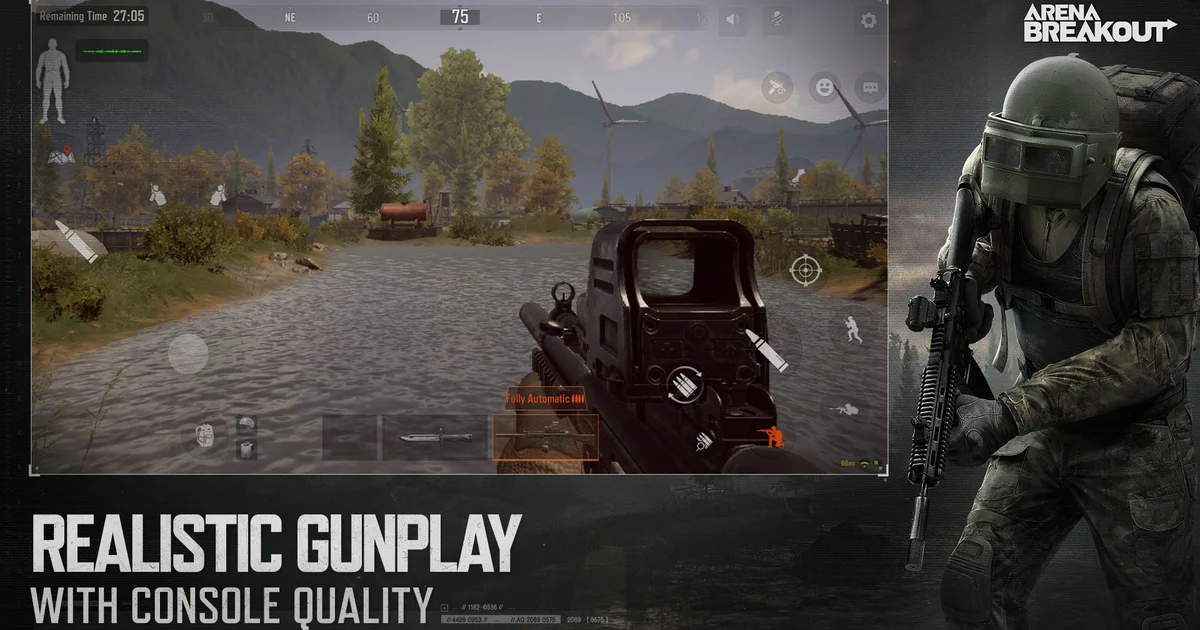
Unreal Engine 4, not 5, pushed unusually far
Arena Breakout is occasionally described by secondary sources as an Unreal Engine 5 game. MoreFun's own GDC technical presentation is more useful: the mobile title is built on Unreal Engine 4.26. That older foundation has not stopped the studio from constructing a surprisingly ambitious rendering stack around it.
The official site highlights real-time dynamic rendering, changing light and shadow and volumetric-cloud technology. These effects serve more than presentation. Dark interiors, bright windows, vegetation and fog all affect visibility in a shooter where spotting a silhouette first can determine the outcome of an entire raid.
Marketing material uses the phrase “console quality”, which cannot describe every configuration in a fragmented mobile market. On capable hardware, however, the amount of geometry, material detail and atmospheric rendering is impressive for an online FPS simultaneously handling players, AI, inventory and ballistic systems.
MoreFun even brought hardware ray tracing to Android
The GDC presentation details a Vulkan Ray Query implementation for supported Android hardware. Reflections, ambient occlusion and soft shadows can use ray-tracing techniques on devices capable of providing the necessary GPU features.
The qualification is essential. This is a high-end path for compatible devices, not an identical mode available across every Android phone. MoreFun's technical presentation discusses maintaining a 60 fps target in large open environments on its tested hardware; that is evidence of the optimisation target, not a universal performance guarantee.
That scalability is more interesting than the ray-tracing label itself. Arena Breakout has to reduce its workload enough for a broad audience while still exposing substantially more advanced rendering paths on recent mobile GPUs.
Fragmentation is the real performance battle
A console developer targets a small number of fixed configurations. Android players can differ in GPU architecture, driver, display refresh rate, thermal envelope and operating-system version. iOS narrows the hardware spread but still adds another set of devices and software revisions.
Arena Breakout consequently offers multiple graphics and frame-rate profiles rather than one fixed presentation. Earlier GLPC testing noted that the game remained visually convincing even at reduced settings, which is arguably more important on mobile than producing one spectacular maximum preset.
Recent user feedback visible on Google Play and the App Store also illustrates the other side of that ambition. Some device-specific reports mention frame drops, freezes or high-refresh modes behaving differently after updates. These anecdotes cannot establish one universal performance problem, but they show why a seasonal mobile live service cannot guarantee identical behaviour across every handset.
More than 1,200 sounds also function as interface technology
MoreFun advertises over 1,200 sound effects. In a tactical shooter, that library is not merely an audio specification. Direction, distance and the approximate type of a sound provide information every bit as valuable as additional visual detail.
Arena Breakout supplements positional audio with visual indicators for certain sounds. It is a revealing mobile compromise: rather than assuming headphones in a controlled environment, part of the acoustic space is translated into graphical information.
The cost is screen density. Minimap, body condition, ammunition, stance, interaction, inventory, firing controls, movement and visual sound cues all compete for display space that is also partially covered by the player's thumbs.
Touch ergonomics remain the least glamorous bottleneck
That may be the game's most persistent technical limitation. An extraction FPS asks players to aim precisely while managing inventory, healing, reloading, posture and multiple contextual actions. The HUD can be heavily customised, but configuring it effectively requires understanding the game before the interface feels natural.
The current US App Store listing shows a 3.9 GB application size. That figure does not necessarily represent every post-install resource used by the live service, but it underlines another constraint of ambitious mobile software: storage, downloads and seasonal updates are part of the hardware experience too.
Arena Breakout is therefore an excellent technical showcase partly because it exposes the contradictions of high-end mobile gaming. Its renderer can deploy features once associated with PCs, yet the experience a player actually receives remains far more dependent on individual hardware than any promotional screenshot can show.