
 By Adri
The ETF has brought a new kind of buyer
Grayscale launched the Zcash ETF on NYSE Arca on August 25 under the existing ZCSH ticker, converting its previous trust structure.
The practical difference is straightforward. Investors can gain exposure to ZEC through a conventional brokerage account rather than buying the cryptocurrency and managing custody themselves.
By September 4, Grayscale data cited by The Block showed at least $34.4 million of net inflows.
September 2 was the strongest individual session so far, with $12.6 million coming into the product.
ZEC moved much faster than the ETF flows
The token climbed to $1,023 on September 4, roughly 94 percent higher over the preceding month and close to a $17 billion market capitalization at that point.
It had been around $200 in March.
That scale difference is worth keeping in mind. Tens of millions of dollars entering ZCSH are meaningful new demand, but they are not enough by themselves to explain every dollar added to Zcash's market value.
Crypto markets can move disproportionately when liquidity thins, momentum traders enter and leveraged short positions are forced to close.
The price rally is now showing up in physical infrastructure
Zcash still relies on Equihash proof-of-work mining, so a more valuable block reward attracts computing equipment.
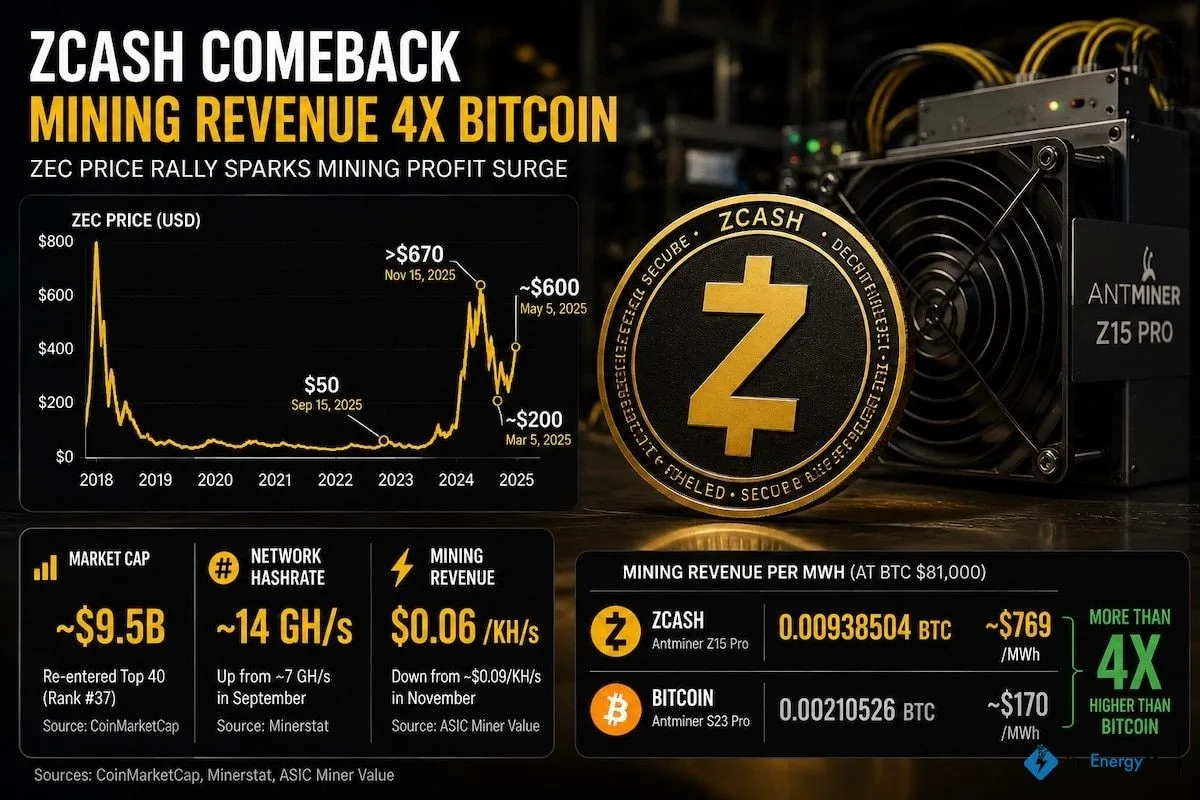
The Block reported Zcash network compute rising from roughly 25 GSol/s in late August to briefly above 30 GSol/s.
CoinWarz estimates are somewhat lower depending on the observation window: 25.9 GH/s on September 4 and roughly 27.1 GH/s on September 5 and 6.
Both datasets point in the same direction. CoinWarz recorded about 17.7 GH/s on July 1.
More miners are already diluting the economics
A rising ZEC price does not give every miner an equal windfall.
As more hashrate joins, difficulty and competition distribute block rewards across a larger amount of hardware.
An analysis from TheEnergyMag cited by The Block estimated an Antminer Z15 Pro at roughly $708 of gross revenue per MWh in early September.
That was around 3 percent below an estimated $727 per MWh on August 24, when ZEC itself was trading below $900.
The coin got more expensive while that specific revenue metric slipped.
ZCSH wraps a privacy-focused asset in a conventional security
That contrast is part of what makes this launch unusual.
Zcash supports transparent transactions as well as shielded transfers using zero-knowledge proofs, allowing transaction information to remain private under supported conditions.
An ETF investor does not receive those privacy properties. ZCSH is a regulated security designed to provide price exposure while Grayscale handles the underlying asset and custody structure.
The privacy technology becomes an investment thesis rather than something the ETF holder directly uses.
Zcash also changed underneath the market this summer
On July 28, the network activated its Ironwood NU6.3 upgrade at block height 3,428,143.
Ironwood introduced a new shielded pool following a soundness vulnerability discovered in Orchard earlier in the year.
The older Orchard pool is now restricted, and funds leaving it pass through a turnstile mechanism before entering Ironwood.
The project says the new pool is designed to make circulating-supply integrity independently verifiable while retaining shielded transactions.
The next test is whether capital and hashrate keep moving together
Zcash now has three strong variables moving at once: ETF inflows, a sharp token rally and substantially more mining capacity.
They do not have to remain synchronized.
ETF demand can slow and market prices can reverse far faster than miners can reorganize deployed hardware. Difficulty will continue adjusting to whatever compute remains online.
CoinWarz still estimated about 27.1 GH/s on the network on September 6, close to the recent high recorded in late August.