
 By Tsuky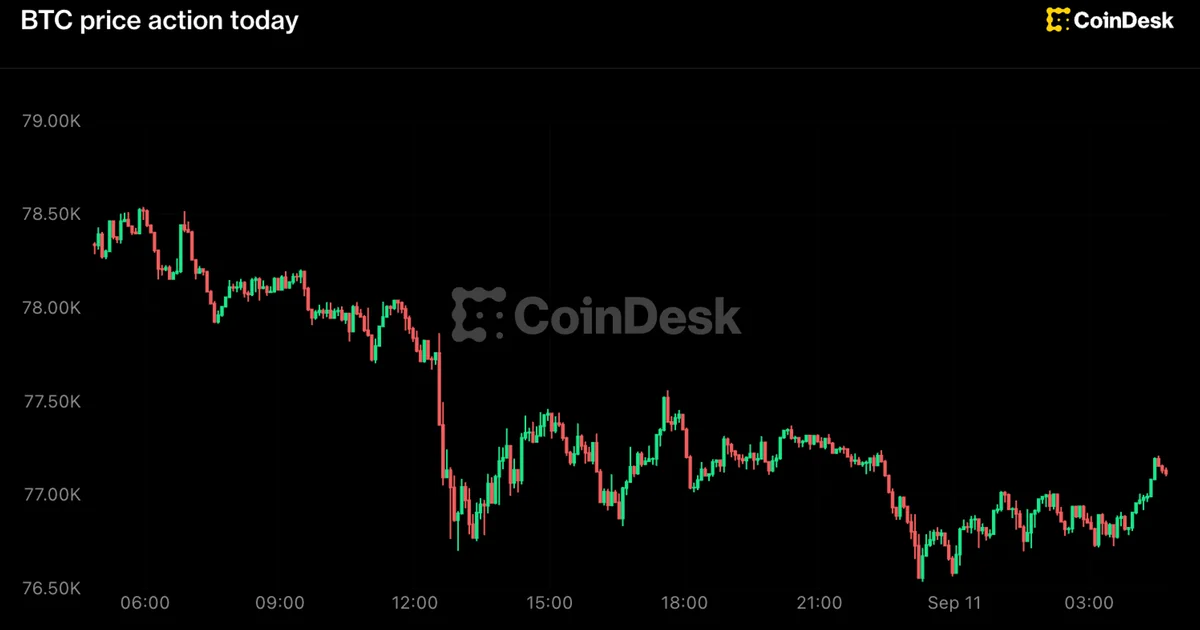
Bitcoin is ending the week in a much weaker position than it started. The cryptocurrency briefly traded below $77,000 before recovering toward $77,300, leaving it down more than 5% over the week.
Much of the broader crypto market did worse. During the selloff, the CoinDesk 20 lost roughly 3%, while 95 of the 100 assets in the CoinDesk 100 traded lower.
The Fed is back in the middle of the Bitcoin trade
The main pressure is coming from the US macro picture. Consumer prices rose 0.4% in August and 3.4% from a year earlier. Core inflation, excluding food and energy, increased 0.3% for the month.
Bond markets reacted quickly. The US 10-year Treasury yield pushed close to 5% as traders increased their expectations that the Federal Reserve will raise interest rates at its next meeting.
By Friday, markets were assigning close to a 90% probability to a quarter-point increase.
Five-percent government bonds are real competition
That matters because Bitcoin does not generate income. When relatively low-risk US government debt offers yields close to 5%, holding a highly volatile asset becomes a more difficult proposition for investors who can simply earn interest elsewhere.
Higher rates also make leverage more expensive, an important factor in a crypto market where futures, borrowing and leveraged positions remain deeply embedded in trading activity.
There is an awkward irony here. Bitcoin is frequently marketed as protection against monetary debasement, yet rising inflation can initially hurt its price when that inflation forces central banks toward tighter policy.
Spot Bitcoin ETFs have turned into a headwind
US spot Bitcoin ETF flows have also weakened. Farside Investors recorded net outflows of about $46.6 million on September 8, $120.2 million on September 9 and $282.7 million on September 10.
That adds up to almost $450 million leaving the funds in three trading sessions.
The scale still needs context. Cumulative net inflows into US spot Bitcoin ETFs remain above $55 billion. Three negative sessions do not amount to an institutional exit, but they do show that the ETF channel can amplify selling pressure just as easily as it supported demand during stronger periods.
Oil is making the inflation problem worse
Energy prices are another complication. Brent crude moved above $100 a barrel amid escalating Middle East tensions, reinforcing inflation concerns and making an easier Federal Reserve policy harder to justify.
Bitcoin is therefore trading as part of a much broader repricing of money rather than suffering from a crisis unique to crypto. Bonds, equities and currencies are responding to many of the same forces.
The $76,270 area is now worth watching
Crypto traders are focusing on roughly $76,270 as an important technical support area that has held since Bitcoin's August rally. The latest selloff brought the price close without producing a sustained break below it.
A stabilization in Treasury yields could give Bitcoin some breathing room. A more aggressive Fed would put that support back under pressure very quickly.
For now, Bitcoin remains around $77,000. With the US 10-year yield flirting with 5%, that level is being defended in a very different macro environment.