
 By Adri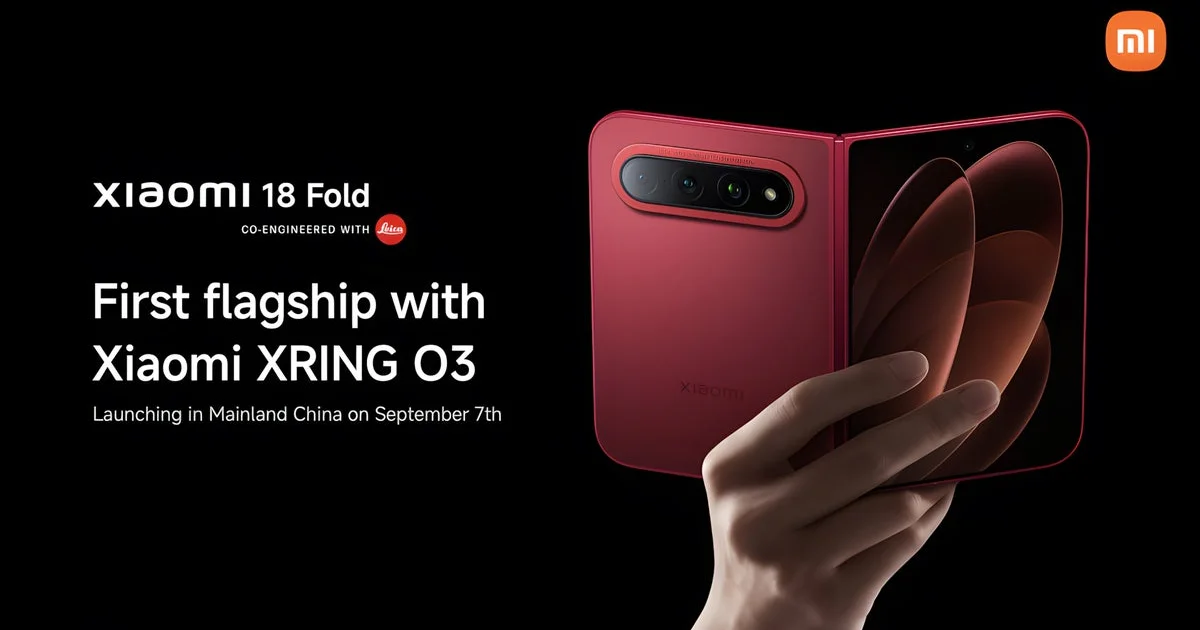
Xiaomi unveiled the 18 Fold in China on September 7, deliberately placing its launch in the middle of an unusually crowded week for foldable phones.
Its shape is the first thing that separates it from Xiaomi's older book-style designs. The company calls this a “mid-fold”: shorter and wider when closed, with proportions closer to a passport than a conventional tall smartphone.
Folded dimensions are 117.8 by 83.6mm at 10.68mm thick. Open it and the chassis falls to 5.02mm. Weight is 219g.
A 5.38-inch phone turns into a 7.58-inch tablet
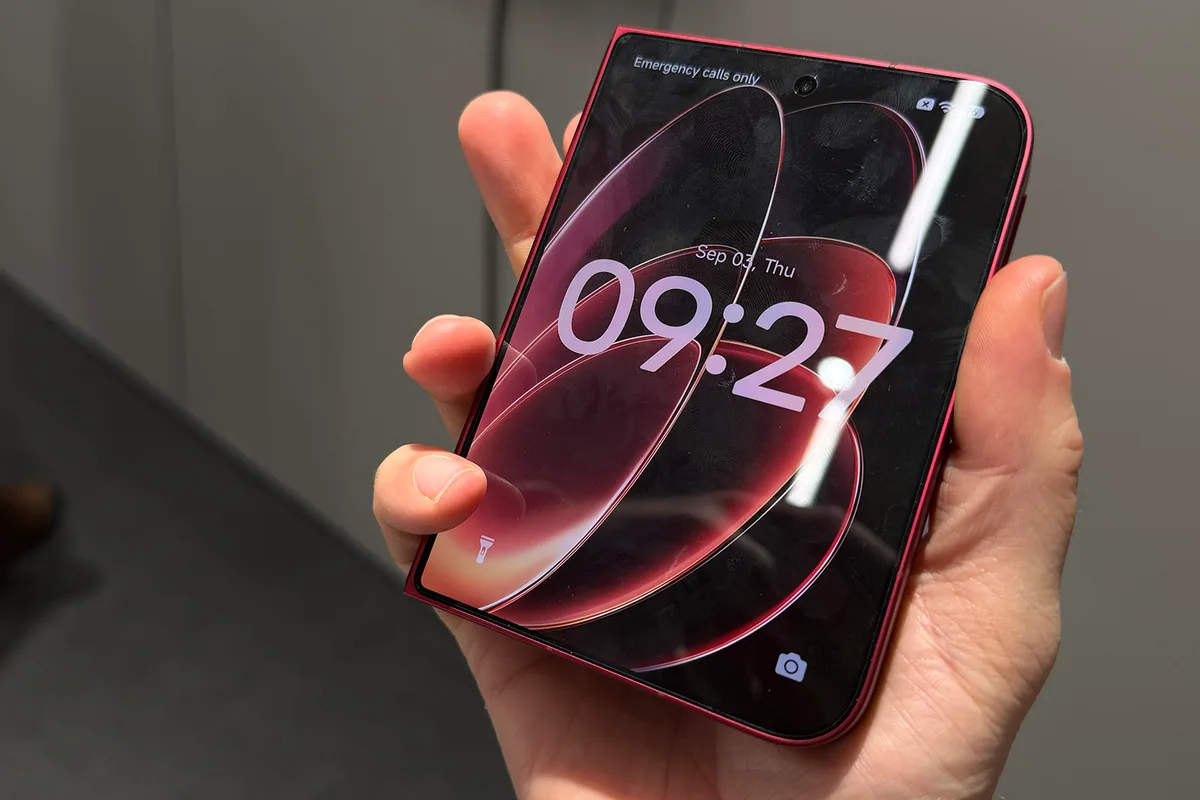
The outer OLED measures 5.38 inches, while the folding panel reaches 7.58 inches.
Both use an aspect ratio close to √2:1, mirroring the proportions of standard A-series paper. Xiaomi's rationale is practical: documents, photos and split-screen apps gain useful horizontal space without turning the closed phone into an excessively tall remote control.
Both displays support 1-120Hz LTPO refresh rates, and Xiaomi quotes peak brightness of up to 4,000 nits under specific conditions.
The battery is the specification rivals will have to explain
Capacity is 6,000mAh.
That is unusually large for a foldable this compact. Xiaomi uses a silicon-carbon battery with high silicon content and claims energy density reaching 920Wh/L.
Charging is rated at 67W wired and 50W wireless.
None of this automatically guarantees class-leading endurance. A large folding OLED and a high-performance SoC still have plenty of ways to consume 6,000mAh. Independent battery testing will matter more than the capacity number alone.
What the number does prove is that manufacturers no longer have much room to argue that a large battery simply cannot fit inside a premium foldable.
XRING O3 moves Xiaomi's chip strategy into its most ambitious phone
The 18 Fold is Xiaomi's first flagship smartphone built around XRING O3, the company's second-generation in-house mobile SoC.
It is manufactured on a 3nm process and contains roughly 24 billion transistors. The design combines a ten-core CPU with a 16-core Arm Mali G2-Ultra NX GPU.
Xiaomi claims roughly 60% greater performance while using 25% less power than its previous generation. Those are vendor figures and should remain vendor figures until broader independent testing arrives.
The GPU is particularly relevant because Arm is introducing neural-rendering features with this generation, including AI-assisted super sampling. The basic objective will be familiar to PC gamers: render less work natively, reconstruct the image intelligently and trade that saved workload for higher frame rates or better visual quality.
LPDDR6 is here, with an asterisk
The highest-capacity versions also make the 18 Fold an early showcase for CXMT's LPDDR6 memory.
Only the 1TB configurations receive LPDDR6. Lower-storage models continue with LPDDR5X.
That detail matters beyond memory bandwidth. Xiaomi is increasingly using flagship hardware to demonstrate a more vertically integrated supply chain: its own application processor, Chinese high-end DRAM and its own HyperOS software layer.
The phone is not remotely made from Xiaomi-controlled components end to end. The direction is still obvious.
Xiaomi did not sacrifice the telephoto camera to make the hinge fit
Foldables have traditionally compromised on cameras because optical modules compete for exactly the same internal volume demanded by batteries and hinge hardware.
The 18 Fold carries a Leica-branded triple rear system instead.
- 200MP optically stabilized main camera.
- 50MP periscope telephoto around an 80mm equivalent with 3.5x optical zoom.
- 50MP ultrawide camera.
The telephoto can extend toward a 160mm equivalent through in-sensor cropping before relying entirely on conventional digital enlargement.
The 200MP headline will attract attention, but the periscope may be the more meaningful hardware decision. Xiaomi is treating the Fold as a camera flagship rather than a device that receives whatever modules fit after the folding mechanism is finished.
The catch is availability
Chinese pricing begins at RMB 10,999 for 12GB of RAM and 256GB of storage.
The 512GB model costs RMB 11,999, the 16GB/512GB configuration is RMB 12,999, and 16GB/1TB with LPDDR6 reaches RMB 14,999. The Ceramic Special Edition tops the range at RMB 15,999.
Sales began in China on September 10.
Xiaomi has not confirmed a European or North American launch.
That leaves the 18 Fold in a slightly absurd position internationally. It is useful evidence that a foldable can carry a 6,000mAh battery, a periscope camera and flagship silicon without becoming a brick, but most buyers outside China cannot officially purchase the evidence.
The hinge is becoming a weaker excuse for weaker hardware
Early foldables trained buyers to accept smaller batteries, compromised camera systems and enormous prices because the hinge and flexible display consumed so much engineering space.
The Xiaomi 18 Fold is not compromise-free. It is thicker when closed than some rivals, the crease remains visible in certain lighting, and its market reach is extremely limited.
Still, the hardware baseline has moved.
Six thousand milliamp-hours fit inside 219 grams. A periscope fits beside a 200MP main camera. A 3nm in-house SoC fits in the same product.
Premium foldables can keep making compromises. They are going to have to get better at explaining them.