
 By Camille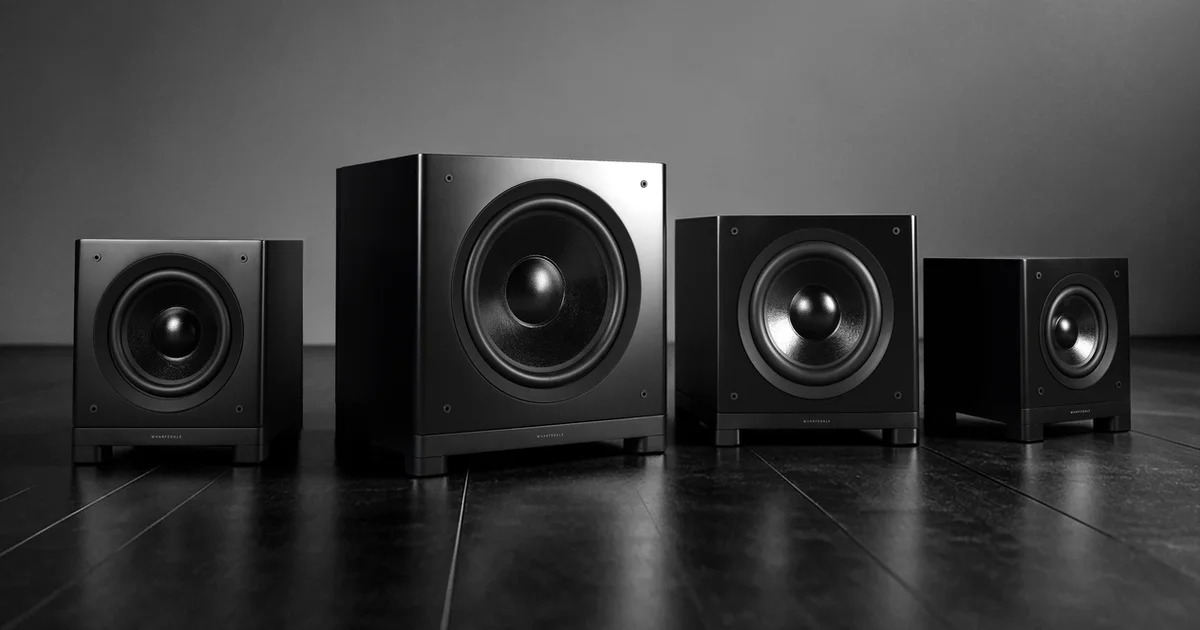
Four sizes cover very different rooms
The family consists of Nova 8, Nova 10, Nova 12 and Nova 15. The number identifies the diameter of the active bass driver in inches.
Wharfedale positions Nova 8 for smaller rooms and compact stereo systems, Nova 10 for medium-sized spaces, and the larger models for systems that need greater low-frequency scale and dynamic headroom.
Even the smallest version is substantial at 348 x 320 x 361mm and 16.3kg. Nova 15 grows to 549 x 540 x 607mm and weighs 47.8kg.
At that point, choosing a subwoofer position before lifting the cabinet into place becomes part of the setup process.
The reflex port is replaced by a passive radiator
The common acoustic feature across all four models is what they do not have: a conventional bass-reflex port.
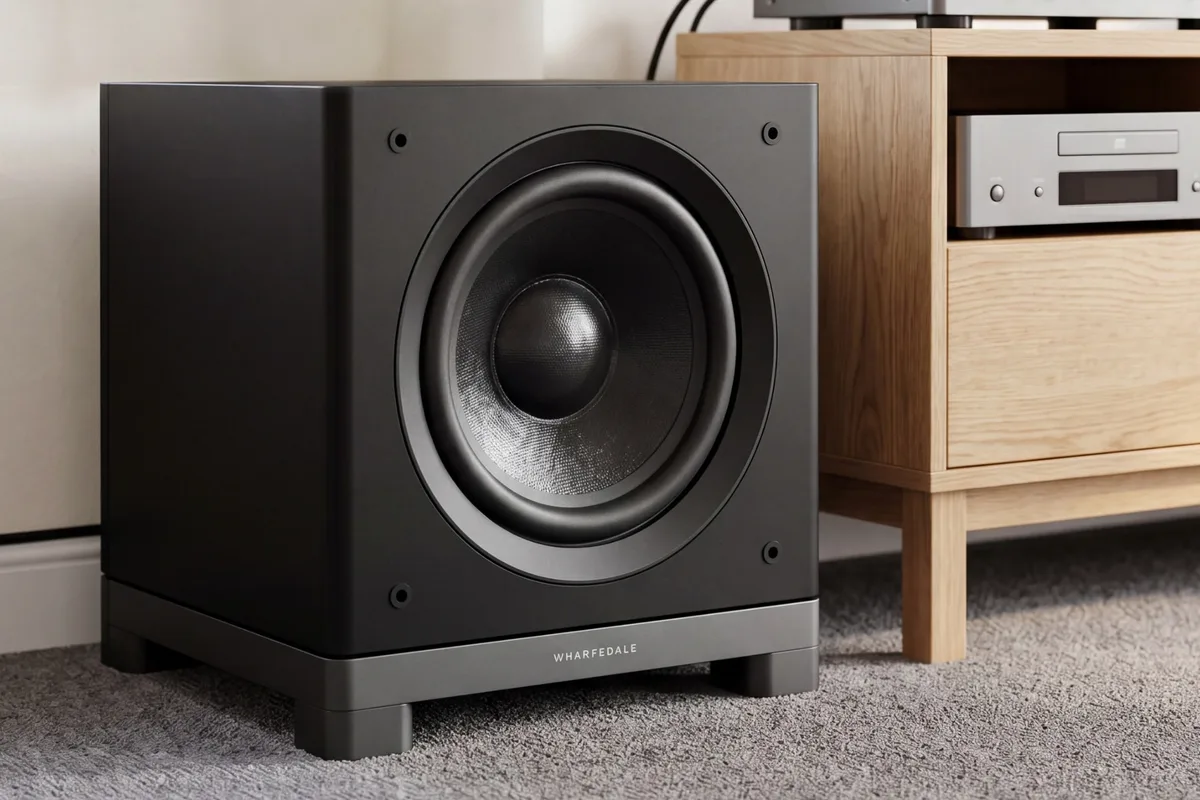
Instead, each Nova uses a downward-firing, mass-loaded Auxiliary Bass Radiator. The passive diaphragm is not electrically driven; pressure changes inside the cabinet make it move in response to the active woofer.
Its purpose is broadly similar to a reflex port, extending low-frequency output by using the energy inside the enclosure.
Wharfedale says the ABR approach helps avoid port turbulence, chuffing, compression and unwanted resonances while combining some of the speed associated with a sealed cabinet with the scale of a larger reflex design.
Nova 8 uses a passive radiator larger than its active driver
The compact model has an unusual detail. Its active woofer measures 8 inches, while the downward-firing passive radiator is 10 inches.
Nova 8 is rated to 33Hz at -6dB and uses a 200W nominal Class D amplifier with a 500W peak rating.
Nova 10 reaches a quoted 29Hz with 230W nominal amplification. Nova 12 reaches 28Hz with 280W, while Nova 15 is also rated to 28Hz but increases nominal power to 360W and brings a much larger radiating area.
That is a useful reminder that extension alone is not the whole purpose of a larger subwoofer. The 15-inch model is primarily about producing more output and dynamic scale with less mechanical strain.
Wharfedale deliberately sticks with coated paper cones
The active drivers use lightweight paper cones with a proprietary coating rather than a more exotic composite material.
Wharfedale says the design combines low moving mass with stiffness and useful self-damping.
A large-diameter voice coil improves power handling, while an aluminum shorting ring in the motor is intended to improve linearity and reduce distortion.
The die-cast chassis, oversized surround and high-excursion motor are all designed around substantial linear movement without losing mechanical stability.
Dynamic EQ changes its priorities with volume
Every model combines its Class D amplifier with DSP developed as part of the overall acoustic system.
At lower listening levels, the dynamic EQ is designed to preserve perceived bass weight and extension, where human hearing becomes less sensitive to very low frequencies.
At higher levels, the processing changes priorities and manages driver excursion to prevent the woofer from being pushed beyond its clean operating range.
That is more useful than a single fixed bass boost. A subwoofer operating quietly and one approaching cinema-level output are dealing with very different physical limits.
Music and movie use are treated differently
Wharfedale includes DSP-controlled operating modes aimed at stereo music and home cinema.
Music mode focuses on controlled integration with the main speakers rather than obvious low-frequency spectacle.
Movie mode allows a more forceful presentation suited to the dedicated LFE channel and large soundtrack effects.
The distinction matters because a setting that makes an explosion exciting can make a bass guitar sound bloated if the same emphasis is left in place for everything.
Physical controls remain part of the design
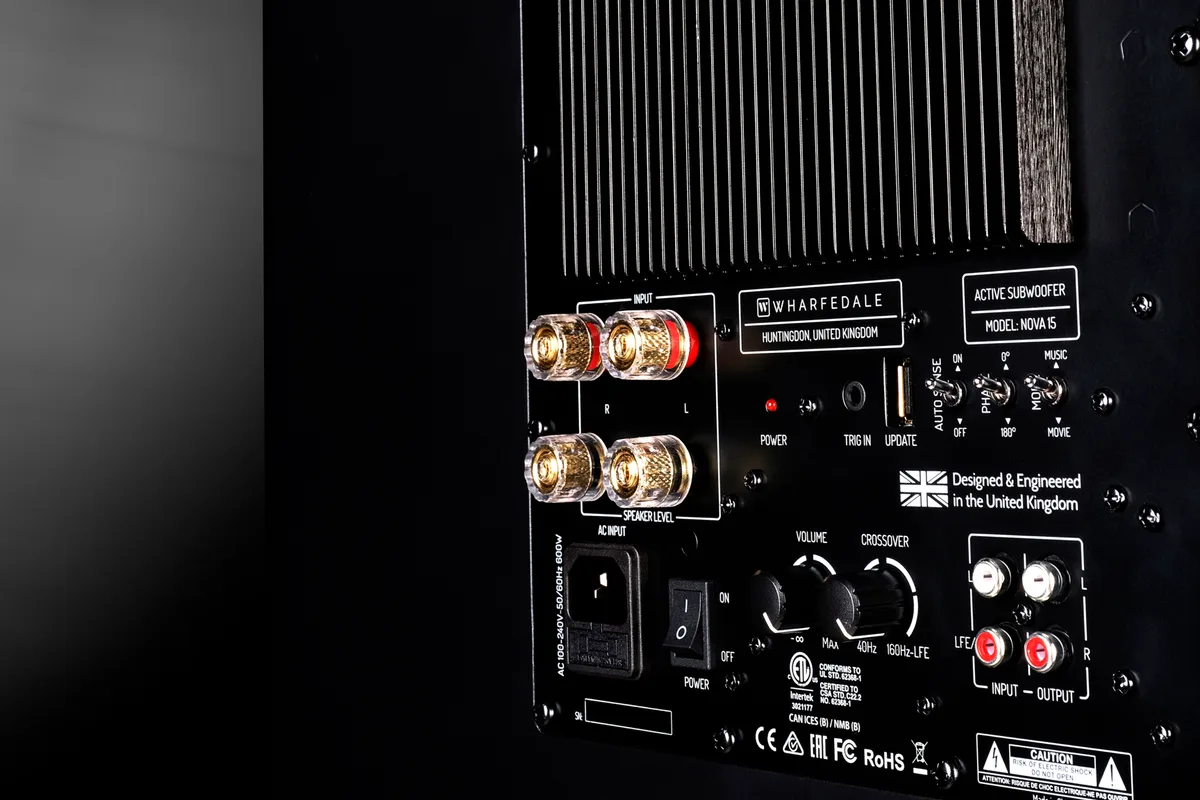
Level, crossover and phase can be adjusted to match the subwoofer to the main speakers and the room.
The crossover range runs from 40Hz to 160Hz across the series.
Connectivity includes stereo RCA line inputs with LFE support as well as speaker-level inputs on binding posts. That allows the Nova models to work with AV receivers and with stereo amplifiers that do not provide a dedicated subwoofer output.
Stereo line outputs, a 12V trigger and USB for firmware updates are also provided.
US pricing is notably higher than the UK list
UK pricing starts at £799 for Nova 8, followed by £899 for Nova 10, £1,099 for Nova 12 and £1,299 for Nova 15.
Wharfedale's current US store lists the same models at $1,099, $1,299, $1,599 and $1,999 respectively.
Some early press coverage quoted slightly lower US prices for the two smaller versions. Wharfedale USA's own live product pages currently show $1,099 and $1,299, making those the more up-to-date figures.
The series is scheduled for late-September availability and comes in matte black.
The best subwoofer should not sound like a separate speaker
The more interesting part of Wharfedale's messaging is not the maximum output. The company repeatedly describes the subwoofer as something that should extend the existing system rather than announce its physical location.
That is particularly important with music. A correctly integrated double bass should not suddenly sound as though it lives in a black box next to the sofa.
Passive radiators, DSP and phase controls do not guarantee that result. Placement and calibration in the room remain critical.
At least Nova is built around the right problem. Making a large woofer produce a lot of bass is straightforward. Making that bass arrive with enough control that the rest of the system still sounds like itself is the harder job.