
 By Adri
WARDOGS entered Steam Early Access on September 10.
Steam lists 50GB of available storage as the requirement, while the pre-launch download was approximately 41.7GB.
Both minimum and recommended configurations call for 16GB of system memory.
The minimum target is 1080p60
BULKHEAD lists an Intel Core i5-8600 or AMD Ryzen 5 3500 as the minimum CPU.
Graphics start at a GeForce GTX 1660 or Radeon RX 590.
That configuration is intended for 1080p Low at 60 fps using upscaling.
The recommended tier moves to a Core i7-12700K or Ryzen 7 5700X with an RTX 3070 or RX 6700 XT.
BULKHEAD targets more than 70 fps at native 1440p Medium or more than 60 fps at upscaled 4K Medium on that hardware.
The heavier stress test is happening outside the GPU
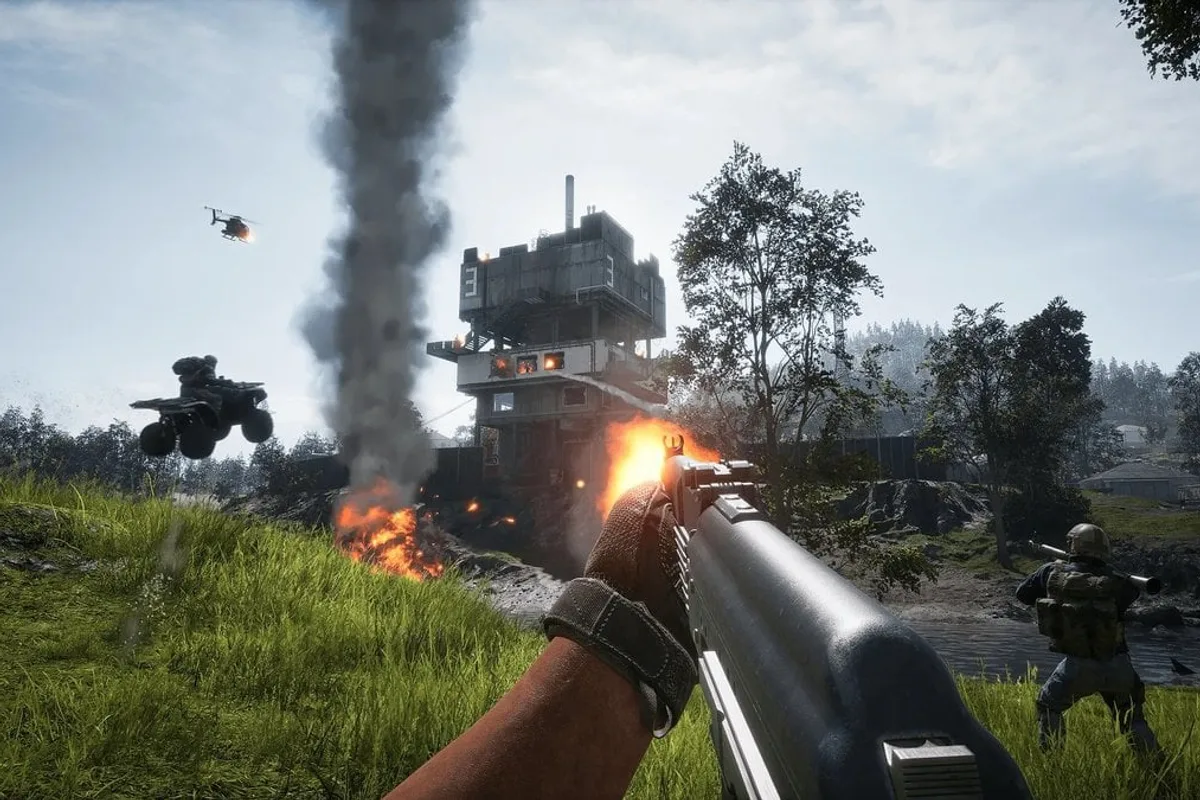
A WARDOGS match can involve up to 100 players divided across three factions.
The backend has to support those players alongside vehicles, changing objectives, construction, destructible positions, spawn infrastructure and an individual economy.
During pre-release testing, the most visible pressure appeared around login capacity, queues and server availability rather than purely graphical performance.
BULKHEAD explicitly asked players to overwhelm its backend before launch so it could expose failures under conditions much larger than its internal testing.
The studio planned for 5,000 concurrents, then saw 200,000
CEO Joe Brammer has said BULKHEAD originally planned around roughly 5,000 concurrent players.
The closed beta exceeded 200,000.
That gap is a meaningful engineering problem.
Systems that behave predictably with a few thousand active users can expose completely different bottlenecks once authentication, matchmaking and server requests increase by orders of magnitude.
The studio encountered overloaded login queues and connection issues during testing and used those events to make changes before Early Access.
The battlefield itself is unusually state-heavy
WARDOGS also asks its servers to keep track of more than a fixed deathmatch arena.
Players build Forward Operating Bases and battlefield structures. Those structures can be destroyed. Vehicles serve as transport systems and mobile combat assets. The active Control Zone moves within a larger map.
Meanwhile, useful actions feed into an economy that rewards individual players for support work as well as kills.
That means a match is continuously maintaining a large collection of interacting state rather than only positions, projectiles and a scoreboard.
The internal economy is intentionally disconnected from real-money currency sales
BULKHEAD has also committed to keeping its game economy separate from direct cash purchases.
The developer says players will never be able to purchase in-game cash or gold bars with real money.
Progression camos will not be sold directly either.
During Early Access, the only planned monetization beyond the base game is an optional Supporter Pack containing a fixed selection of cosmetics.
That removes one common pressure from the balancing problem: the in-game economy does not also need to operate as a store funnel.
Steam is the laboratory before 2028
WARDOGS is currently a PC-only Early Access release.
BULKHEAD says console versions are planned for 2028.
That gives the studio a long period in which Steam players can expose balance problems, performance bottlenecks and backend limits before the audience expands again.
In this case, Early Access is not just about adding maps and weapons.
It is an opportunity to discover what the entire technical stack looks like when a multiplayer game designed to survive with a modest community suddenly attracts hundreds of thousands of people.
WARDOGS has already found the demand.
Now BULKHEAD has to scale everything underneath it.