
 By Camille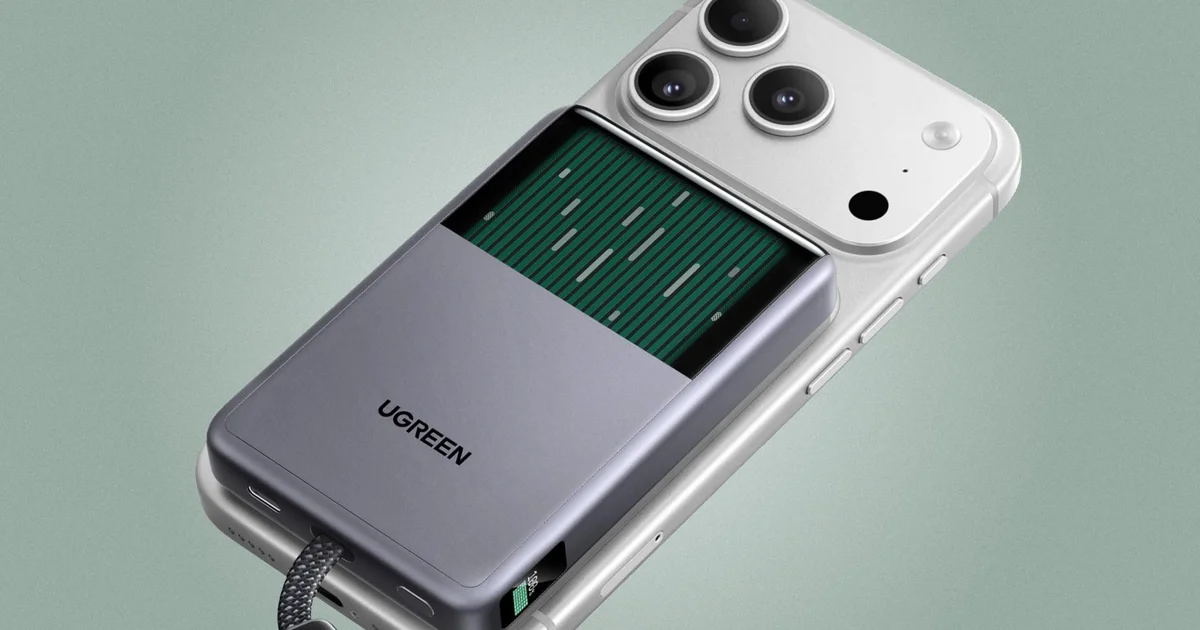
This is a shipping 10,000mAh battery, not a show-floor experiment
UGREEN introduced the MagFlow Pro Magnetic Power Bank at IFA 2026 as the first Qi2 25W magnetic battery with active micro-pump liquid cooling.
It went on sale alongside the announcement.
European launch pricing was announced at €119.99, while US pricing is $149.99.
That is extremely expensive for a 10,000mAh power bank.
The product therefore lives or dies on whether active cooling solves a problem that passive 25W magnetic batteries cannot solve as consistently.
Wireless charging turns part of its power into heat
A USB-C cable transfers energy through direct electrical conductors.
Wireless charging couples two coils through a magnetic field and introduces additional conversion and alignment losses.
As charging power rises, those losses become increasingly important.
UGREEN points out that moving from 15W to 25W represents nearly 70% more wireless power.
That does not translate directly into 70% more heat because efficiency varies, but it makes thermal management much harder to ignore.
CryoPulse is a genuine miniature liquid loop
UGREEN calls the cooling architecture CryoPulse.
A micro-pump continuously circulates coolant through internal channels to move heat away from critical charging components.
Copper heat-spreading foil distributes localized hotspots across a larger area.
The charging components themselves are physically separated to reduce heat concentration.
A transparent section on the front exposes part of the liquid circuit.
Small green sections of coolant can actually be seen moving while the system operates.
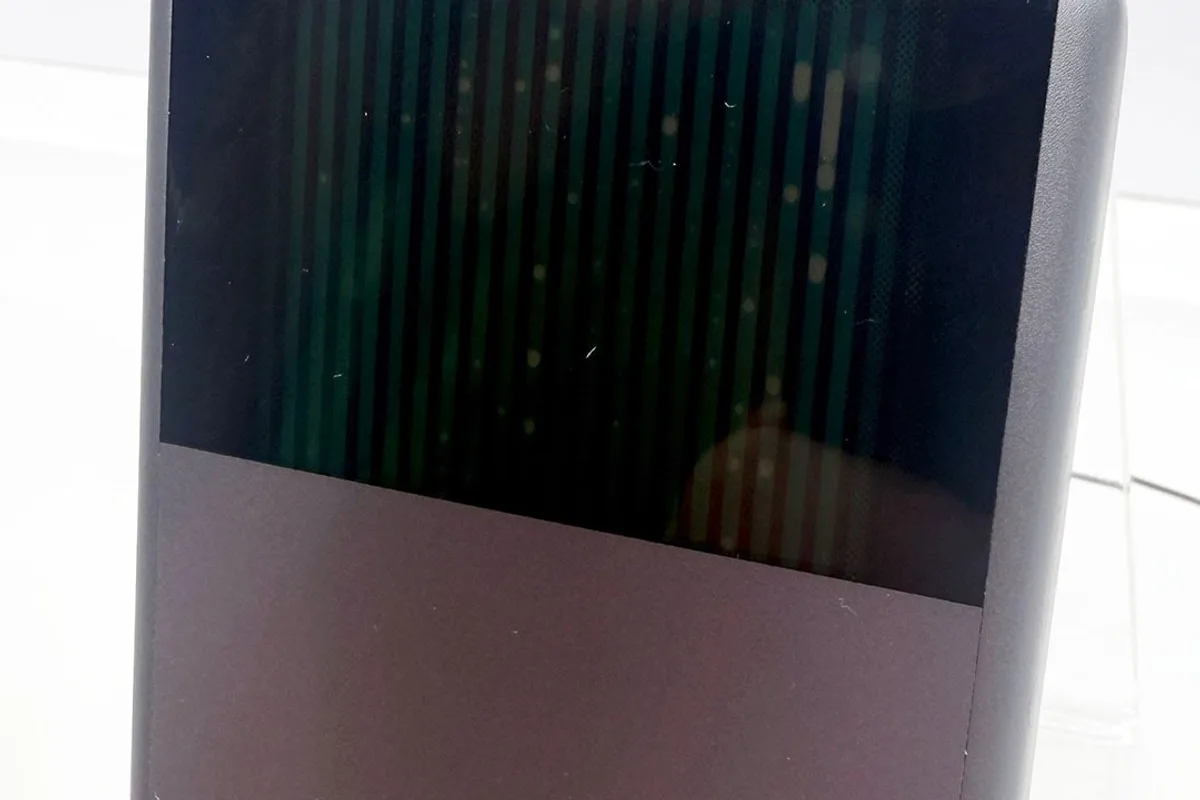
The Cyber Window is mostly there because UGREEN wants you to see what you paid for
A transparent panel is not required for liquid cooling to function.
The same pump and channels could sit behind an opaque shell.
UGREEN exposes them because cooling is the product's defining feature and much of the explanation for its premium price.
It is technology designed to be visible rather than disappear into the enclosure.
UGREEN claims a 10°C reduction under a very specific test
The company tested the battery with an iPhone 17 Pro Max at an ambient temperature of 25°C.
It reports peak temperatures up to 10°C below a 48°C industry reference.
UGREEN also claims the system can reduce temperature rise by as much as 44% under its internal conditions.
Those are manufacturer measurements, not an independent guarantee for every phone, case and room temperature.
They nevertheless reveal the actual purpose of the pump: staying farther away from thermal limits that force charging power down.
The useful benefit is potentially sustaining 25W for longer
Phones and chargers monitor their own temperatures.
If either becomes too hot, charging power can be reduced automatically to protect the electronics and cells.
A charger can therefore advertise a 25W peak without maintaining 25W through most of the session.
If CryoPulse delays that throttling, the important measurement is not peak wattage but the complete charging curve.
UGREEN says an iPhone 17 Pro Max reaches 50% in around 40 minutes over Qi2 25W.
Independent testing against passive Qi2 batteries under identical conditions will show how much of that advantage actually comes from cooling.
10,000mAh never means 10,000mAh delivered to the phone
The pack uses two 5,000mAh cells for a nominal 10,000mAh total.
That number cannot be translated directly into the same amount of capacity appearing inside a phone battery.
Voltage conversion, power electronics and wireless-transfer losses all consume part of the stored energy.
UGREEN estimates approximately 1.36 full charges for an iPhone 17 Pro Max or just over two for an iPhone Air in its own testing.
As with every power bank, nominal capacity is more useful for comparing battery packs than predicting exact full-charge counts.
Wired charging reaches 45W
A built-in USB-C cable also functions as a carrying loop.
That cable can deliver up to 45W.
There is a second USB-C port for another device.
Total output from the entire power bank remains capped at 45W.
Connecting several devices therefore divides available power rather than producing 25W wireless plus two independent 45W wired feeds.
Three devices can charge simultaneously
One device can use magnetic charging while two others connect through the integrated cable and secondary USB-C port.
When several outputs are active, the wired connections take priority.
Wireless charging may be disabled by default in that situation and can be enabled with the power button.
That is a sensible compromise when total output is limited to 45W.
The cable-lanyard solves one problem and creates another
An integrated cable means there is one less accessory to remember.
UGREEN says it has survived more than 10,000 bending tests and is strong enough to function as a carrying loop.
That is convenient.
Unlike a fully detachable cable, it also becomes a mechanical part expected to survive for the life of the power bank.
Long-term repairability will matter more than a laboratory bend count if owners regularly carry the battery by that loop.
The liquid loop still fits inside a 16.2mm-thick body
Adding a pump and channels has not turned the MagFlow Pro into a desktop cooling brick.
UGREEN's regional specifications put the enclosure at roughly 108 by 71 by 16mm.
That remains within the dimensions of a conventional magnetic power bank.
The engineering achievement is therefore not merely adding liquid cooling.
It is fitting active cooling into hardware that still attaches to the back of a phone without a protruding fan.
The display tracks charging and cooling
A small screen shows more than remaining battery percentage.
UGREEN also exposes charging power, cycle count and cooling status.
That information makes more sense on a product whose main selling point is sustained power and thermal control.
Users can at least see whether the battery is operating as expected rather than relying on a single status LED.
ATL cells and Dymondcell 2.0 address the other side of the heat problem
UGREEN uses high-density ATL cells and packages its battery protections under the Dymondcell 2.0 name.
It claims 13 layers of protection and more than 80% remaining capacity after 800 cycles under its validation conditions.
That does not guarantee every user will see exactly the same aging curve.
Temperature, depth of discharge and charging habits have a large effect on lithium-ion degradation.
That is also why the active cooling concept is coherent: repeated high temperatures are generally undesirable for long-term cell health.
The cooling system consumes some of the energy it is trying to protect
A micro-pump requires power.
Some fraction of stored energy therefore circulates coolant instead of entering the phone.
UGREEN has not published enough detailed efficiency data to quantify that penalty across a complete wireless charge.
The system has to earn that energy back by reducing thermal losses and, more importantly, preserving higher charging power for longer.
That tradeoff requires measurement rather than simply watching green liquid move behind a window.
At €119.99, cooling is what you are paying for
The thermal hardware has an obvious financial cost.
UGREEN already sells 10,000mAh magnetic Qi2 25W batteries for far less without an active liquid loop.
The MagFlow Pro's premium is therefore not primarily buying additional capacity or a unique wireless power level.
It is buying active thermal management, additional mechanical complexity and a more detailed status display.
It looks excessive because magnetic charging is becoming serious hardware
Liquid cooling inside a phone battery pack sounds like overengineering.
The thermal constraint behind it is less absurd.
Qi2 power is increasing while the charger remains physically pressed against the device it is also heating.
The longer manufacturers want to sustain 25W and eventually higher levels, the more thermal design becomes part of charging performance rather than merely a safety system.
UGREEN has chosen the most visible possible response: a pump, coolant and a window so owners can watch it all circulate.
Whether a 10°C manufacturer-claimed reduction is worth more than €100 is a separate question. What the MagFlow Pro demonstrates already is that wireless charging has reached the same old hardware reality as CPUs and GPUs: eventually, watts always become heat.