
 By Tsuky
For a foldable smartphone, the hinge is far more than a mechanical convenience. It determines how the flexible display opens, how stress is distributed and ultimately how well the device withstands repeated use.
Apple is now confronting the engineering challenges associated with that design.
The iPhone Duo, which went on sale Friday, October 23, has attracted reports of cracks developing on its inner screen.
After several days of user accounts and photographs circulating online, Apple officially acknowledged that some devices are affected.
The company's response matters because it recognizes the reported problem and offers a replacement process.
However, the full extent of the issue and its precise cause remain unclear.
Apple confirms an issue affecting a small number of phones
On Monday, October 26, Apple provided a statement to several publications, including Reuters, MacRumors and 9to5Mac.
The company acknowledged a problem affecting the inner display on a limited number of iPhone Duo units.
Owners experiencing the issue have been directed to contact AppleCare for a replacement.
According to additional information shared with journalists, the overwhelming majority of devices are not expected to be affected.
Apple also indicated that the problem appears relatively quickly on units that develop the defect.
That may reassure owners whose devices are functioning normally, but it does not establish long-term reliability through statistical evidence.
The company has not disclosed the number of affected units or the percentage of total production involved.
It has not announced a general recall.
For now, Apple's official response centers on replacing individual devices that exhibit the problem.
Cracks are appearing near the central fold
The first public reports emerged during the weekend following the phone's launch.
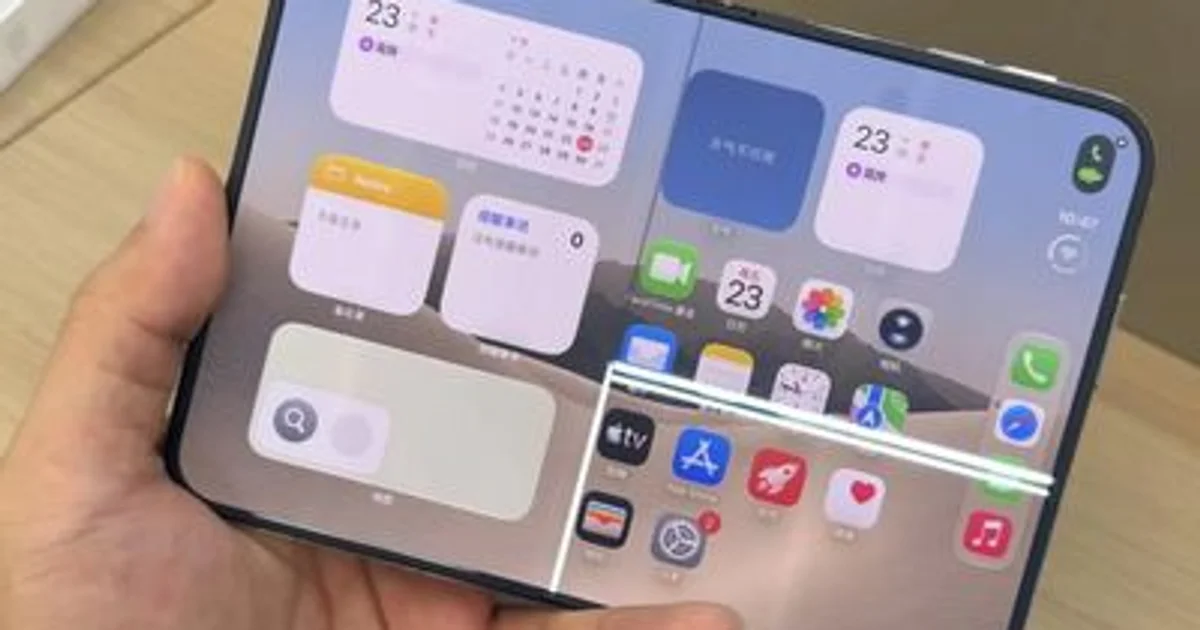
Several owners described cracks in the lower portion of the inner display, near the central hinge.
Some photographs also show a line of unusually bright pixels extending across part of the screen.
Certain users reported resistance when opening the phone.
Others described a popping sound shortly before the display failed.
The similarities between these accounts have focused attention on the folding mechanism.
However, not every social-media post should be considered equally reliable.
MacRumors has warned that some images allegedly showing the defect may have been generated using artificial intelligence.
Unverified photographs cannot establish how many devices have actually failed.
Apple's statement confirms that a genuine issue exists, but does not authenticate every individual report.
iFixit identifies a possible mechanical weakness
A teardown published by iFixit on October 25 provides a potential technical explanation.
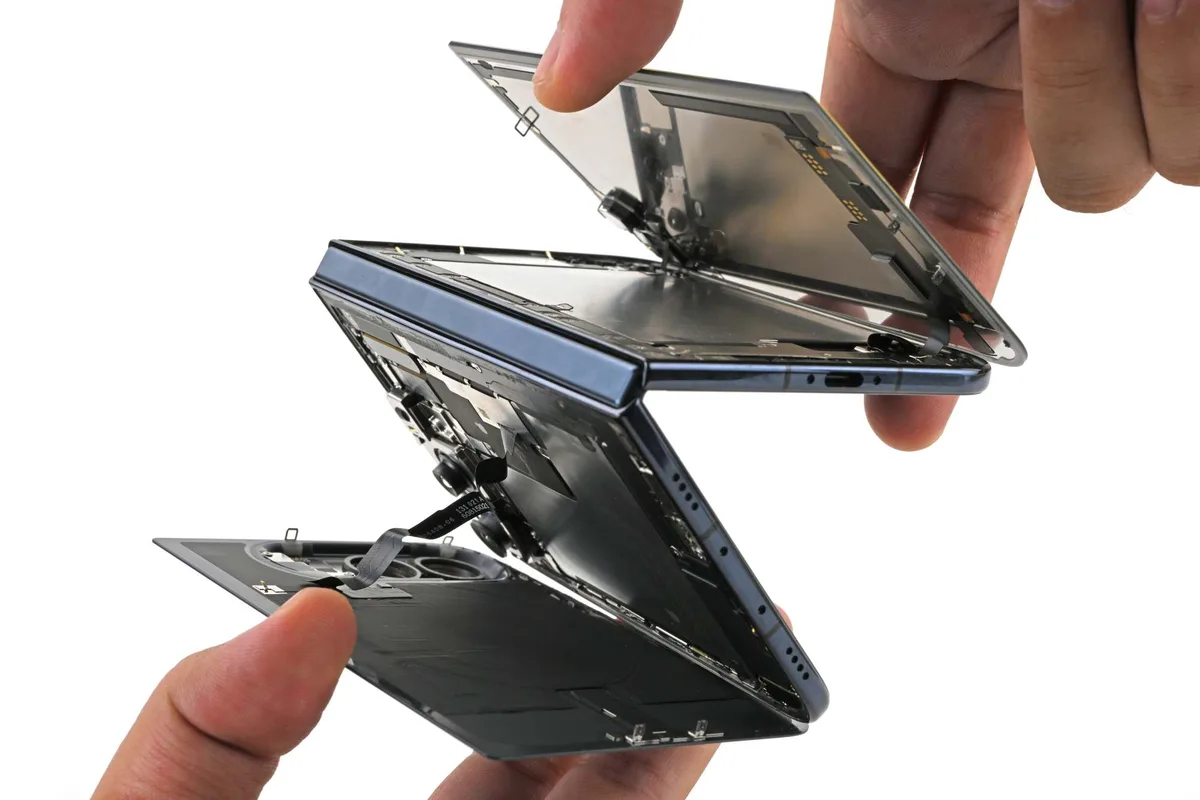
The repair specialist opened the iPhone Duo to examine its internal construction, including the display layers and hinge mechanism.
Its investigation also drew on technical documentation, patents and three-dimensional representations.
The objective was to understand why reported damage appeared to cluster in a similar location.
According to iFixit, several mechanical components meet near that area.
A central support bar plays a role in the hinge's operation.
The researchers suggest that this component might not always move sufficiently out of the way during folding.
That could create concentrated pressure on a vulnerable part of the flexible display.
Such stress might help explain some of the reported cracks.
However, this remains a mechanical hypothesis rather than an established cause.
Apple has not confirmed the explanation, and no systematic reproduction of the defect across a large sample of phones has been published.
Why foldable displays are sensitive to mechanical stress
Unlike conventional smartphone screens, foldable panels must withstand repeated movement.
They combine multiple layers intended to protect pixels, distribute mechanical forces and permit bending.
Their performance also depends on the precision of the hinge and the structures supporting the display when fully opened.
A small misalignment can become significant when pressure is concentrated over a very limited area.
Repeated folding is not the only potential challenge.
Manufacturing variation, assembly problems or foreign particles can also create unfavorable mechanical conditions.
These mechanisms are recognized engineering concerns in foldable devices.
That does not establish that all of them are responsible for the iPhone Duo reports.
A technical investigation must determine whether the incidents share one underlying cause and whether manufacturing changes are necessary.
The most repairable foldable still has a difficult inner screen
One unusual aspect of the iPhone Duo is that its repairability has some positive characteristics.
In its teardown, iFixit assigned the device a provisional repairability score of 5 out of 10.
The organization describes it as the most repairable foldable smartphone it has examined so far.
Several design decisions contributed to that assessment.
The batteries use a procedure intended to simplify removal.
The outer display is relatively accessible, and some components can be reached without completely disassembling the device.
However, the inner screen remains a major exception.
Its fragile structure, multiple layers and adhesives complicate replacement.
Servicing requires careful handling to avoid damaging flexible components.
Better overall repairability does not therefore mean that every repair is simple or affordable.
Replacing the inner display can cost $999 without coverage
Repair pricing is particularly relevant for a smartphone costing approximately $2,000 in the United States.
According to the service information examined by iFixit, a complete inner-display replacement costs $999 without coverage.
The organization also describes a different service operation: replacing the display's outer protective layer.
That procedure is listed at $49 without AppleCare coverage, or $19 under the specified AppleCare terms.
The two repairs should not be confused.
Replacing a surface layer is not equivalent to repairing a damaged OLED panel.
Similarly, the full out-of-coverage display price should not automatically be applied to customers whose devices exhibit the defect acknowledged by Apple.
The company has specifically offered a replacement process through AppleCare for affected units.
The exact conditions will depend on the assessment of each device.
The reviewed sources do not establish equivalent official French repair prices.
What owners should do if their device develops symptoms
Affected owners should avoid actions that could worsen the damage.
If the hinge develops unusual resistance, forcing the phone open is not advisable.
Users should also avoid attempting to peel away the layers covering the inner display.
What appears to be a simple protective film may be part of an assembly requiring specialized tools and procedures.
If the device still works, backing up important information before service is a sensible precaution.
Apple then advises contacting AppleCare.
An appointment at an Apple Store or authorized service provider can help establish the problem and the appropriate replacement process.
Some owners have received immediate replacements in stores.
Others may face delays depending on replacement stock.
Using the official service process is preferable to attempting an improvised repair.
Replacement availability could be affected by limited stock
The iPhone Duo entered the market with constrained initial availability.
Reuters reports that early orders attracted substantial demand and that inventory remains limited.
The complexity of manufacturing a foldable smartphone may also make rapid production increases difficult.
That could complicate service logistics for affected customers.
An offer to replace a defective device does not necessarily guarantee that the same configuration is immediately available in a particular store.
Wait times may depend on region, color, storage capacity and service inventory.
Apple has not published one guaranteed replacement period for every customer.
It would therefore be inaccurate to promise immediate replacement in every location.
No general recall or hardware revision has been announced
Apple currently describes the problem as affecting a limited number of devices.
No general recall has been announced.
The company has also not stated that a revised hinge design is already entering production.
Nor has it announced a specific software correction for the issue.
That lack of technical detail matters.
The symptoms appear hardware-related, but the precise cause remains unknown.
Engineers will need to determine whether assembly procedures, mechanical tolerances or individual components require changes.
Manufacturing adjustments could potentially occur without an immediately visible change to the retail product.
However, no verified information currently establishes that Apple has adopted any particular solution.
An early test of trust for foldable iPhone buyers
Launching a first-generation foldable device represents a significant step for any manufacturer.
Beyond specifications, buyers want confidence that the hinge and screen will withstand prolonged daily use.
That concern becomes especially important when the phone costs around $2,000.
An incident affecting relatively few devices can generate concern far beyond its actual scale.
However, a lack of detailed public data also makes it difficult for buyers to assess the true risk.
The manufacturer's response is therefore important.
Acknowledging the issue and offering replacements is a concrete first step.
The next question is whether failures will indeed remain limited to a small number of devices.
Information about replacement units, further owner experiences and any technical explanation will help clarify the situation.
What is known and what remains uncertain
The confirmed facts are relatively straightforward.
Some iPhone Duo owners reported damage to the inner display shortly after launch.
Apple acknowledges an issue affecting certain units and offers replacements.
iFixit has identified a mechanical area that might contribute to concentrated stress.
However, no public evidence yet establishes that this hypothesis explains every failure.
The exact number of affected devices remains unknown.
There is also no proof of a universal defect affecting the entire production run.
For owners experiencing the problem, the next step is clear: contact AppleCare rather than forcing the hinge or attempting a screen repair.
For everyone else, Apple has issued no instruction to stop using the device.
The broader outcome will depend on whether Apple can identify the precise cause and demonstrate that the problem remains limited.