
 By Tsuky
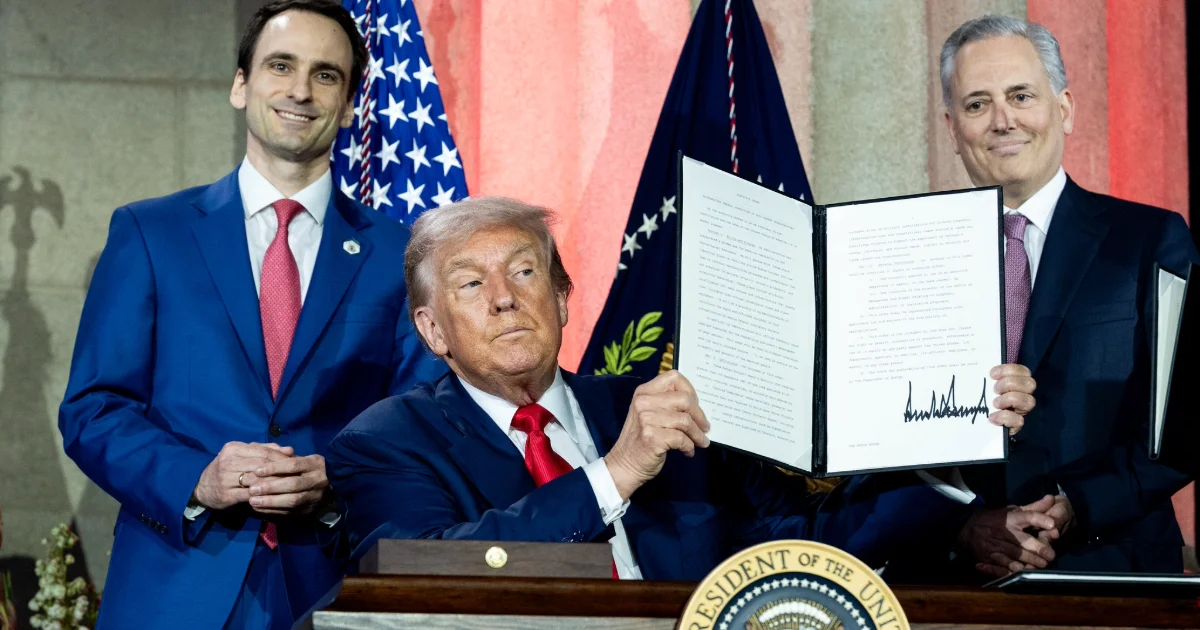
The debate over artificial intelligence safety often starts with a choice between innovation and regulation. Donald Trump's latest remarks suggest that he does not regard the two as completely incompatible. In an interview broadcast by CBS on November 8, the US president said he was willing to consider guardrails for advanced AI. The statement was notable given his administration's emphasis on reducing obstacles to technology development. However, his willingness to accept safeguards comes with a clear strategic condition. He does not want American companies constrained in ways that could allow China to take the lead in artificial intelligence. That qualification defines the scope of his comments more clearly than his general expression of openness.
What Trump actually told 60 Minutes
The exchange took place during an interview with CBS correspondent Ross Douthat. Douthat raised concerns expressed by some leaders of the artificial intelligence industry about the possibility that increasingly advanced systems could create serious risks. Trump responded that he considered some of those warnings exaggerated. He nevertheless said that the dangers could be managed. This is not quite the same as claiming that AI presents no risks. The president acknowledged the possibility of safeguards while questioning the severity of the dangers described by some developers.
Douthat then asked whether Trump would cooperate with Democrats on AI safety. Trump indicated that he would. He also made clear that he would oppose measures he believed could place the United States far behind China. The full CBS transcript confirms both elements. His position combines an openness to certain protections with a continued commitment to technological competition.
No specific legal proposal accompanied the remarks. Trump did not identify the obligations he would impose on AI companies, the agencies responsible for enforcement or a timetable for new rules. The interview should therefore be understood as a political statement rather than a formal regulatory announcement.
The China rivalry remains central to the White House position
Trump framed the development of advanced AI as a competition between the United States and China. He argued that allowing Beijing to take the lead would create a substantial strategic disadvantage for Washington. That perspective reflects the growing importance of AI in national security and economic policy. Advanced models are relevant not only to consumer software but also to scientific research, industrial automation and defense-related applications.
The competition also includes the infrastructure required to develop and operate those models. Semiconductor manufacturing, high-performance computing systems, data centers and electricity supply are all important components. Countries able to secure those resources may gain advantages in developing and deploying sophisticated systems. It is within this wider industrial context that Trump considers regulation.
Rules that improve system reliability may support adoption and trust. Rules that impose substantial delays or costs may create commercial challenges. The ultimate effect depends on the design of the requirements. Trump did not offer enough detail to establish how his administration would evaluate that trade-off.
China does have AI regulations
One of Trump's claims requires factual qualification. During the interview, he argued that China did not have guardrails comparable to those being discussed in the United States. China already operates a regulatory framework covering several aspects of artificial intelligence. Its interim measures for generative AI services were published in July 2023 and took effect on August 15 of that year.
The measures establish obligations concerning information security, personal data and certain forms of generated content. China also has regulatory systems covering recommendation algorithms and synthetic media. These rules do not necessarily pursue the same goals as Western AI safety proposals. Chinese regulation places substantial emphasis on content governance and state-defined security requirements.
Nevertheless, it is factually inaccurate to say that China has no AI regulation. The meaningful comparison concerns which activities are restricted, how compliance is enforced and what effects the rules have on innovation. Those differences were not examined in detail during the CBS exchange.
The existing US strategy prioritizes rapid development
Trump's remarks should be understood alongside the administration's earlier AI policy. On July 23, 2025, the White House released America's AI Action Plan. The document outlined more than 90 federal actions organized around three central objectives. The first was accelerating innovation. The second concerned building American AI infrastructure. The third focused on international diplomacy and security.
The plan emphasized reducing regulatory obstacles, expanding data center capacity and improving the domestic semiconductor manufacturing environment. It also addressed the protection of critical infrastructure and the security of advanced computing systems. The administration's approach was therefore not entirely devoid of safety measures. Its central priority was to expand American AI capabilities while avoiding requirements it considered unnecessarily restrictive.
The November 2026 comments are consistent with that broader strategy. They may indicate greater willingness to negotiate additional protections. They do not establish that the White House has abandoned its earlier emphasis on deregulation and industrial competitiveness.
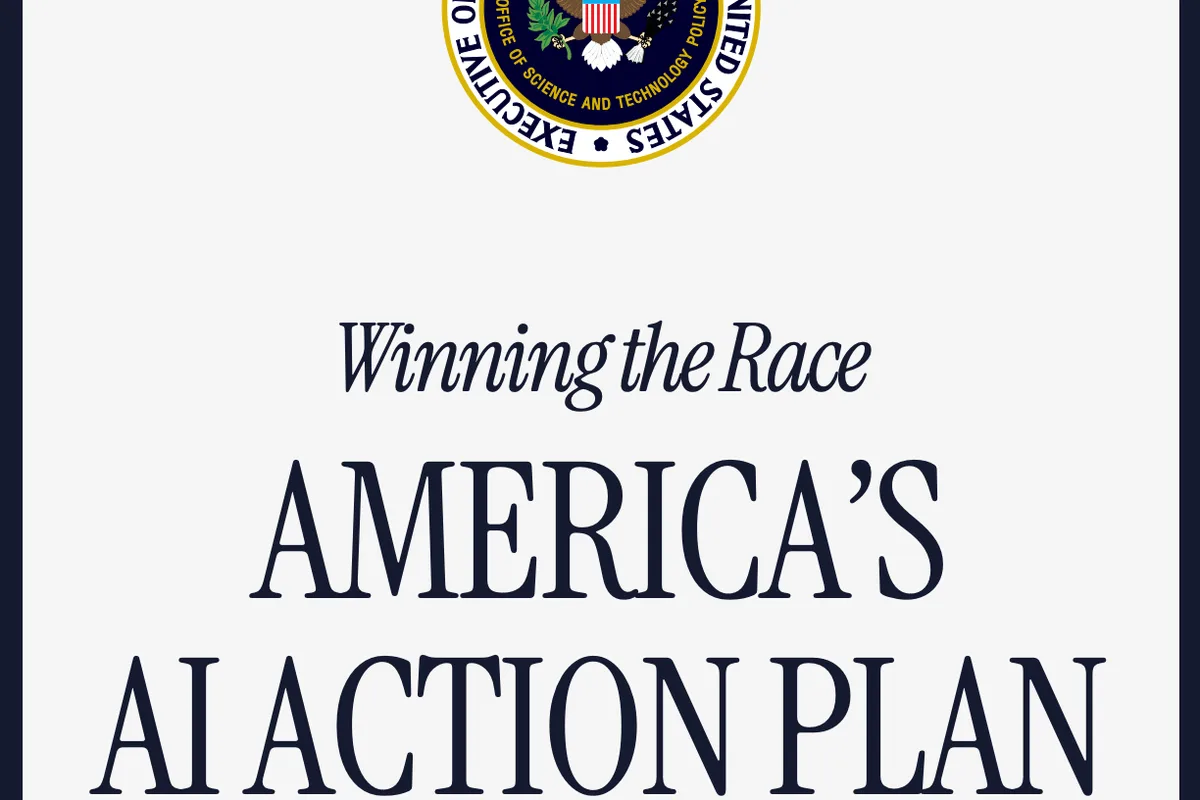
The cover of America's AI Action Plan, released in July 2025. It illustrates the administration's existing strategy rather than a new policy announced in the November 2026 interview.
What could AI guardrails actually mean?
The term guardrails can refer to several distinct policy tools. Some involve technical requirements imposed directly on model developers. Examples include safety evaluations, testing before deployment, incident reporting and restrictions on access to dangerous capabilities. Other requirements concern the organizations building and operating AI systems. They can include documentation, audits, security controls and responsibilities linked to sensitive applications.
Governments may also choose to regulate particular uses of AI rather than model development itself. An automated system used in a medical setting presents different risks from one generating marketing text. A regulatory framework can therefore establish different obligations based on the potential consequences of failure.
Trump's interview did not establish a preference among these approaches. He did not announce compulsory independent testing for frontier models. He did not introduce new computing thresholds or reporting requirements. Nor did he describe a federal licensing process for AI developers. All of those possibilities remain separate policy options rather than decisions made during the interview.
Trump describes an alleged Justice Department intervention
The interview also contained a more unusual claim. Trump said his administration had received information about someone allegedly doing something improper with AI. He described a forceful warning that included the possibility of imprisonment. According to his account, the warning caused the individual to change their behavior. He linked the episode to the Department of Justice.
When Douthat asked whom he was describing, Trump declined to identify either the person or the company. He indicated only that the individual was associated with a major AI business. The CBS transcript confirms that Trump made these statements. It does not independently confirm that the alleged incident unfolded as described.
No verifiable information was provided about the conduct involved, the applicable law or any formal proceedings. There is therefore no adequate basis for identifying the company or describing the episode as a confirmed criminal investigation. The claim must remain attributed to the president.
Criminal enforcement and preventive regulation serve different purposes
Trump's account raises a significant distinction between enforcing existing laws and creating new AI safety obligations. The Department of Justice can investigate and prosecute conduct that falls within its legal authority. Using AI to commit an offense does not automatically place that conduct outside existing criminal law. However, preventive AI safety measures may address situations before a specific offense or harm has occurred.
For example, a government might require a developer to test a powerful system before releasing it. That requirement serves a different purpose from prosecuting an individual after discovering potentially illegal behavior. The approaches can complement one another. But they do not necessarily replace each other. Trump did not explain whether his administration would rely primarily on existing enforcement powers or support new preventive obligations.
The interview therefore leaves a substantial policy gap between the claim that risks can be managed and a description of how that management would work.
Cooperation with Democrats is possible, but not yet negotiated
Trump's willingness to work with Democrats is politically significant. His comments came after the November 3 midterm elections, which changed the balance of power in Congress. The result creates a different legislative environment for the remaining years of his presidency. However, a president's expression of willingness to negotiate does not automatically produce a bipartisan agreement.
American lawmakers have different priorities regarding AI. Some focus on consumer protections and the possible impact on workers. Others emphasize national security, cybersecurity or the risks of increasingly autonomous systems. Another group is concerned that expensive compliance requirements could favor established technology companies over smaller competitors.
These perspectives are not necessarily mutually exclusive. Legislation could combine targeted safety obligations with measures intended to preserve innovation. But that would require a specific proposal, negotiation and formal adoption. Nothing in the 60 Minutes interview establishes that those steps have already occurred.
The cost of compliance is part of the competitive debate
Safety rules can impose real costs on AI developers. Technical evaluations consume computing resources and require specialists. Documentation, auditing and incident-response obligations also demand organizational investment. Smaller developers may find those costs more difficult to absorb than companies with extensive existing infrastructure.
However, regulatory compliance may also produce benefits. Reducing serious failures can protect customers and limit operational disruption. Clear standards may help organizations decide whether advanced AI systems are suitable for sensitive environments. In some sectors, predictable rules can support adoption rather than prevent it.
Consequently, there is no universal relationship between stronger safeguards and slower technological progress. The outcome depends on proportionality, implementation and the types of risks being addressed. That is the technical policy discussion left unresolved by Trump's broad remarks.
AI safety involves more than catastrophic scenarios
The CBS exchange concentrated partly on warnings about extremely advanced AI systems. Trump expressed skepticism toward the more alarming predictions. But AI safety is not limited to speculative scenarios involving future superintelligence. Current systems already create practical challenges.
They can produce false information in sensitive contexts. AI agents may encounter malicious instructions embedded in files or webpages they are asked to analyze. Systems can expose personal information or be used to create deceptive content. These problems vary significantly in their severity and technical characteristics.
They also require different responses. Cybersecurity controls, privacy obligations, transparency requirements and model evaluations are not interchangeable. A coherent regulatory approach would need to identify which risks fall under which responsibilities. Trump's comments establish no such framework.
The political signal is real, but the rules have not changed
The most important development from November 8 is the president's expressed willingness to consider AI safeguards. That represents an opening for discussion without a detailed commitment to legislation. His condition remains clear: American technological leadership, particularly in relation to China, must be preserved.
Other aspects of the exchange require caution. The alleged Justice Department intervention has not been independently established in the available reporting. The claim that China lacks AI rules does not accurately describe its existing regulatory framework. And no new federal requirement was announced during the interview.
As of November 9, 2026, there is no identified executive order, legislative proposal or enforcement framework directly resulting from Trump's remarks. For AI companies and their customers, the statements do not immediately alter the obligations already in force. A more meaningful policy development would require concrete proposals explaining which systems are covered, how risks must be assessed and which authorities will enforce the rules.
Only then will it be possible to determine whether the administration intends to introduce substantial new protections or simply remain open to discussing them. For now, the president has accepted that safeguards may be compatible with America's AI ambitions. The unanswered question is how much regulation he would accept before deciding that it threatens the country's position in the global technology race.