
 By Kilam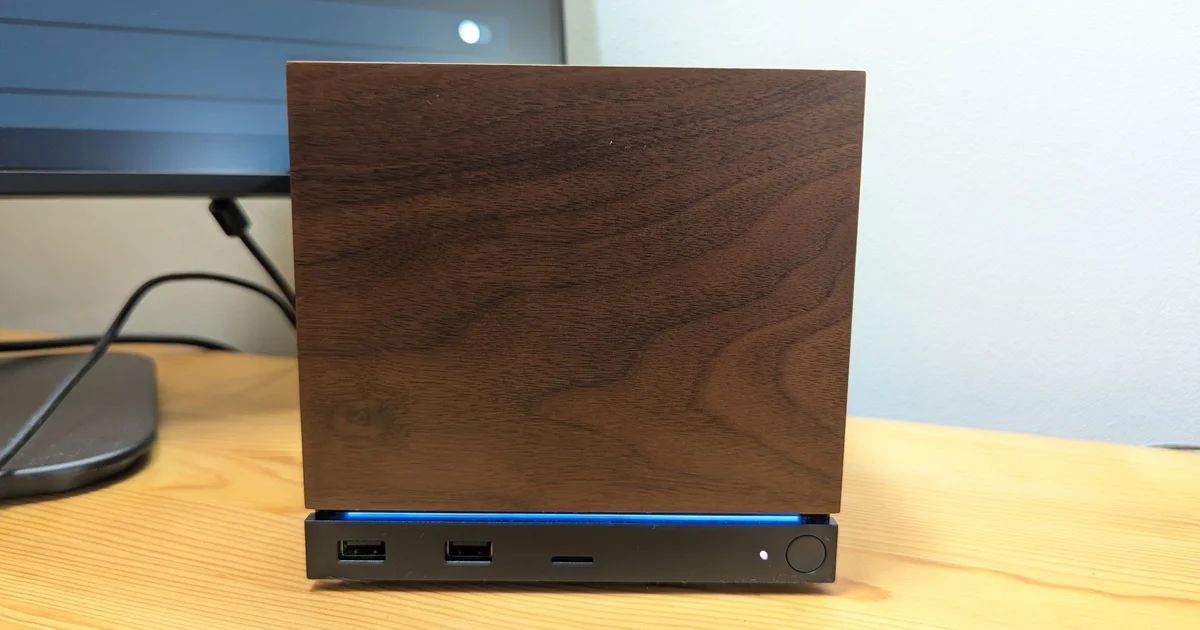
This is a compact discrete-GPU PC architecture
Valve combines a six-core, twelve-thread semi-custom Zen 4 CPU with 16 GB of DDR5 system memory and a separate 28-CU RDNA 3 graphics processor carrying 8 GB of GDDR6.
That topology matters. Current consoles package CPU and GPU into a tightly integrated SoC with shared high-bandwidth memory. Valve's box behaves more like a highly compressed desktop PC, including the familiar division between system RAM and dedicated graphics memory.
The 8 GB graphics allocation is the obvious pressure point.
The GPU's natural territory is below native 4K
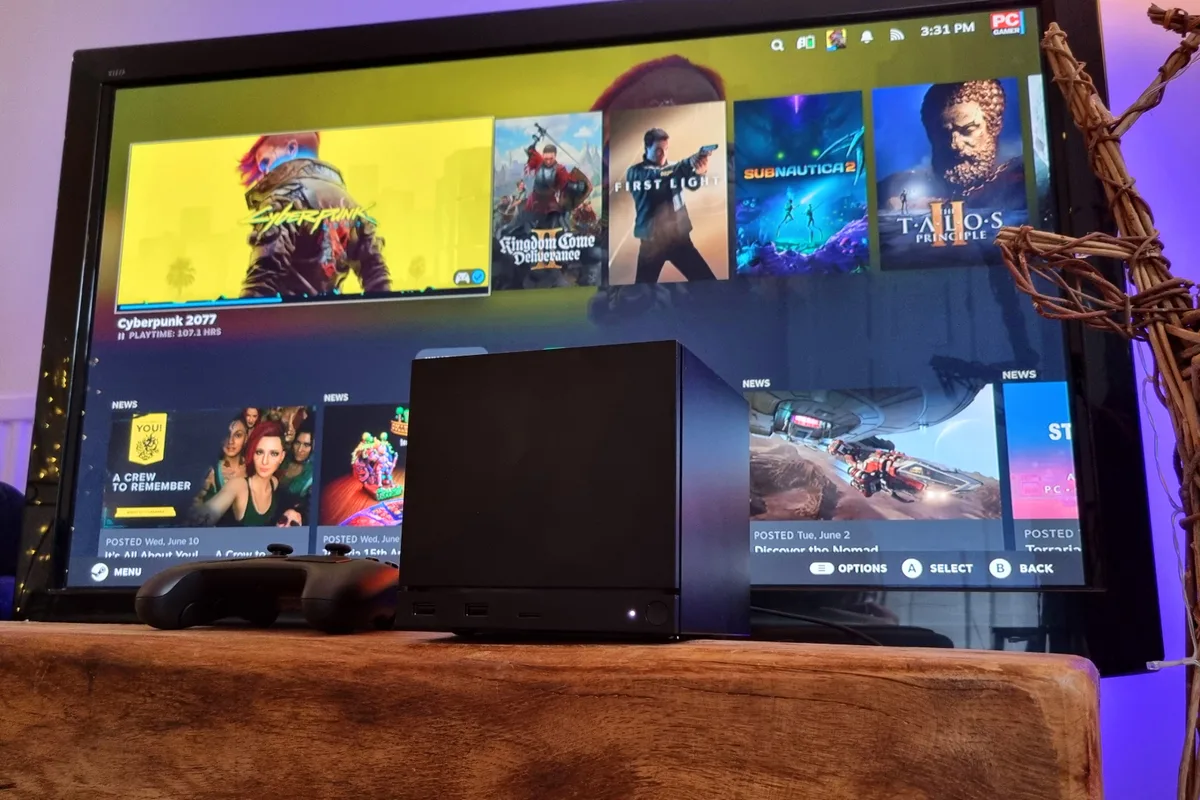
GamersNexus measured performance that moved around the RX 6600, RTX 3060 and Arc B570 class depending on workload. PC Gamer's testing showed why a single comparison is difficult: Metro Exodus Enhanced Edition produced a 45 fps average at 1440p Ultra, while ray-traced Cyberpunk 2077 at 1440p Medium fell to 28 fps with FSR Quality and no frame generation.
RDNA 3 ray tracing is part of that gap. So is the reality of PC software, where one system may be asked to run settings designed for hardware several tiers above it.
A console avoids much of that choice. Developers pick the settings. Valve hands the menu back to the user.
FSR 4.1 matters unusually much on this class of GPU
The Steam Machine sits in the performance range where reconstruction quality can change the character of the product. Rendering below the television's native resolution is often necessary, so a better upscaler is not merely a bonus feature.
Valve and AMD's newer FSR 4.1 path has improved reconstruction and frame-generation behavior in supported titles since launch. That gives the fixed Steam Machine hardware more room than its original reviews suggested.
It is still software leverage rather than additional silicon. Memory capacity and native rendering throughput remain unchanged.
The cooling system is arguably the most successful hardware component
Valve fits an internal power supply and a 120 mm exhaust fan into a chassis roughly 16 cm across. PC Gamer measured average gaming temperatures of 68°C on the CPU and 65°C on the GPU, while emphasizing how little noise the system produced.
Those numbers are not glamorous, but they expose the design target. This machine was engineered to sit a few meters from a sofa without sounding like a desktop tower.
For a living-room computer, acoustic performance is part of performance.
A faster $1,000 tower is easy to find
The straightforward value criticism remains valid. Conventional prebuilt systems with newer entry-level GPUs can deliver substantially higher frame rates around the same money. A DIY build can push the gap further.
That comparison begins to change once volume, acoustics, integrated power, wireless connectivity and controller-first software are included. Matching all of those constraints is more difficult than matching the benchmark score.
The Steam Machine therefore has poor performance-per-dollar without necessarily having poor engineering.
SteamOS turns fixed PC hardware into something console-like
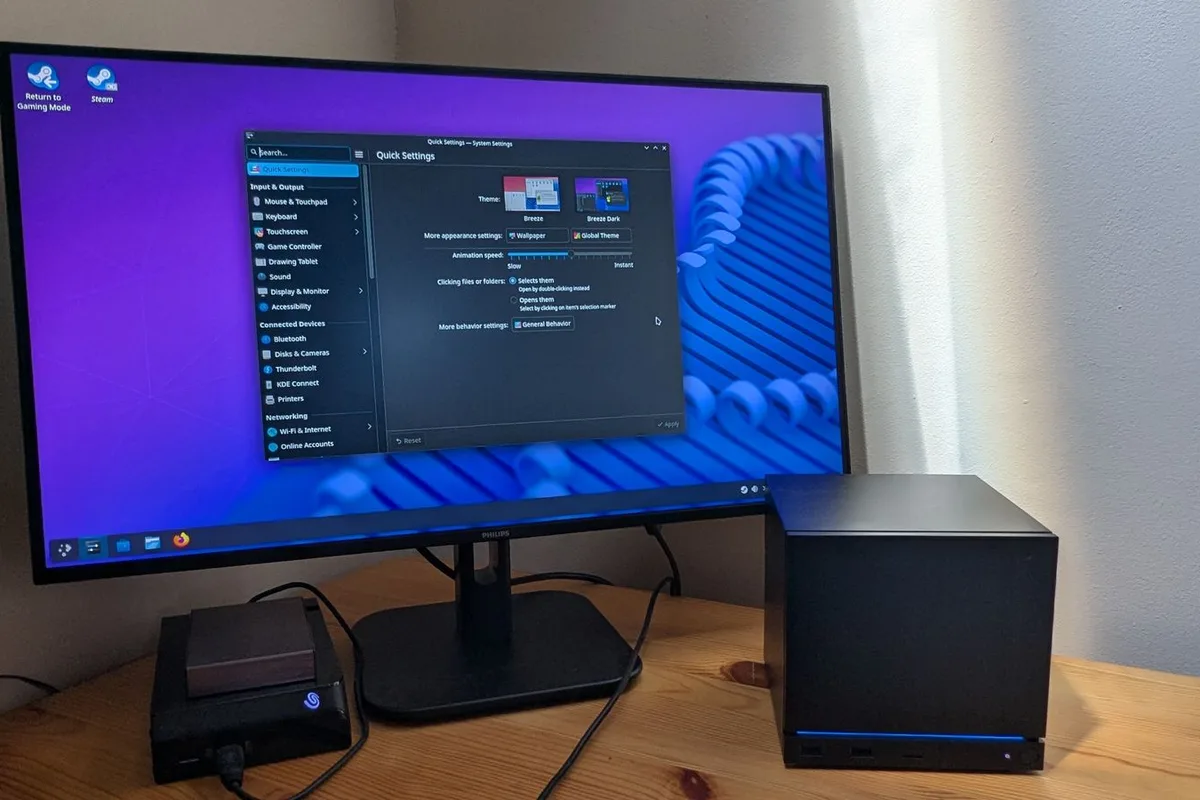
Every Steam Machine uses the same hardware target. Valve can tune the kernel, Mesa graphics stack, Proton compatibility layer, power behavior and upscaling support around one device rather than an arbitrary Windows PC.
That resembles console development more than ordinary desktop support and helps explain why software updates can materially alter the experience months after launch.
Then Desktop Mode exposes KDE Plasma and the illusion ends. Standard peripherals work, applications can be installed, NVMe storage is serviceable and Windows drivers exist.
Its weakest identity may be the one printed by its shape
Treating the Steam Machine as a $1,049 console highlights almost every weakness: price, graphics horsepower, memory capacity and inconsistent game-by-game settings.
Treating it as an unusually integrated Linux gaming PC highlights nearly the opposite set of characteristics: compact thermal design, low noise, an open desktop, replaceable storage and a software platform that is improving around fixed hardware.
The cube looks like a console. Technically, it makes far more sense when it is allowed to remain a PC.