
 By Camille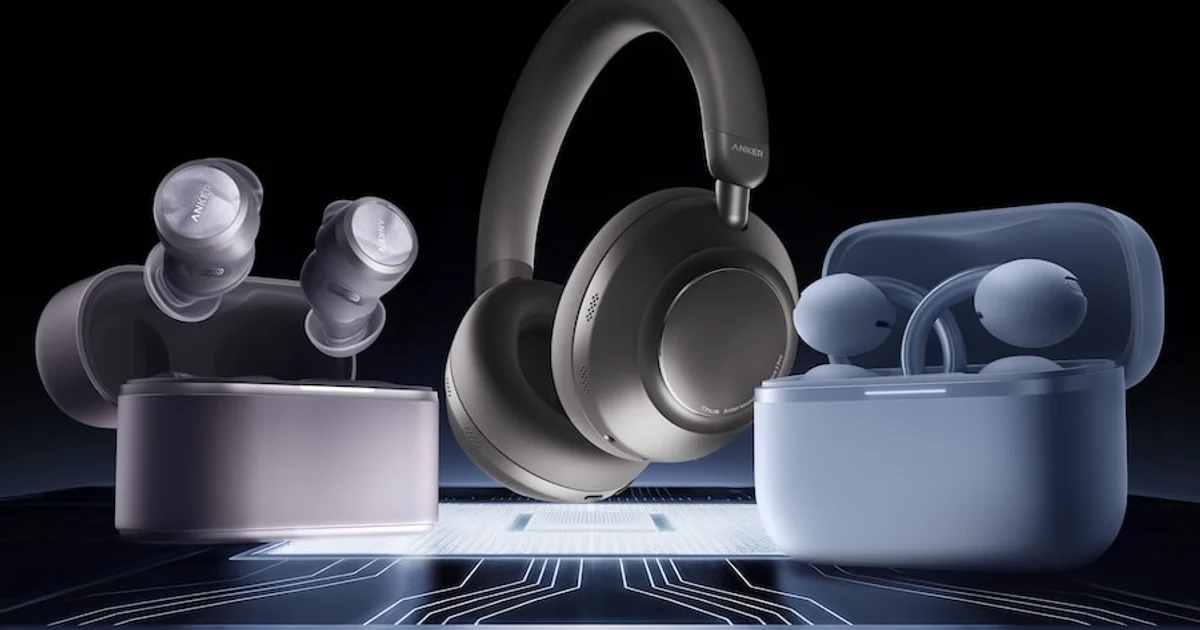
Thus is becoming a platform rather than a one-product experiment
Anker introduced Thus earlier in 2026 and first deployed it in the Liberty 5 Pro family. With Space 2 Pro, Liberty Buds 2 and AeroClip 2 reaching retail around September 22, the chip is now spreading across multiple listening formats.
Its key architectural idea is Compute-in-Memory. Rather than repeatedly moving neural-network data between separate memory and compute blocks, part of the processing happens where that data is stored.
Anker claims this gives Thus dramatically higher peak AI compute capability while keeping power consumption appropriate for battery-powered wearables. Its headline figure reaches up to 150 times the peak AI computing performance of earlier audio implementations.
That number should not be confused with a 150-fold improvement in headphones. The relevant question is much simpler: can the extra local compute separate speech and noise better without destroying battery life?
Space 2 Pro uses separate microphone systems for calls and ANC
Space 2 Pro is the over-ear model and launches at $199.99 in the U.S., with a €200 European price announced around its IFA introduction.
For outgoing call audio, the Thus chip works with a six-microphone array and real-time voice-separation processing. Soundcore says the system is designed to isolate speech even against complex environmental noise approaching 100dB.
Adaptive ANC uses eight microphones and runs its processing at a claimed 384kHz. The goal is to react quickly to mixed and changing noise such as conversations, keyboards, HVAC systems and transport.
Those are manufacturer claims rather than an independent performance verdict. Fortunately, call quality is one of the easier AI promises to test: record the same voice in a loud environment and listen to what reaches the other end.
Battery life reaches 60 hours without ANC
Soundcore rates Space 2 Pro for up to 60 hours of music with ANC disabled and 30 hours with noise cancellation enabled.
Higher-quality LDAC playback uses more power. Soundcore’s support documentation lists roughly 20 hours when ANC and LDAC are used together under its test conditions.
A five-minute charge is rated for up to eight hours of playback. Bluetooth 6.1, two-device multipoint and spatial audio are also supported.
HearID 5.0 provides personalized calibration based on a hearing test. It is a less novel feature than Thus, but potentially more relevant to music playback if the resulting tuning matches the listener well.
Liberty Buds 2 are the $129.99 entry point
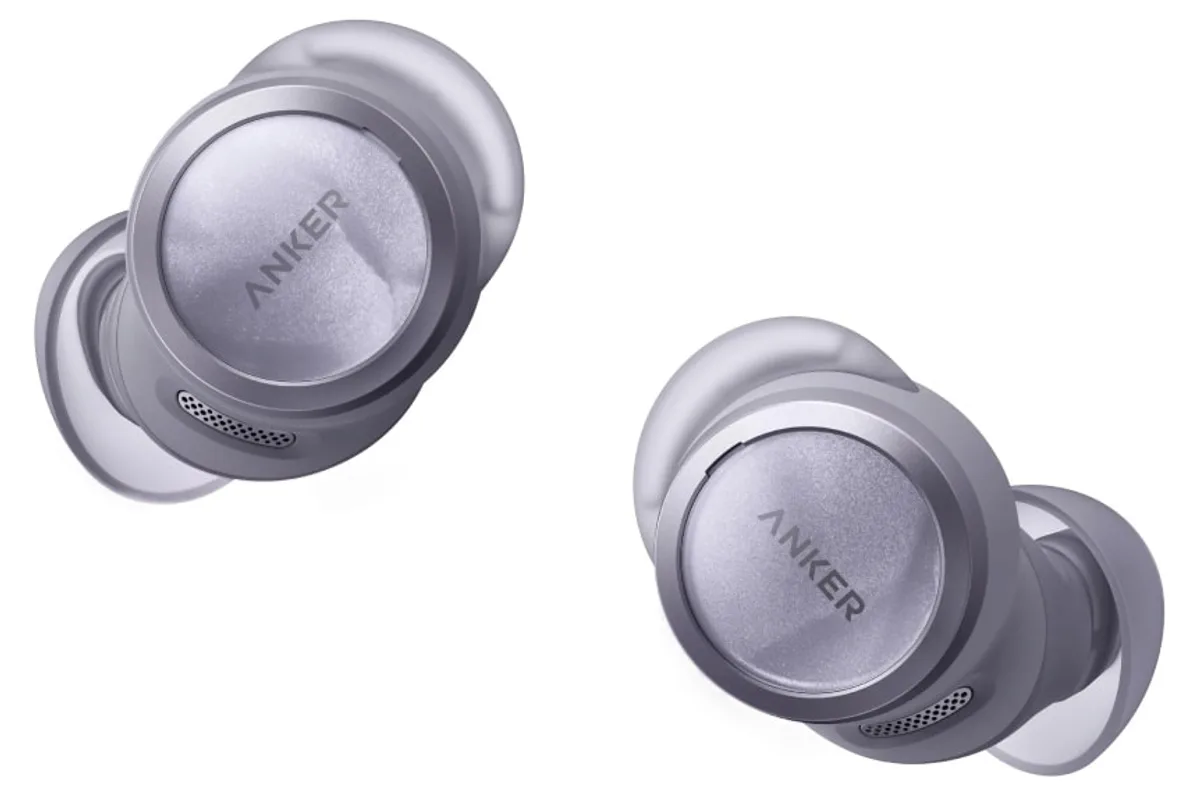
Liberty Buds 2 bring the platform down to $129.99 in a conventional compact true-wireless design.
Soundcore combines an eight-sensor call system with Thus and dedicated voice-processing units, while active noise cancellation uses a six-microphone arrangement with selectable and adaptive modes.
Final support documentation lists 9.2mm drivers, Bluetooth 6.1, LDAC, multipoint, Dolby Atmos and IP55 protection.
Battery life reaches up to 12 hours per charge in normal listening and 46 hours with the charging case. Ten minutes of charging can provide up to four hours of playback.
At this price, the AI chip cannot be the entire value proposition. Liberty Buds 2 compete in a segment where ANC, higher-quality Bluetooth codecs and wireless charging are already common.
AeroClip 2 puts the same processor into an open-ear design
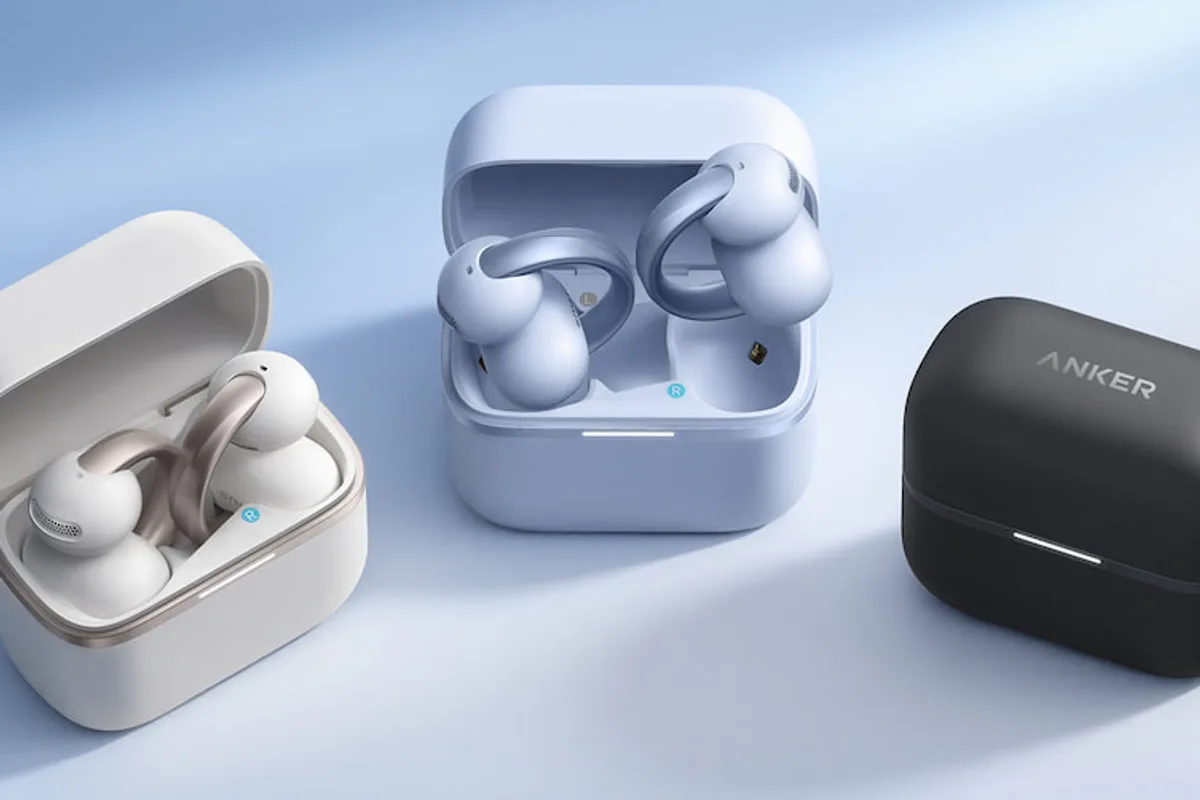
AeroClip 2 launches at $169.99 and around €180. Unlike the other two products, it does not seal the ear canal and is designed to preserve environmental awareness.
That changes the job of the processor. Thus is focused less on isolating the listener from outside noise and more on extracting the user’s voice for calls and enabling related language features.
Soundcore lists a 12mm dynamic driver, LDAC support and up to eight hours of battery life from the earbuds, increasing to 32 hours with the case.
The company says the C-shaped fit was developed using around 2,000 ear profiles. That work matters particularly in open-ear audio, where small positioning changes can have a large effect on both bass response and comfort.
Translation is another obvious use for the speech pipeline
AeroClip 2 includes real-time AI translation and Soundcore promotes simplified access on Apple devices through MFi support.
It is worth separating local audio processing from the entire translation service. Thus can help capture and isolate speech, while translation itself may still involve the connected phone, Soundcore software and external processing.
Putting an AI processor inside an earbud therefore does not automatically mean every intelligent feature works completely offline.
The Pro version goes all the way to AI meeting recorder
Soundcore has also announced AeroClip 2 Pro, although it is not part of the same September 22 retail rollout and final availability varies by market.
That model can record in-person meetings, online meetings and both sides of phone calls. The Soundcore app can then turn those recordings into transcripts, summaries and searchable information.
It shows the broader direction of the Thus platform. The chip is being positioned not only as an ANC coprocessor but as the front end of a speech-processing workflow.
That also moves the product into legal territory that has little to do with audio quality. Recording-consent requirements vary by jurisdiction, especially when phone calls are involved.
An AI chip does not automatically improve music
It would be easy to treat Thus as the new center of Soundcore’s sound-quality story. Most of the features announced so far do not really support that conclusion.
The strongest claims concern calls, noise cancellation, speech analysis and related services. Music quality still depends heavily on drivers, acoustic design, fit and tuning.
That distinction matters because a feature-rich headphone can still sound less convincing than a simpler rival if dynamics, tonal balance or detail are not competitive.
Thus therefore has two separate jobs to prove. Its neural processing needs to improve calls and noise handling, while the products built around it still need to work as good headphones when nobody is speaking.
Audio AI finally has a problem narrow enough to measure
The most convincing part of the platform may simply be its specialization. Headphones already contain microphones, constantly encounter environmental noise and need to decide within milliseconds which sounds should remain and which should disappear.
That is a sensible problem for a small local neural network: either the user’s voice reaches the other side of a call cleanly, or it does not.
Space 2 Pro, Liberty Buds 2 and AeroClip 2 now give Soundcore three very different ways to demonstrate whether its dedicated AI silicon makes a measurable difference.