
 By Camille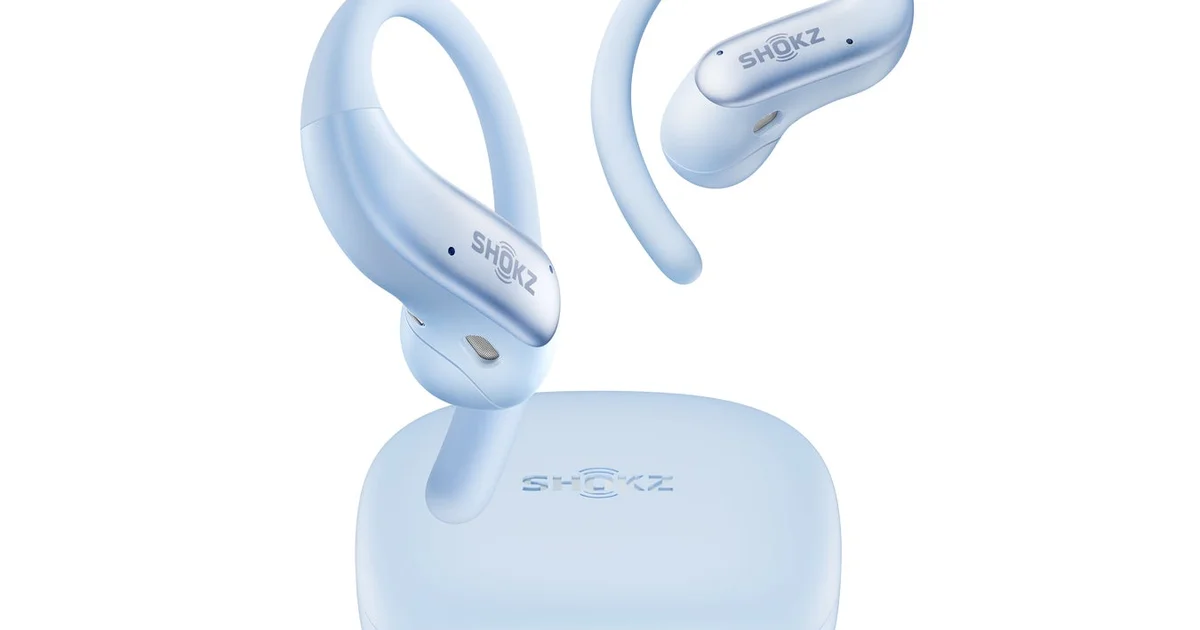
Each earbud is now 17.2% lighter
OpenFit Air 2 weighs 7.2g per side, down from 8.7g for the original OpenFit Air.
Shokz says reaching that figure required redesigning the battery, acoustic chamber, outer pod and supporting frame together rather than simply removing material from one component.
The hook still uses flexible nickel-titanium alloy, with a 0.75mm internal frame intended to hold its shape while adapting to different ears.
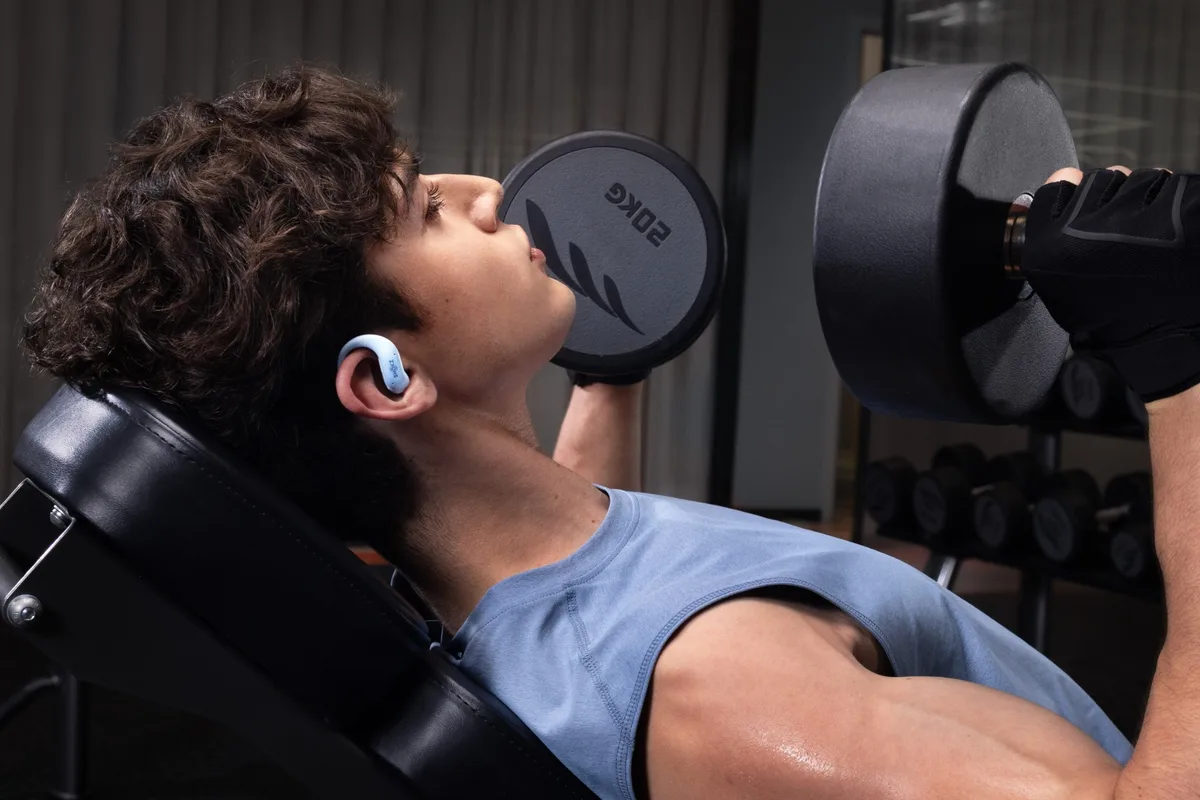
Weight matters particularly in this form factor because nothing is inserted into the ear canal to stabilize the product. Fit depends on balancing the sound module around the ear hook.
Open-ear listening still comes with a physical trade-off
OpenFit Air 2 uses conventional air conduction. Its speaker sits in front of the ear canal rather than sealing inside it.
That makes it different from Shokz’s OpenRun products, which rely primarily on bone-conduction transducers.
The benefit is permanent environmental awareness. Traffic, conversation and warning sounds remain naturally audible without requiring an electronic transparency mode.
The limitation is equally fundamental. Without an acoustic seal, deep bass is harder to reproduce and outside noise cannot be blocked in the way a closed in-ear design can manage.
Bassphere attacks the obvious weakness of open earbuds
The largest acoustic change is Shokz’s Bassphere system. The company describes a pair of high-sensitivity 11.8mm circular drivers working together inside each compact housing.
Shokz says the combined arrangement achieves output comparable to a custom 16mm driver while fitting into the slimmer enclosure.
OpenBass 2.0 processing then reinforces low frequencies to compensate for some of the bass energy lost by leaving the ear canal open.
Early independent testing suggests the new version sounds fuller and more balanced than its predecessor, while still lacking the deepest low-end weight of properly sealed in-ear headphones.
Driver angle becomes part of the tuning
The speaker assembly is positioned at roughly a 30-degree angle to aim sound more directly toward the ear canal.
That small geometric change matters in open-ear audio because minor differences in distance and angle can produce noticeable changes in perceived bass.
Shokz also continues to use DirectPitch technology to concentrate more acoustic energy toward the listener and reduce leakage away from the ear.
It does not make the product completely private. At high volume in a quiet environment, people nearby can still hear some of what is playing.
Pressure buttons replace touch controls
One of the most practical changes is the move away from touch-sensitive controls.
OpenFit Air 2 uses small pressure-operated buttons that are less likely to react accidentally to wet fingers, hair or sweat.
Physical feedback is also easier to recognize while running, when the user is not looking at the earbuds.
Control assignments can be changed through the Shokz app.
Official battery life is eight hours, 36 with the case
Shokz rates the earbuds for up to eight hours of music on one charge and 36 hours total when the charging case is included.
The original OpenFit Air was rated for six hours per charge and 28 hours total.
A ten-minute quick charge now provides up to three hours of listening rather than two.
Some early launch coverage reported 50 hours of total playback. Shokz’s current U.S. and European specification pages list 36 hours, making that the appropriate final figure to use.
The charging case has also been reduced
The redesigned case weighs 46.4g and contains a 600mAh battery.
Total system weight is a little over 60g with the earbuds inside.
The case carries an IP54 rating, while the earbuds themselves reach IP55.
That is enough for dust and splash protection but does not turn either part of the system into swimming equipment.
IP55 is a modest but useful upgrade
The previous OpenFit Air carried an IP54 rating. OpenFit Air 2 moves to IP55 for the earbuds.
The improvement provides better protection against water jets and sweat, fitting the running and workout positioning more naturally.
They are still not intended for immersion.
Shokz sells separate products for swimming; Air 2 is designed around rain, sweat and ordinary outdoor training.
Bluetooth moves forward while the codecs stay simple
Bluetooth advances from version 5.2 to Bluetooth 6.1.
Multipoint allows the earbuds to remain connected to two source devices simultaneously, which is useful for moving between a computer and phone.
Google Fast Pair and Microsoft Swift Pair simplify initial setup on Android and Windows hardware.
Codec support remains limited to SBC and AAC. There is no LDAC or aptX family support.
For a lightweight open-ear sports product, that omission is less dramatic than it would be on a premium sealed headphone. Environmental noise and the open acoustic design will usually be larger constraints than Bluetooth bitrate.
Four microphones handle calls, not ANC
The earbuds use four microphones in total with noise-reduction processing for voice calls.
The system is designed to reduce environmental noise in the signal being transmitted to the person on the other end.
That should not be confused with active noise cancellation for music.
The wearer continues to hear the outside world by design; the processing is primarily trying to make the microphone feed cleaner.
The price rises to €139
OpenFit Air 2 is listed at €139 in France and Germany, $129.95 in the U.S. and £129 in the UK.
The original OpenFit Air remains available for around €109 in parts of Europe.
The extra money therefore buys refinement rather than a completely different product philosophy: lower weight, stronger battery life, improved protection, physical controls and the Bassphere acoustic system.
Black, White and Ice Blue finishes are available.
The feature that matters most may be the one you stop noticing
OpenFit Air 2 will not beat sealed earbuds for sub-bass and cannot silence a train carriage with ANC because that would defeat the entire open-ear concept.
Its job is to remain stable and comfortable enough that the hardware itself gradually disappears during a run or a working day.
At 7.2g, Shokz has pushed that idea further while fixing several everyday annoyances from the original Air.
For something designed to stay on your ears for hours, losing 1.5 grams and adding a button that still works with sweaty fingers may ultimately matter more than another premium Bluetooth codec.