
 By Camille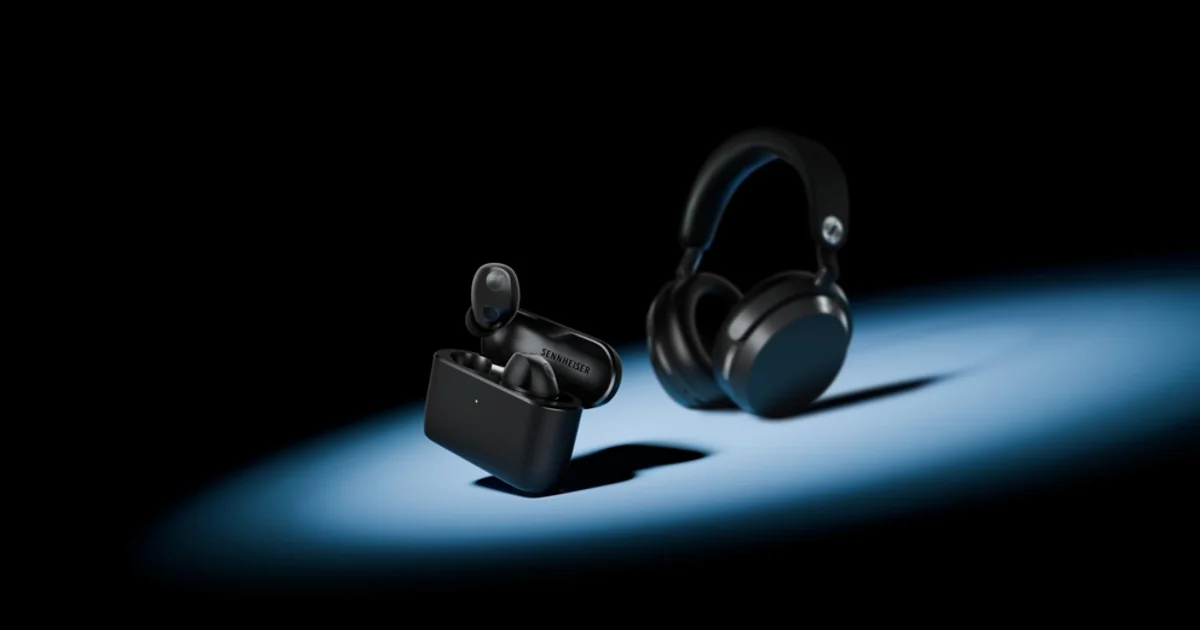
The new flagship pair launches September 3 for $299.95 in the US. Each earbud battery is user-replaceable, and so is the battery inside the wireless charging case.
Sennheiser's support documentation goes beyond vague serviceability language. The housings can be opened with a standard Phillips PH000 screwdriver, and the retail package includes a battery replacement tool.
Serviceable means more here than sending them back to the manufacturer
Some consumer electronics technically contain replaceable batteries while still requiring professional servicing. Momentum True Wireless 5 is designed around an end-user procedure instead.
That distinction is particularly valuable for true wireless earbuds. Their cells are tiny, cycled frequently and traditionally packed inside aggressively miniaturized enclosures that are difficult to open cleanly.
A replaceable battery does not make the entire product repairable. Microphones, charging contacts, circuit boards and physical housings can still fail, and Sennheiser has not turned every internal component into a user-swappable module.
It does address the component whose degradation is virtually guaranteed. The remaining long-term question is parts support: battery pricing and availability years after launch will determine how valuable the design ultimately becomes.
Battery life is now a renewable specification
Sennheiser rates the earbuds for up to 12 hours on one charge and up to 40 hours including the Qi charging case. An eight-minute quick charge can provide up to another hour of playback.
Those are maximum figures rather than a guarantee for every configuration. Noise cancellation, volume, wireless conditions and codec use all affect real-world endurance, and published launch coverage reports substantially shorter runtime with ANC enabled.
The more interesting number may be what happens after hundreds of charge cycles. A conventional sealed pair gradually loses runtime with no straightforward way back. A replaceable cell makes it possible to restore the power subsystem without throwing away the audio hardware around it.
Bluetooth 6 and hi-res audio are separate pieces of the chain
Momentum True Wireless 5 ships with Bluetooth 6.0, multipoint, Google Fast Pair and Microsoft Swift Pair. Sennheiser also includes a selectable robust radio mode intended for congested wireless environments.
The advertised path to 24-bit/96kHz audio comes through aptX Adaptive on compatible source devices, not simply from having Bluetooth 6.0. aptX Lossless is supported through Snapdragon Sound as well.
That compatibility qualification matters. A phone has to support the relevant codec and implementation before the earbuds can use it. Pairing them with an arbitrary Bluetooth 6 device does not automatically create a 24/96 link.
Acoustically, Sennheiser continues to use its 7mm TrueResponse dynamic driver manufactured in Tullamore, Ireland. Whether the finished earbuds sound meaningfully better than their predecessor will therefore need listening and measurement rather than inference from the Bluetooth version number.
Fit is doing part of the noise-cancellation work
The adaptive hybrid ANC system has been revised alongside new ear tips and an automatic anti-wind mode. That combination is sensible because passive sealing is fundamental to how an in-ear product controls outside noise and reproduces low frequencies.
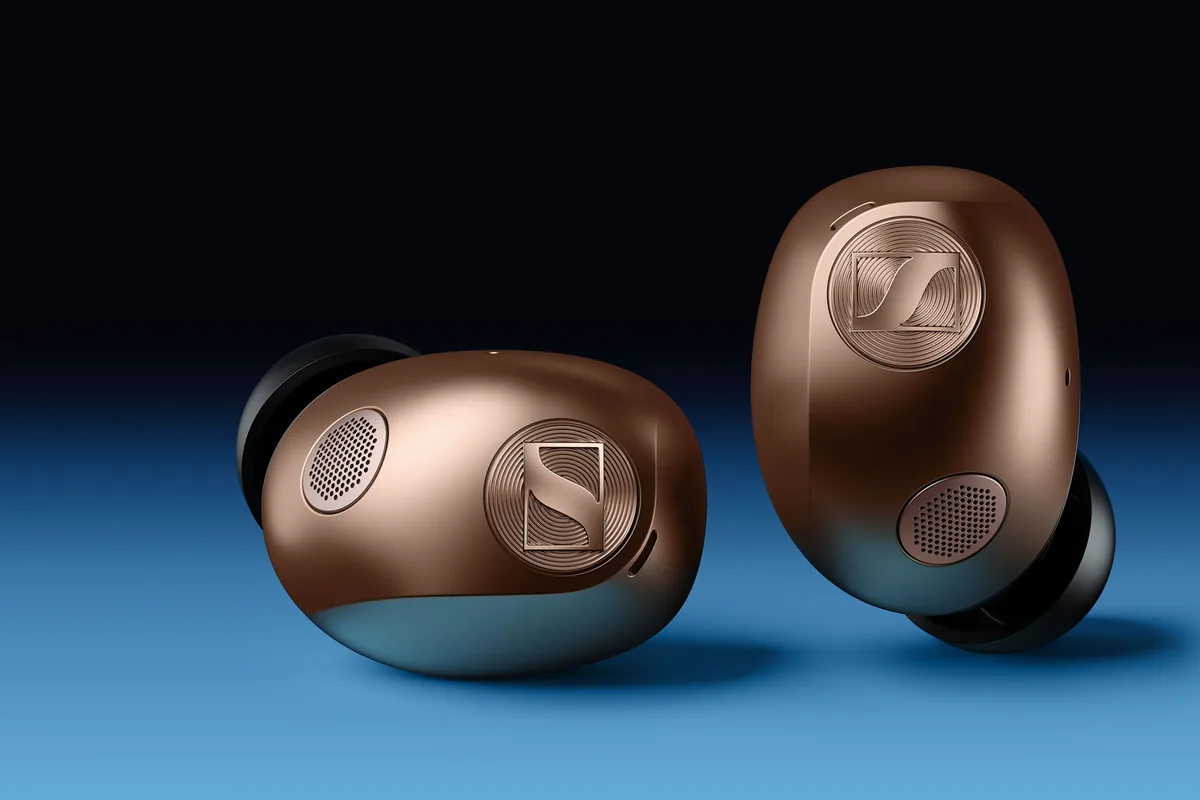
Sennheiser says the shell geometry was developed using data from thousands of individual ear shapes. In the company's own tests, 73% of participants preferred the new finless design for comfort over the previous generation.
That figure is manufacturer testing rather than an independent comfort assessment, but the physical redesign is substantial. The earbuds are IP54-rated against dust, sweat and splashes, and the charging case has also become slimmer while retaining Qi charging.
Calls now combine airborne sound with vibration
Voice pickup uses six microphones and two bone-conduction voice accelerometers across the pair. An AI speech-extraction algorithm combines those signals to distinguish the wearer from competing voices and environmental noise.
Dolby Atmos support arrives with interactive head tracking, while Smart Control Plus provides an eight-band EQ and Sennheiser's sound-personalization controls.
These are meaningful flagship features, but they are also the sort of features that will inevitably be superseded by another codec, another ANC algorithm or another generation of spatial processing.
A $300 earbud is easier to justify when its battery is not a countdown timer
Premium true wireless products have become expensive enough that their disposable construction increasingly looks out of place. Better ANC is useful on day one; a replaceable battery becomes useful precisely when the product is old enough that manufacturers normally want customers thinking about an upgrade.
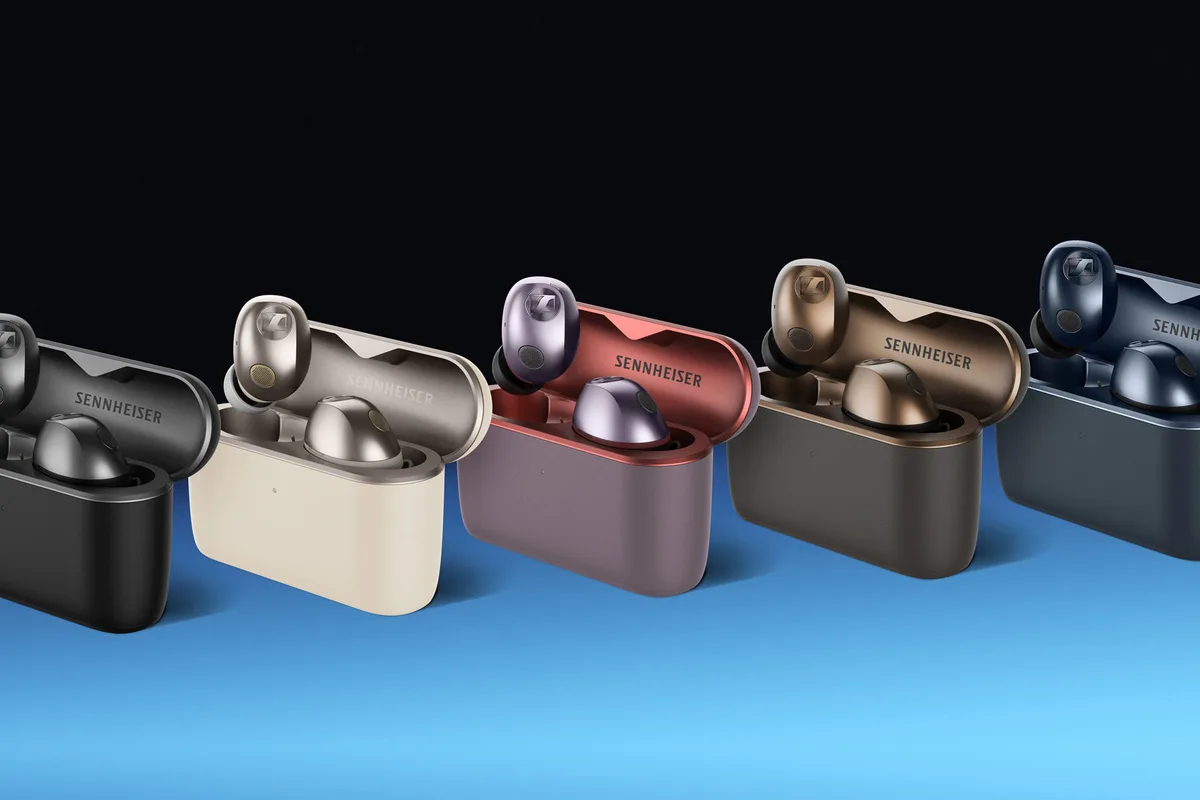
Momentum True Wireless 5 will ship in Graphite, Cream, Copper, Denim and Lavender on September 3.
Their most consequential specification may therefore be the one that cannot be properly judged at launch. If Sennheiser keeps replacement cells available at sensible prices, these earbuds have a credible route to remaining useful after the original batteries no longer do.