
 By Tsuky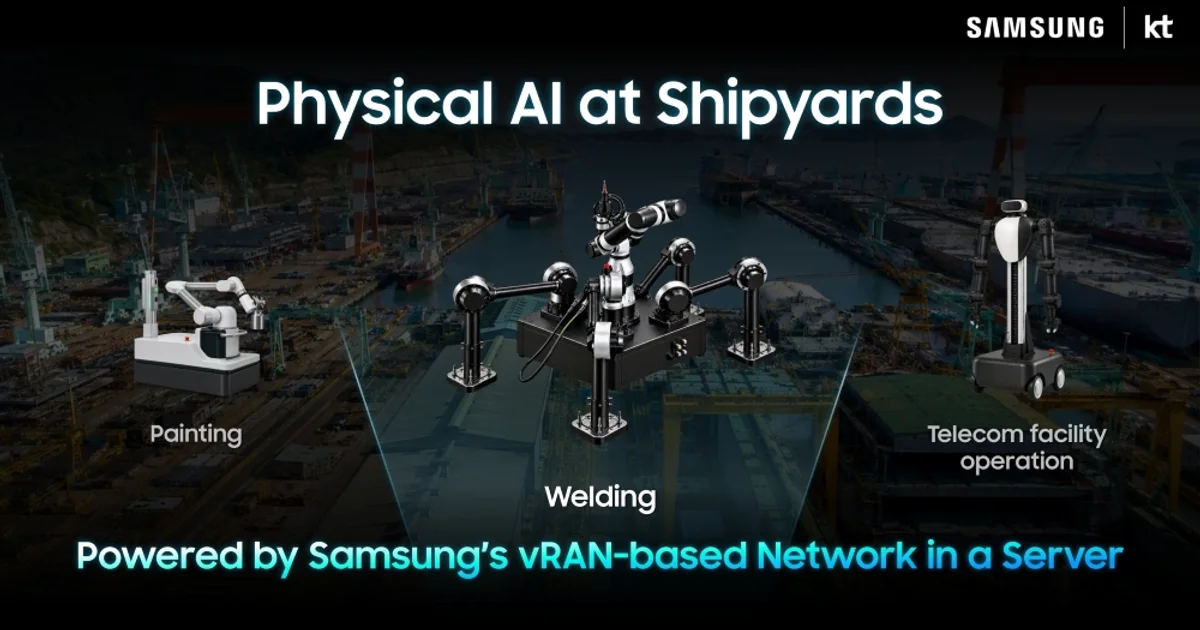
Samsung Electronics announced on September 23 that it had signed AI RAN contracts with South Korean operators KT and SK Telecom.
Both projects are part of the Korean Ministry of Science and ICT's Hyper AI Network initiative.
Deployment is scheduled to begin in October 2026 using private 5G Standalone networks installed inside real industrial environments.
Samsung is the sole global vendor for KT's project and the main vendor for SK Telecom's. That wording matters: Samsung does not describe its SK Telecom role as exclusive.
The first experiment teaches a quadruped robot to weld inside a shipyard
KT will conduct its field trials at HD Hyundai Samho's Yeongam Shipyard.
The program covers several physical-AI use cases, including welding robots, painting systems and autonomous machines used for telecom facility operations.
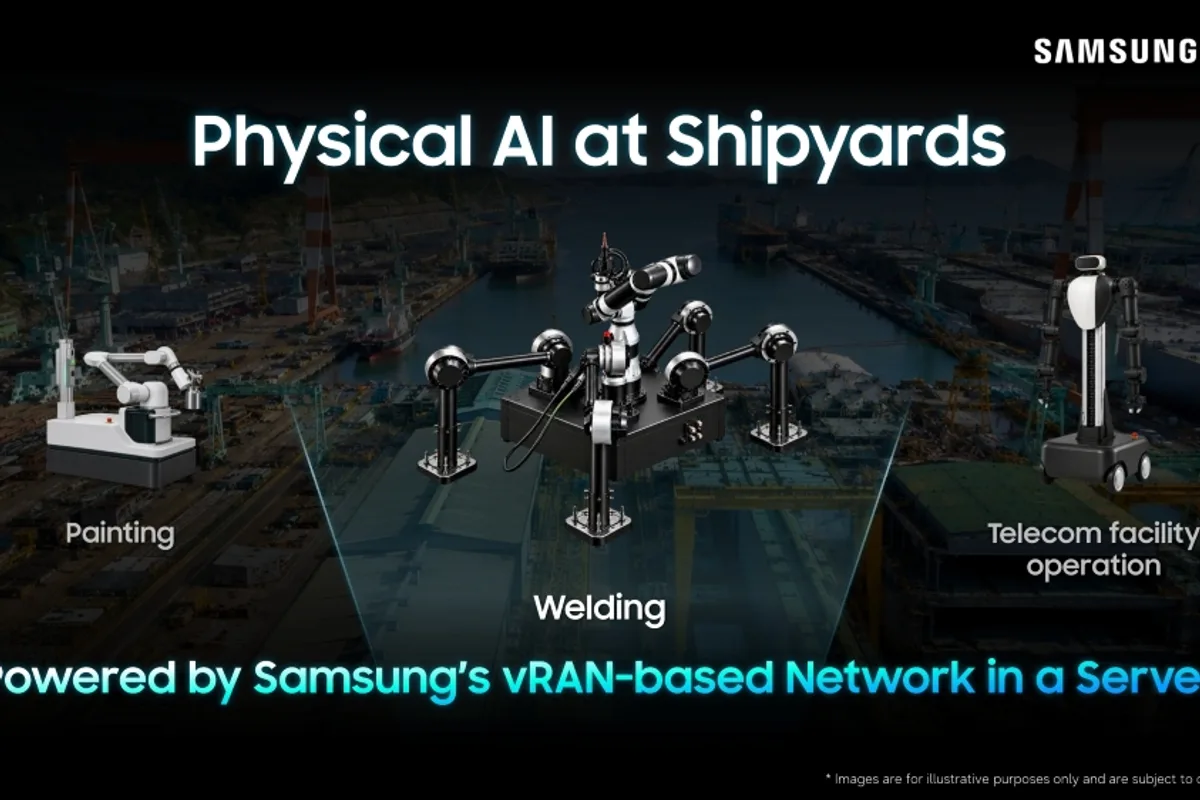
Samsung provides the clearest detail around a quadruped welding robot.
The machine is intended to use 5G connectivity and local AI processing to perceive its surroundings and perform precise welding tasks autonomously.
This is where abstract network characteristics such as latency, reliability and consistent throughput become less theoretical. A robot moving welding equipment cannot simply wait around every time a decision has to travel to a distant data center and back.
Samsung wants to move AI toward the machine instead of moving every machine toward the cloud
The central platform is called Network in a Server, or NIS.
Samsung describes it as an edge-AI architecture combining virtualized RAN, a 5G core and AI applications.
The objective is to process more information locally, close to where sensors and cameras actually generate it.
For an industrial robot, that means a camera feed can enter the local network, reach an AI workload and return a decision without requiring every interaction to depend on a remote cloud region.
Under the AI-native label sits fairly conventional server hardware
Samsung has disclosed an unusual amount of infrastructure detail.
NIS runs its vRAN and 5G Standalone core software on a Supermicro Compact Edge Server powered by an AMD EPYC 8004 CPU and Wind River Cloud Platform.
GPU acceleration can be added when a particular deployment needs more compute.
The important point is that the AI-native concept is not built around an unexplained proprietary appliance. Much of the architecture is about combining software-defined networking, mobile-core functions and AI compute on standardized server hardware that can live directly at the industrial site.
CognitiV handles the network work nobody wants to tune manually
Samsung is also supplying its CognitiV Network Operations Suite.
That software layer is designed to automate network operation and optimization.
Samsung says its AI RAN technology can support anomaly detection, throughput improvement and energy-efficiency optimization, capabilities the company says have already been validated on live networks.
That does not mean an operator can switch on a fully autonomous network overnight. It does show where Samsung wants AI to sit: not only inside the application controlling a robot, but also inside the infrastructure responsible for carrying that robot's data.
At the petrochemical site, the robot is watching instead of welding
The second project will take place at SK Incheon Petrochem.
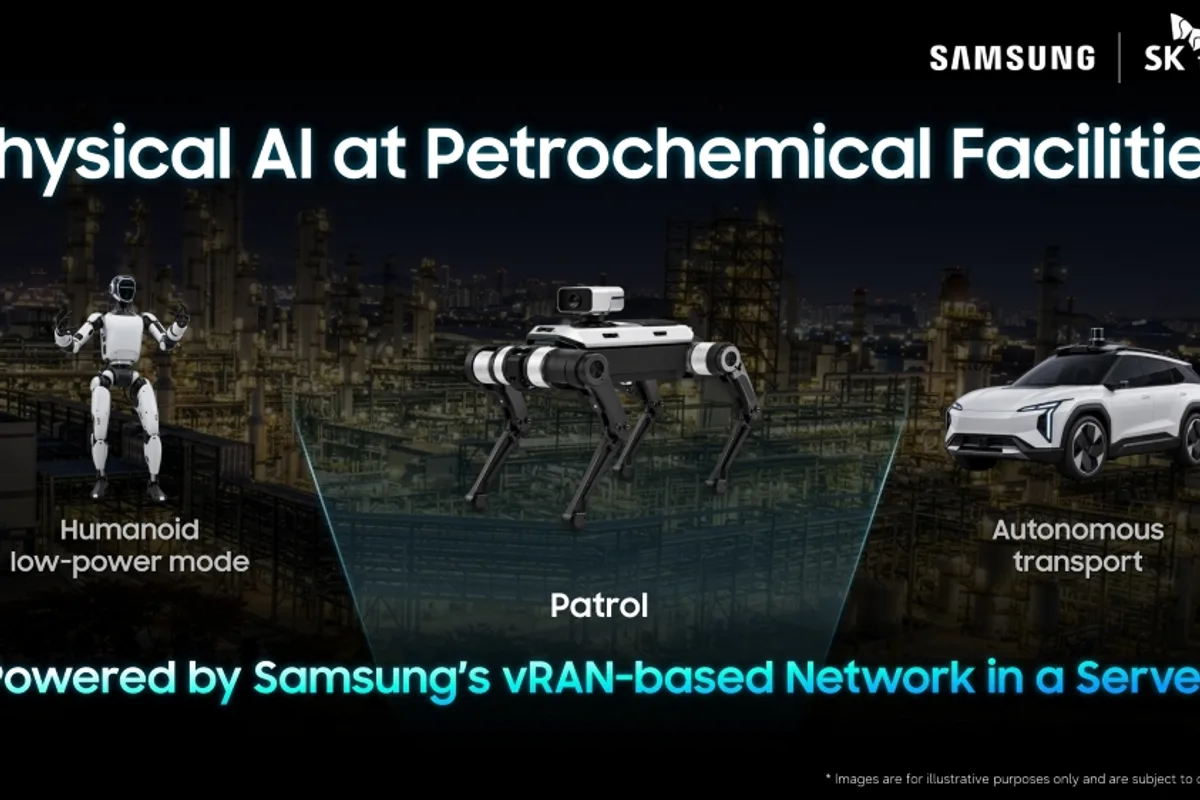
SK Telecom plans to test an autonomous robot that patrols hazardous areas.
The machine will transmit high-definition video in real time while moving through the facility. AI analysis can then examine those feeds for potential hazards and feed information into the site's broader monitoring system.
Samsung is again supplying its NIS platform.
The use case is different from robotic welding, but the network requirement is similar: move large amounts of visual data, analyze it quickly and maintain connectivity reliably enough for automated equipment operating in a safety-critical environment.
AI RAN does not mean putting a chatbot inside an antenna
The terminology can make the concept sound stranger than it is.
RAN stands for radio access network, the portion of a mobile network that connects devices to the wider infrastructure.
AI RAN applies artificial intelligence around that layer in several ways: optimizing network performance, automating operations and placing compute resources closer to radios and connected devices.
In the KT and SK Telecom projects, the objective is therefore not to bolt a conversational AI onto a 5G base station. It is to treat connectivity and AI compute as a coordinated operational platform.
5G is doing the work, while 6G remains the destination
Samsung and the operators frame these projects as groundwork for future AI-native networks associated with 6G.
The deployed technology and the long-term ambition should not be confused.
The private networks going into operation in October are 5G Standalone networks.
They will generate data and validate techniques that may later contribute to next-generation network architecture.
This is not a commercial 6G launch, and it does not establish that every component demonstrated today will become a mandatory part of a future standard.
Why a shipyard is more useful than another clean laboratory demo
Samsung has already been experimenting with AI RAN technology alongside multiple operators and technology partners.
What changes here is the environment.
Shipyards and petrochemical facilities bring physical constraints that are difficult to simulate away: large areas, moving machinery, steel structures, live video, safety requirements and a strong need for predictable connectivity.
A system that behaves well under those conditions produces more meaningful engineering evidence than another peak-throughput demonstration.
When the projects start in October, Samsung will therefore be testing more than whether its network can carry AI workloads. The more interesting question is whether industrial machines can rely on that architecture enough to work through it.