
 By Camille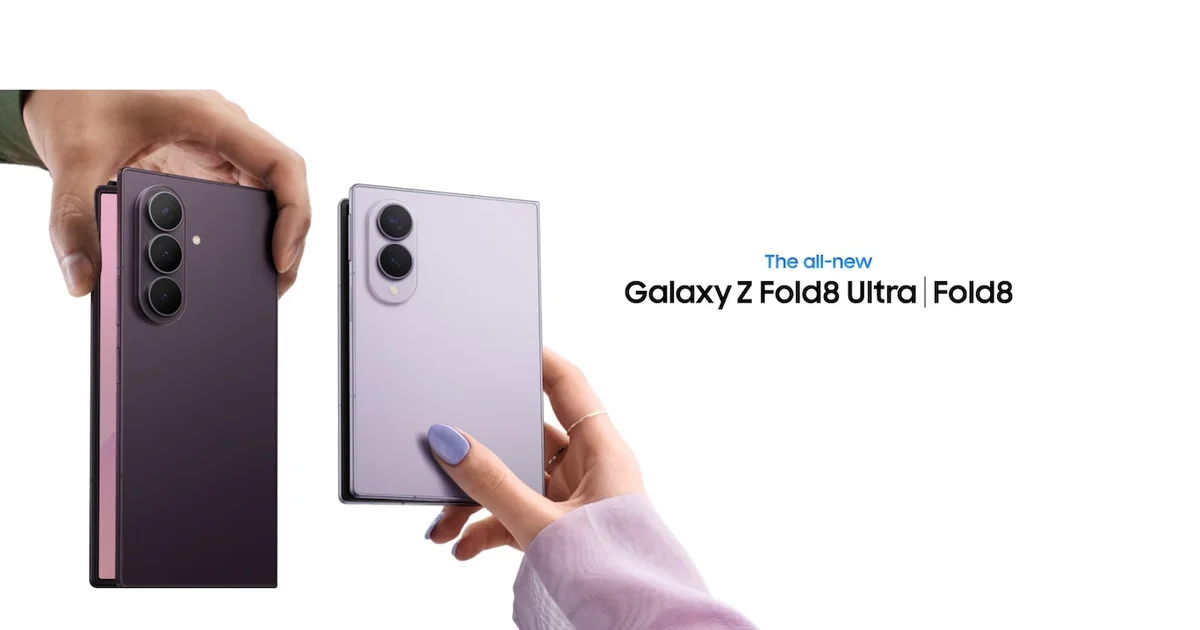
Samsung wanted more companies to take foldables seriously.
It now has Apple.
Around the launch of the iPhone Duo, Samsung rolled out its "Welcome to Foldables" campaign across major cities including Seoul, Tokyo and London. The outdoor advertising promotes the Galaxy Z Fold8 family with messages centered on thinness, weight and Samsung's history in the category.
There is no need for particularly subtle interpretation. Apple has just launched its first foldable. Samsung would like everyone to remember that it has been doing this since 2019.
Seven years ago, Samsung was the company with the broken review units
That history was not always useful marketing material.
The original Galaxy Fold launch became infamous after review devices suffered display failures and Samsung delayed its commercial release.
Eight generations later, the embarrassment has become experience.
Samsung has had years to redesign hinges, reinforce flexible displays, rework internal layouts and discover which parts of a large book-style foldable make people stop wanting to carry one.
The easiest number to understand is weight.
The original Galaxy Fold weighed 276 grams. Galaxy Z Fold8 weighs 201 grams.

That difference directly addresses one of the form factor's oldest complaints. A large inner display is attractive until the closed device feels like two phones stacked in a pocket.
Apple's new CEO John Ternus used essentially that criticism when describing existing foldables.
Samsung's answer was: yes, we noticed
The billboard campaign was only the polite part.
After Apple's presentation, Samsung accounts published a series of sarcastic responses on X, including jabs reported by Reuters such as "reheating our leftovers" and "So far, so same".
That is ordinary technology-industry trolling with an unusually complicated supply-chain footnote.
Apple is entering foldables partly through an industrial ecosystem Samsung helped create. Samsung Display supplies folding screens for Apple's device.
Samsung Electronics therefore has to compete against a foldable iPhone that another part of Samsung helps make possible.
Corporate structure occasionally produces excellent comedy without assistance from a social-media manager.
The Fold8 was engineered around exactly the criticism Apple is making
Samsung had already made portability the central engineering goal of this generation before Apple unveiled the Duo.
Galaxy Z Fold8 uses a shorter, wider passport-like body than Samsung's older Folds. Its 5.5-inch cover display uses a 10:16 aspect ratio, while the 7.6-inch internal screen opens into a 4:3 canvas.
It measures 9.7mm folded and 4.5mm unfolded.
Getting the device down to 201 grams required something less glamorous than a new hinge name. Samsung says engineers reviewed roughly 270 components and more than 180 categories of auxiliary parts.
Some optimizations were measured in thousandths of a gram.
The company redesigned circuit boards, removed or merged small components and introduced titanium structures beneath the flexible display.
Seven generations of maturity often looks like people arguing over fractions of a gram that no buyer will ever directly see.
Samsung even gave up a telephoto camera to get there
Weight reduction still comes with trade-offs.
The standard Fold8 uses two 50MP rear cameras but drops the dedicated telephoto lens. Buyers who want Samsung's more ambitious camera hardware are pushed toward the heavier Galaxy Z Fold8 Ultra.
The standard device carries a 4,800mAh battery and Snapdragon 8 Elite Gen 5 for Galaxy.
That decision says quite a lot about where mature foldable design is heading.
Samsung is no longer optimizing the mainstream Fold around having every possible flagship feature. It is optimizing around being a device people might tolerate carrying every day.
Apple appears to have made similar compromises with its first Duo.
The engineering contest is no longer simply about whether a hinge works. It is about which compromises consumers still accept once the novelty of folding stops excusing everything else.
Samsung's problem is that Apple does not need first-mover advantage
Samsung has experience. Apple has an enormous installed base.
Counterpoint expects Apple to capture roughly 25% of the global foldable market in 2026, while Samsung is projected at around 38%.
If that estimate holds, a first-generation entrant will already sit only thirteen percentage points behind the long-established leader.
That is the least amusing statistic behind "Welcome to Foldables".
The iPhone Duo starts at $1,999 in the United States. Galaxy Z Fold8 starts at $1,899.
For customers already using an iPhone alongside Apple services, a Mac, AirPods or Apple Watch, paying another $100 to change form factor without changing ecosystem may be easier than moving to Android solely to get a foldable display.
Apple can grow Samsung's market while taking Samsung's share
The outcome does not have to be purely zero-sum.
The foldable category had been losing momentum after several weak quarters. IDC now expects Apple's arrival to help drive roughly 13% year-over-year growth.
Samsung can therefore lose market share while selling into a substantially larger market.
Its executives have been making that argument before Apple even arrived. Hee-Cheul Moon, head of Samsung's Advanced Mechanical R&D Group, told WIRED that new brands entering foldables were "absolutely welcome".
Samsung also says global preorders for its 2026 foldable lineup increased by more than 30% compared with the previous generation.
Galaxy Z Fold8 accounted for nearly half.
This is not actually a two-company market
The Apple-versus-Samsung framing is irresistible and incomplete.
Huawei dominates foldables in China and is already selling phones that fold twice. Honor, vivo, OPPO, Xiaomi, Motorola and Google all compete in a category that looks much healthier technically than it did when Samsung launched the first Galaxy Fold.
Apple may therefore mainstream the form factor at exactly the moment Samsung no longer enjoys anything close to exclusive technical credibility.
Seven years of experience remain valuable.
They are no longer seven years of being effectively alone.
Foldables still have boring problems to solve
Marketing campaigns prefer weight and thinness. Ownership eventually reaches dust, repairs and accidents.
Galaxy Z Fold8 remains IP48-rated. Water protection has improved substantially, but fine dust remains a harder problem than on conventional IP68 flagships.
iFixit gave the Fold8 a 4 out of 10 repairability score, with the hinge still buried deep inside the device.
Apple is therefore entering a mature category, not a solved one.
Creases, hinges, battery compromises, repair costs and prices around $2,000 have not disappeared because the iPhone logo finally arrived.
Samsung spent years trying to make foldables normal
It may finally have succeeded.
For eight generations, Samsung had to argue for the existence of the category before it could argue for its own product.
The iPhone Duo changes that conversation. Apple is no longer evaluating foldables from outside the market. It is selling one.
The consumer question becomes much more ordinary and much more dangerous for Samsung: which foldable should I buy?
Samsung has seven years of engineering answers.
Apple had seven years to watch the questions.
Welcome to foldables, indeed.