
 By Adri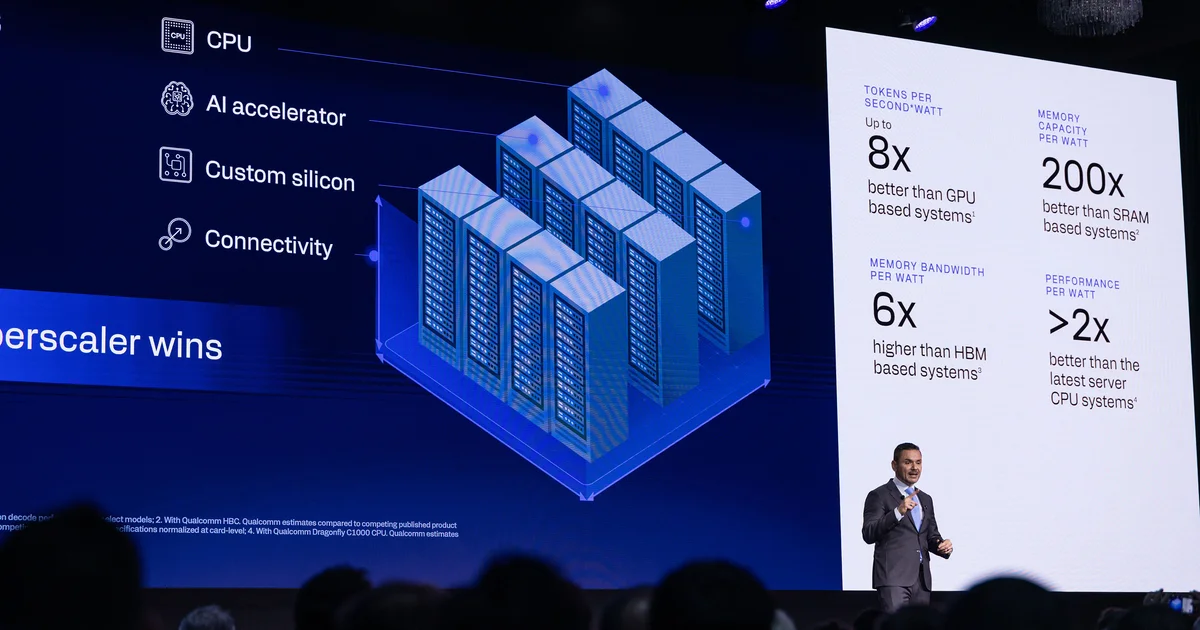
Qualcomm and Amazon announced a multi-generation collaboration on September 8 for future AWS AI data-center infrastructure.
The companies will work together on customized silicon focused on inference, the process of running already-trained AI models at large scale.
The agreement also includes optical connectivity for those systems, with solutions reaching 1.6 Tbps and future generations planned beyond that point.
Qualcomm has not named the custom chips, and the companies have not disclosed a detailed deployment schedule.
The $60 billion figure needs some context
Reuters reports that Amazon could purchase as much as $60 billion in Qualcomm AI data-center chips and related products over the life of the arrangement.
That does not mean Amazon has written a $60 billion check today.
It represents the potential scale of purchases under the long-term commercial framework.
The number is still large enough to change how Qualcomm's data-center ambitions are evaluated.
Qualcomm is targeting $15 billion in annual data-center chip revenue by 2029, which means Amazon could become one of the most important customers behind that goal.
Amazon also gets a path to a much larger Qualcomm stake
The financial relationship extends beyond product purchases.
Qualcomm granted Amazon warrants covering as many as 25 million Qualcomm shares at an exercise price of $161.26.
At the announced terms, that represents roughly $4 billion worth of potential equity.
The warrants vest in connection with product purchases.
That creates a direct alignment between the commercial relationship and Amazon's potential ownership: the more deeply AWS deploys Qualcomm technology, the more significant Amazon's eventual stake could become.
The interesting part is that Qualcomm is not selling compute alone
The agreement directly connects two layers that are becoming difficult to separate in large AI clusters: the silicon running the models and the network moving data between that silicon.
When a workload uses a handful of accelerators inside one server, individual compute performance can dominate the discussion.
When a model is spread across thousands of devices, moving activations, weights and intermediate results becomes part of the workload itself.
A very fast accelerator can spend an embarrassing amount of time waiting if the network around it cannot keep up.
Qualcomm therefore wants to arrive at AWS with both customized compute and some of the plumbing required to keep that compute busy.
1.6 Tbps connectivity is becoming part of the AI product
Qualcomm and Amazon are working on optical links reaching 1.6 Tbps.
The effort will use Qualcomm's high-speed SerDes and optical DSP technology.

An optical DSP processes and conditions the electrical and optical signals used by the transceivers carrying data between networking equipment.
Qualcomm's current Dragonfly O100 already demonstrates that capability with a 4nm PAM4 DSP designed for 800G and 400G optical transceivers at 100 Gbps per lane.
The Amazon collaboration extends toward the next 1.6T class and later generations.
That makes networking more than an accessory sitting beside an AI chip. It becomes part of the compute architecture.
The Alphawave acquisition suddenly looks much easier to explain
Qualcomm strengthened this part of its portfolio through its approximately $2.4 billion acquisition of Alphawave.
That transaction brought additional high-speed interconnect, SerDes and data-center connectivity IP into Qualcomm.
Those technologies once looked relatively distant from the company's historical modem business.
The Amazon deal shows exactly where they fit.
Qualcomm does not want to enter data centers with one large accelerator. It wants to provide several of the components required to make an entire cluster operate as a coherent machine.
AWS already designs its own AI chips
The partnership is more interesting because Amazon does not need an outside supplier simply to begin designing custom AI silicon.
AWS already builds Trainium for training and Inferentia for inference through Annapurna Labs.
Amazon therefore has its own chip architecture teams and substantial experience building cloud ASICs.
Qualcomm's arrival does not imply Trainium or Inferentia are going away.
It instead suggests that even a hyperscaler with internal accelerator programs sees room for additional silicon families optimized around different workloads.
The public announcement does not yet explain exactly where Qualcomm-built parts will sit beside AWS's internal chips.
Inference is exactly where silicon diversity can explode
Frontier-model training can favor a relatively small number of extremely powerful architectures because only a limited group of customers can finance those clusters.
Inference behaves differently.
Once a model has been trained, it may be executed billions of times to answer users, process documents, generate code or drive autonomous agents.
Those requests do not all require identical amounts of memory, compute or numerical precision.
That creates far more room for specialized ASICs, workload-specific architectures and systems optimized primarily around cost per token.
That is the opening Qualcomm is targeting.
Dragonfly is now a complete data-center roadmap rather than one accelerator
The Amazon announcement does not arrive in isolation.
In June, Qualcomm introduced a much broader data-center roadmap including the Dragonfly C1000 CPU, AI200, AI250 and AI300 accelerators, High Bandwidth Compute technology and a portfolio of connectivity products.
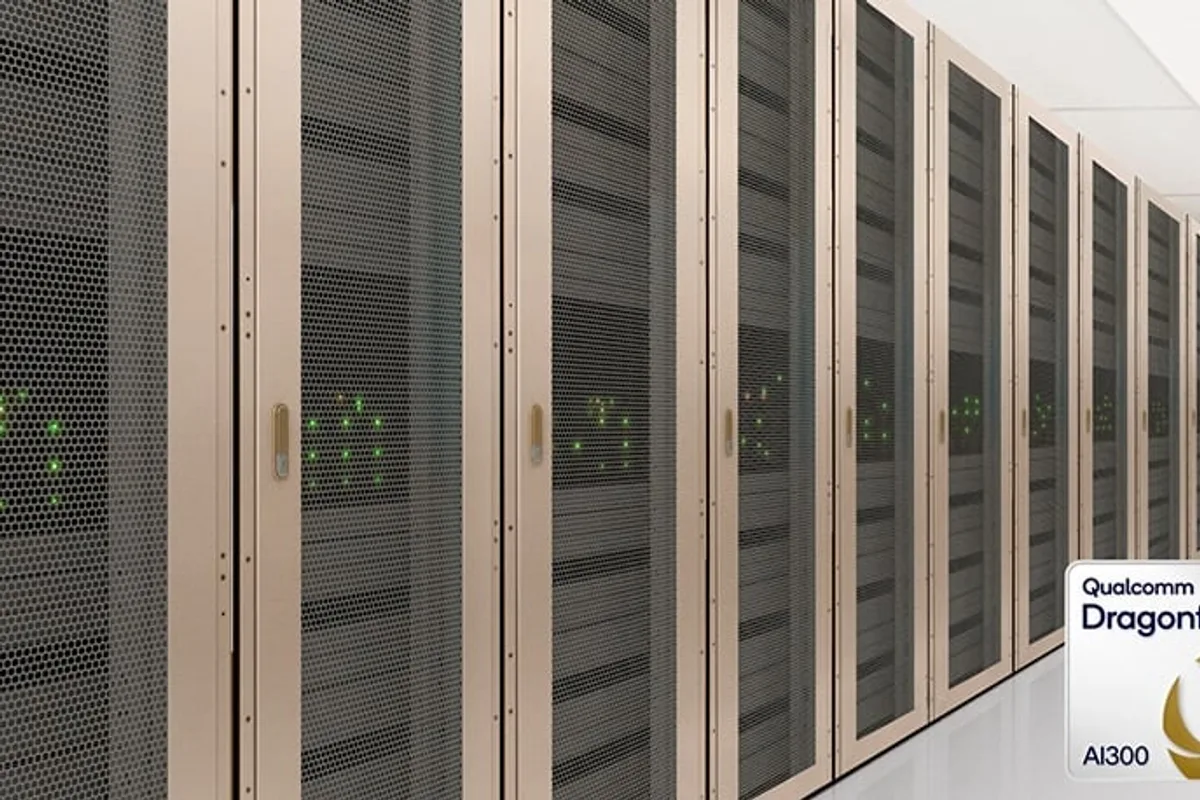
AI300 is intended to become the third generation of Qualcomm's rack-scale inference platform, with commercial sampling expected in 2028.
The company is simultaneously offering fully customized silicon for hyperscalers.
That final category may be the most directly relevant to Amazon.
The resulting device does not have to be a standard Dragonfly accelerator sold from a public catalog. Qualcomm can use its CPU, memory, networking, packaging and silicon-design IP as building blocks for hardware designed around one very large customer's requirements.
This is a very different way of attacking NVIDIA
Qualcomm is unlikely to win by asking Amazon to replace every NVIDIA GPU with a cheaper imitation.
The strategy is more fragmented.
Some workloads will continue to run on general-purpose GPUs. Others can move to Trainium or Inferentia. Highly specific inference tasks may justify custom ASICs built with Qualcomm.
At AWS scale, capturing only a fraction of inference can still represent an enormous market.
Qualcomm's real opponent is therefore not one particular NVIDIA GPU.
It is the assumption that CUDA and NVIDIA accelerators should remain the automatic choice for almost every AI workload.
Power efficiency is Qualcomm's natural argument
Qualcomm has emphasized energy efficiency for decades because its industrial history comes from mobile computing.
In a smartphone, wasting a few watts quickly becomes a battery and thermal problem.
Inside an AI data center, the scale changes but the principle returns.
Extra megawatts mean more cooling, transformers, backup generation, electrical infrastructure and operating cost.
If a specialized accelerator can execute a particular inference workload using materially less energy than a more general architecture, the savings become enormous when repeated billions of times.
That is the environment in which Qualcomm's performance-per-watt background becomes strategically useful.
Amazon becomes customer, design partner and cloud supplier at once
The relationship also runs in the other direction.
Qualcomm plans to expand its use of AWS infrastructure for its own electronic-design workloads.
The company specifically mentions Amazon Bedrock as part of the AI infrastructure used for EDA.
The stated goal is shorter chip development cycles.
The loop is unusually neat: AWS provides infrastructure that helps Qualcomm design chips that Qualcomm may later sell back to AWS.
These cross-linked relationships are becoming increasingly common in AI infrastructure, where customers and suppliers can finance or enable different layers of the same compute chain simultaneously.
Smartphones still matter, but they are no longer enough
This diversification also arrives as Qualcomm knows its historical business cannot remain its only major growth engine forever.
Apple continues replacing Qualcomm modems with internally developed components, while the global smartphone market is considerably more mature than AI infrastructure.
Qualcomm is therefore pushing into PCs, automotive, IoT and now much more aggressively into data centers.
An AWS agreement materially changes the credibility of that last effort.
Publishing a Dragonfly roadmap proves that Qualcomm has an ambition. Convincing a hyperscaler to commit across several product generations shows that a customer is willing to build around it.
A huge potential contract does not guarantee technical success
Several major questions remain unanswered.
Qualcomm has not disclosed the architecture of the Amazon chips, their manufacturing process, performance, power consumption, memory configuration or first production date.
There is also no guarantee that the full $60 billion potential purchasing level will be reached.
Software will matter just as much.
An inference accelerator can look excellent on a cost-per-token spreadsheet and still struggle if AWS customers need substantial work to adapt models, compilers and frameworks to it.
Qualcomm therefore faces the same test as every new AI-compute entrant: proving not only that it can build silicon, but that customers can actually use that silicon without turning every deployment into a research project.
Amazon just gave Qualcomm something a roadmap cannot provide
Qualcomm has spent months assembling the pieces required to call itself a data-center supplier.
CPUs, accelerators, HBC, optical networking and custom silicon certainly form the outline of a platform.
The missing validation was harder to manufacture: a hyperscaler willing to connect several future generations of its infrastructure to that strategy.
Amazon now provides exactly that.
The potential $60 billion naturally attracts attention, but the more important part of the agreement may be structural.
Qualcomm is no longer merely trying to enter the data center.
It is now helping design what one of the world's largest clouds intends to put inside it.