 By Tsuky
Developing a drug involves more than discovering a promising molecule. Manufacturing capacity, toxicology studies, regulatory preparation, budgets and clinical scheduling must all advance together. A delay in one activity can force several other teams to revise their plans.
Orchestra Bio was built around that coordination problem. Its software combines program information and AI agents to help pharmaceutical teams monitor development activities, identify dependencies and prepare decisions.
OpenAI confirmed its acquisition of the company on October 20. Orchestra's technology and employees are set to join Rosalind, the AI product ecosystem designed for life sciences research. Financial terms were not disclosed.
This is a meaningful expansion of what OpenAI wants its scientific products to do. GPT-Rosalind focuses on scientific questions and analysis. Orchestra addresses the administrative and operational work required to translate research progress into a coordinated development program.
A failed manufacturing batch can disrupt an entire program
OpenAI uses a manufacturing failure to explain the problem Orchestra is designed to address. If a batch cannot be used, a clinical study may need to be delayed. That change can affect supplier commitments, research milestones, regulatory preparation and spending plans.
Orchestra's agents are intended to recognize these relationships, gather the relevant information and help program teams compare potential responses.
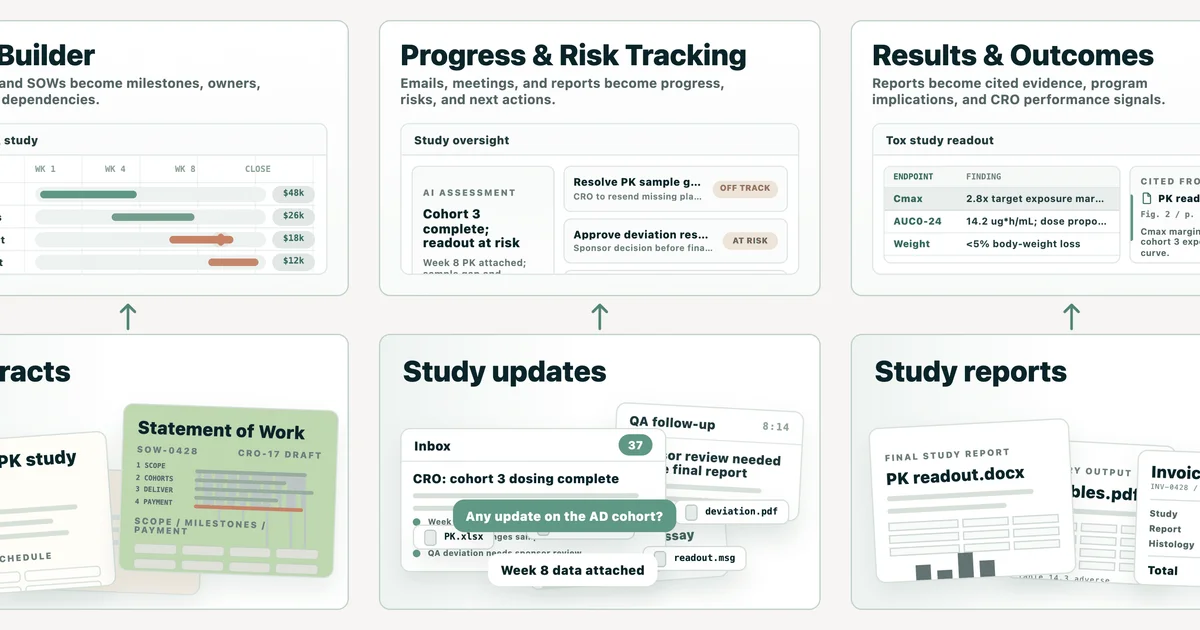
The platform brings together information from studies, project plans, communications and financial tracking. Scientists and project leaders can delegate monitoring tasks while retaining responsibility for scientific and business decisions.
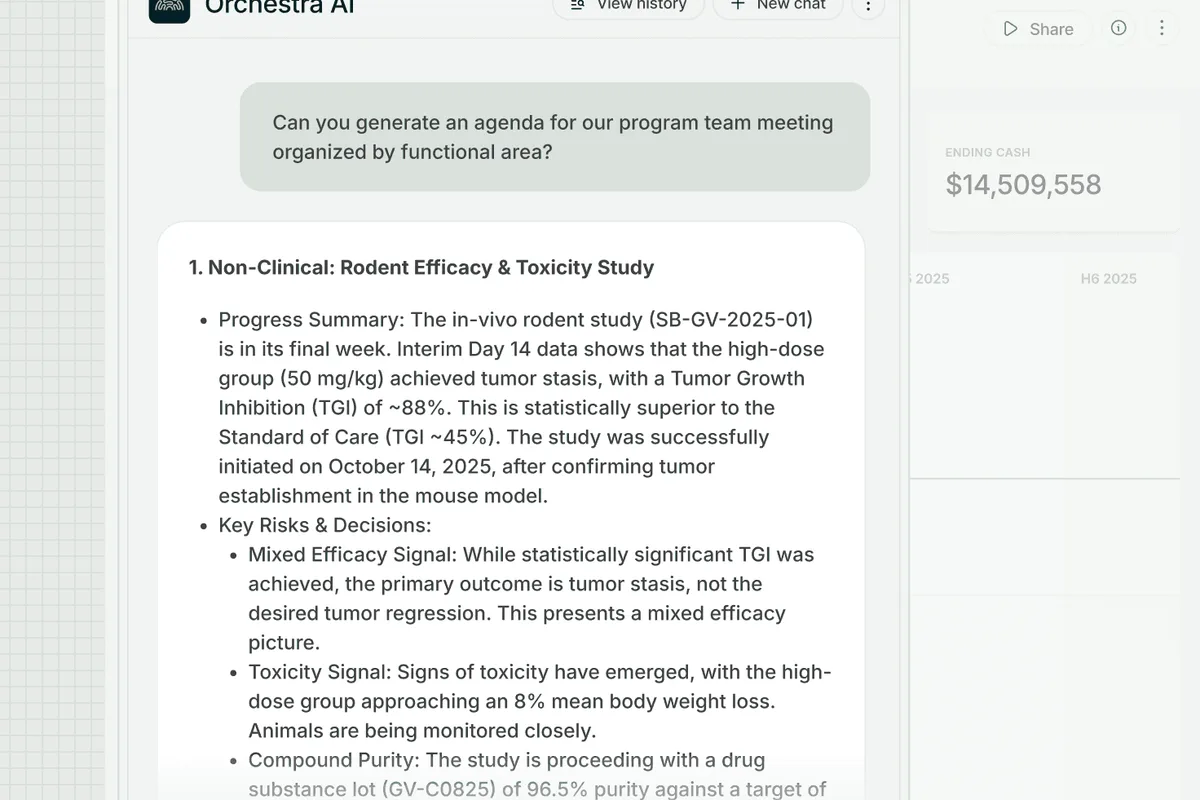
Its existing interface illustrates several practical applications. Dashboards display development milestones, expected costs, dependencies and potential schedule problems. An AI assistant can also organize project information into meeting agendas or summaries of unresolved issues.
These capabilities differ from simply asking a general-purpose assistant to summarize a document. Effective program coordination requires continuity: updated information must remain connected to the activities and decisions that depend on it.
That is particularly important in pharmaceutical development, where scientific work frequently involves external partners and specialized teams operating on different schedules.
Rosalind supplies the scientific reasoning layer
OpenAI introduced GPT-Rosalind in April 2026 as a specialized model for life sciences, including biology, chemistry and drug discovery.
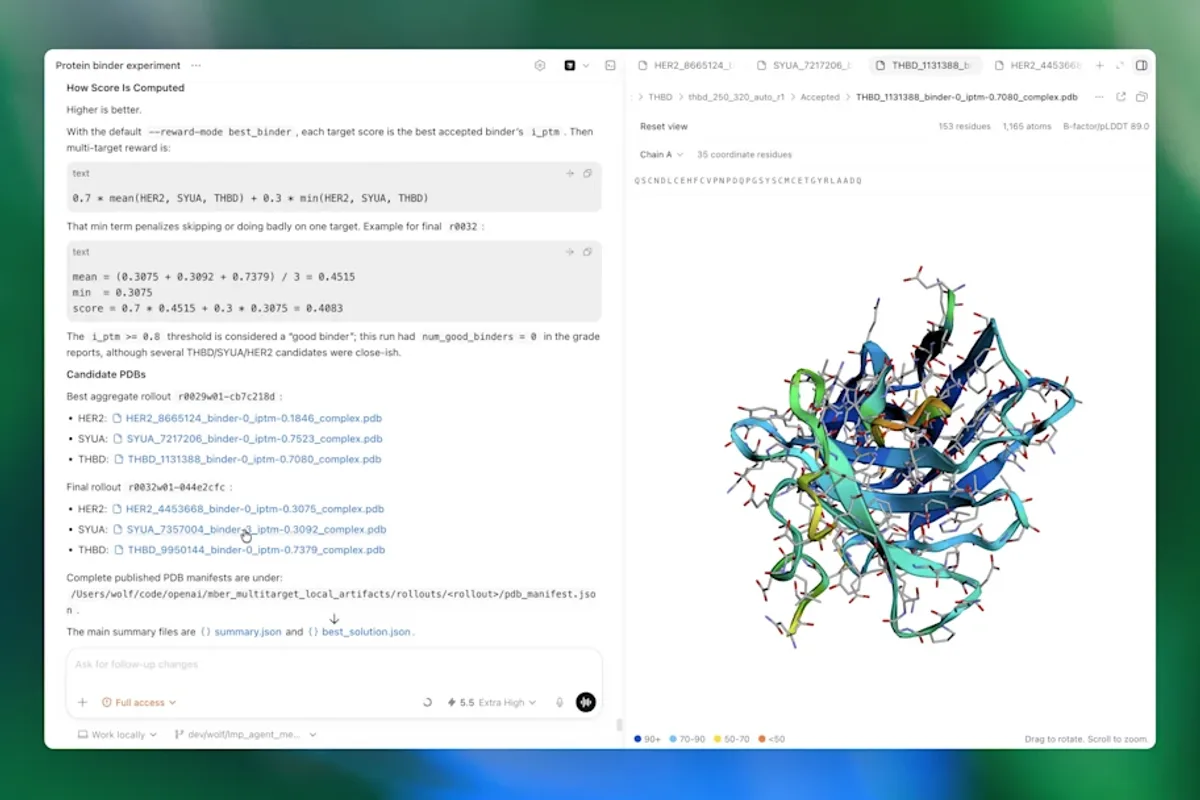
The accompanying Rosalind Workbench connects AI reasoning with scientific tools and data. Researchers can use the environment to analyze results, explore hypotheses and prepare experimental work.
Orchestra offers a potential continuation of that process. Once an experiment produces a result, the project may require additional validation, new studies, manufacturing preparation or revisions to its development plan.
OpenAI wants agents capable of linking scientific findings with those subsequent tasks. The company describes a long-term vision covering discovery, experimental design, interpretation and the coordination of promising treatments through development.
The acquisition provides software and personnel to pursue that vision. It does not mean a fully unified Rosalind-Orchestra platform has already been deployed to every customer.
The deal also follows OpenAI's October 15 announcement of the Rosalind Academic Plan. Eligible research laboratories can apply for up to 30 Business Standard seats at no cost for twelve months, with access to GPT-Rosalind subject to additional approval.
Academic research and commercial pharmaceutical development have different requirements, but both initiatives place specialized scientific workflows at the center of OpenAI's product expansion.
Faster coordination does not automatically mean faster drug approval
OpenAI notes that developing a new medicine in the United States can take roughly 10 to 15 years from identifying a therapeutic target to regulatory approval.
That figure provides context for its ambitions. It is not evidence that Orchestra or Rosalind has already shortened the drug development process by any specific amount.
There are areas where AI-assisted coordination could plausibly improve productivity. Teams spend time reconciling documents, tracking dependencies and communicating changes. Identifying a delay earlier or preparing a decision more efficiently may help prevent avoidable administrative setbacks.
Other aspects of drug development cannot be compressed so easily. Experimental validation, toxicology, clinical trials and regulatory review involve evidence requirements that remain essential regardless of how efficiently project information is organized.
The acquisition announcement contains no controlled comparison demonstrating a reduction in development timelines across complete pharmaceutical programs.
Scientific productivity is also different from therapeutic success. More hypotheses, faster document analysis or improved experiment planning do not guarantee that more drug candidates will prove safe and effective.
Data access and agent permissions become central questions
A system coordinating pharmaceutical research needs access to sensitive information. Study results, manufacturing plans, budgets and proprietary research decisions may be spread across internal systems and external partners.
Connecting these sources to AI agents creates practical governance requirements. Organizations need to determine what an agent can read, which information it can modify and when a proposed action requires explicit human approval.
Traceability is equally important. A program manager must be able to distinguish a verified study outcome from an AI-generated interpretation and establish which documents support a recommendation.
If an agent incorrectly classifies a delay or relies on outdated information, that mistake could affect multiple teams even without the agent making any clinical decision itself.
These are design considerations for regulated enterprise software, not evidence of security failures at Orchestra Bio. OpenAI's announcement emphasizes human collaboration and governance but does not provide a complete technical account of the future integration's permission architecture, data residency controls or regulatory compliance arrangements.
The operational value of such a platform will depend partly on its ability to make AI-generated analysis inspectable and correctable.
OpenAI is moving deeper into industry-specific software
The acquisition fits into OpenAI's broader relationships with pharmaceutical companies. OpenAI identifies Novo Nordisk and Moderna as organizations using or developing AI-supported workflows in research and development.
At Novo Nordisk, the partnership aims to improve scientific and operational execution while preserving governance. At Moderna, OpenAI describes AI helping teams translate complex data into experimental workflows.
These efforts require more than a capable language model. Scientific software must work with established applications, access controls, specialized data formats and decision-making processes.
Other AI companies are pursuing similar opportunities. Anthropic has expanded its life sciences offerings, including Claude Science, as competition moves from general-purpose model performance toward software designed for specific industries.
Orchestra brings OpenAI expertise in pharmaceutical program management rather than merely another scientific foundation model. That distinction may become important as AI vendors compete for long-term enterprise relationships.
The commercial details remain limited. Neither company has disclosed the acquisition price, and no comprehensive schedule for combining the platforms has been announced.
Orchestra's own website confirms that it is joining OpenAI and intends to continue its work on a larger scale. That establishes the company's direction, not the performance characteristics of future integrated products.
For customers, the meaningful evidence will come from deployments that demonstrate reliable study tracking, usable audit trails, fewer avoidable delays and better-supported decisions. The acquisition is complete; its impact on real pharmaceutical development remains to be established.