
 By Adri
The most important distinction in the reported $35 billion order figure is that it is not recognized revenue. It represents the potential list-price value of orders described by people familiar with the matter. NVIDIA has not publicly confirmed the volumes attributed to the three Chinese companies, and none of those orders guarantees immediate delivery.
According to Reuters, ByteDance, Alibaba and Tencent have collectively requested more than three million RTX PRO 5500 graphics cards. Total demand from customers in China reportedly exceeds six million units. That figure is particularly striking because NVIDIA is said to have indicated it may manufacture no more than three million units worldwide in 2027.
The resulting supply imbalance would be considerable even before accounting for orders from customers outside China. But the production forecast itself is based on anonymous sourcing rather than a formal public capacity announcement.
A workstation GPU with data-center ambitions
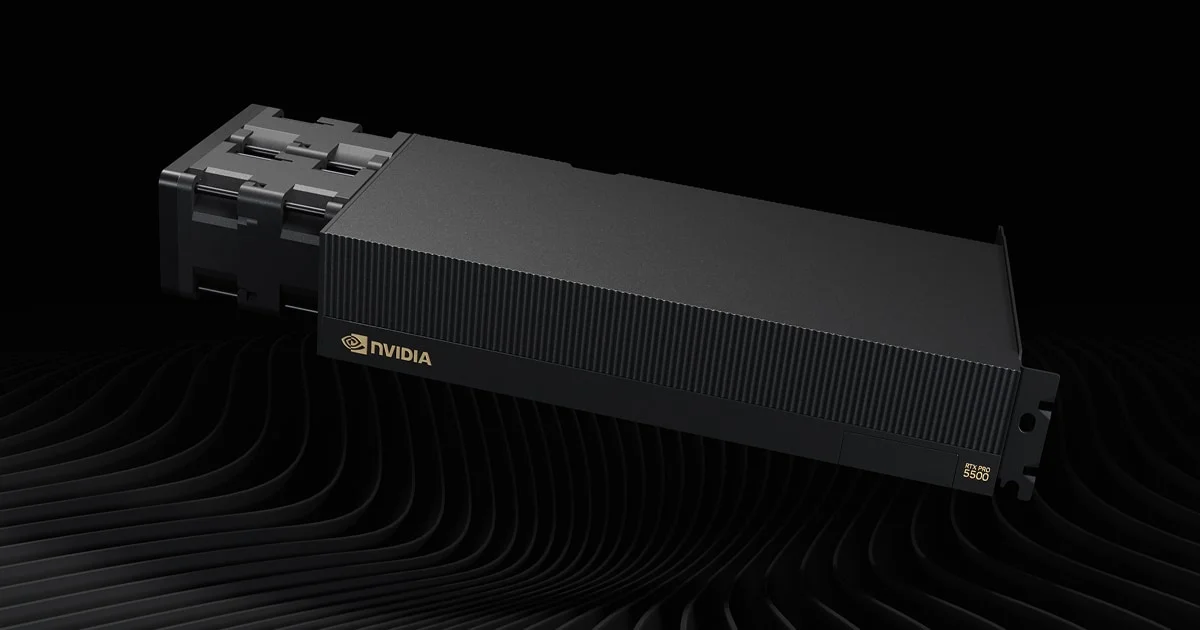
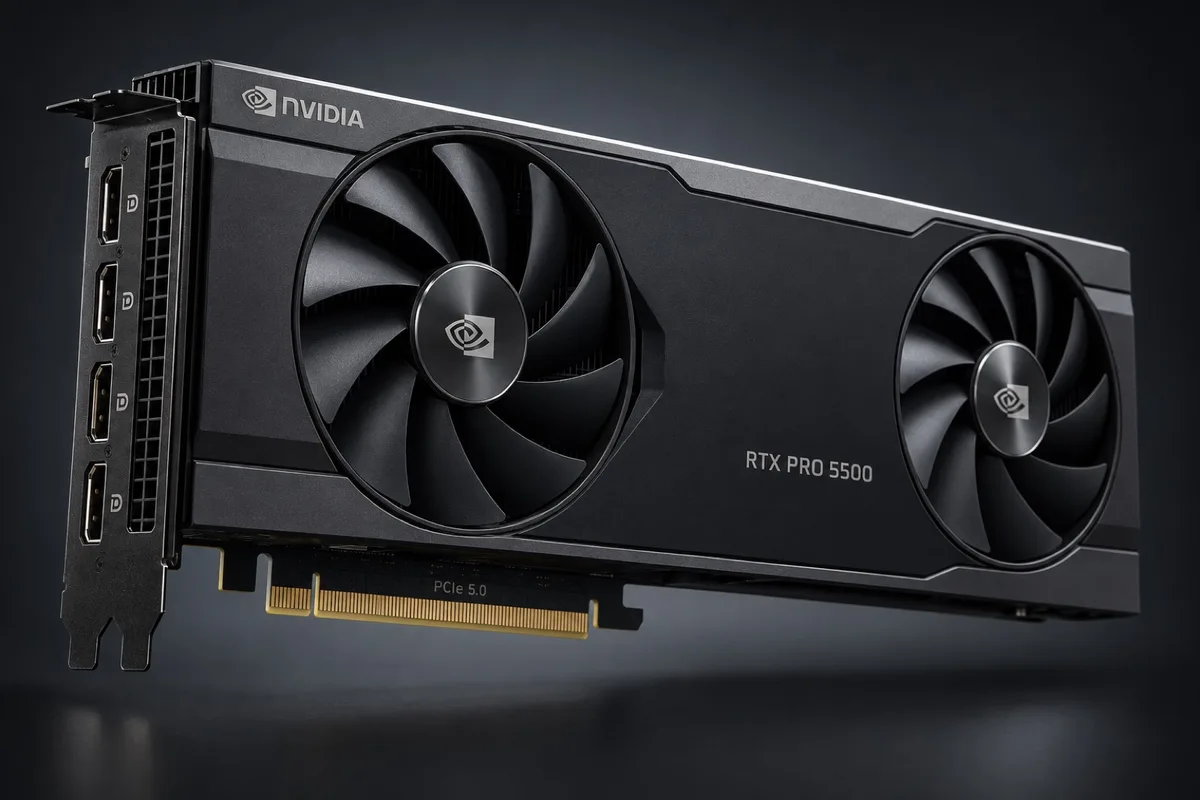
NVIDIA's RTX PRO 5500 Blackwell Workstation Edition is officially positioned as a professional GPU for AI, simulation, rendering and centrally managed workstation infrastructure. It is not designed as a direct replacement for the company's most powerful interconnected data-center platforms.
The specifications nevertheless make it attractive for substantial AI workloads. NVIDIA lists 84 GB of error-correcting GDDR7 memory and 1,398 GB/s of memory bandwidth. The card supports PCIe Gen 5 x16, fifth-generation Tensor Cores and fourth-generation ray-tracing cores.
Maximum board power is rated at 600 W. Air cooling is supported, while a liquid-cooled RXM solution is also available. Multi-Instance GPU functionality can divide the accelerator into two isolated instances with dedicated resources.
Memory capacity is central to the current demand. Inference systems require access to model weights, attention caches and intermediate data. Keeping more of that information in fast GPU memory can improve performance and reduce the need to move data between system and accelerator memory.
For applications serving large numbers of chatbot users, inference capacity can matter as much as raw training performance. These are different computational problems, however, and strong performance in one does not establish equivalent capability in the other.
A large-memory workstation GPU cannot simply be equated with an H200 or B300 deployment. Networking architecture, interconnect bandwidth, software configuration and the characteristics of individual models significantly affect performance at scale.
Export controls have changed what Chinese buyers can realistically obtain
The B300 remains subject to US restrictions preventing sales to Chinese customers, while H200 exports face case-by-case licensing requirements. The RTX PRO 5500 is less powerful but is reportedly compatible with the current rules governing relevant exports.
That distinction has altered purchasing priorities. Companies that might previously have preferred higher-end accelerators now have an incentive to secure large quantities of hardware that can actually be supplied within the regulatory framework.
Reuters reports that Chinese customers primarily want the RTX PRO 5500 for inference, rather than the most demanding large-scale training workloads. Product specifications reviewed by the agency suggest performance in the range of the earlier RTX 6000D, though that comparison should not be treated as an independently reproduced benchmark.
The RTX 6000D provides useful context. NVIDIA introduced it as a product adapted to export restrictions, but some large Chinese companies initially considered it too expensive relative to its capabilities. Buyers also hoped stronger accelerators might eventually become accessible again.
Those expectations appear to have weakened. Reuters says the RTX 6000D has been discontinued and that its market price in China has doubled. Hardware that once looked like an unattractive compromise has become more valuable as access to alternative computing resources remains constrained.
The supply figures point to an allocation problem, not just a sales opportunity
One source told Reuters that partners might receive only 5% to 10% of the quantities they requested. These figures describe reported allocation guidance, not a definitive delivery percentage applicable to every customer.
The difference matters because an order book can expand far faster than semiconductor manufacturing capacity. Each accelerator depends on fabrication slots, memory availability, packaging, board assembly and final system integration.
NVIDIA also faces a strategic production decision. Reuters reports that the company expects to devote substantial capacity at TSMC to its next-generation Rubin platform in 2027. Rubin is intended for large-scale data-center infrastructure and may take priority over lower-tier professional products.
The RTX PRO 5500 is therefore competing for industrial resources within NVIDIA's own portfolio. Demand from China does not automatically translate into an equivalent expansion in manufacturing volume.
A supply shortage can also affect purchasing behavior. Customers may order more than they ultimately expect to receive in the hope of securing enough capacity through the allocation process. The figures published by Reuters cannot establish how much of the reported demand will translate into completed transactions.
Why the $11,400 unit price is only part of the calculation
At approximately $11,400 per card, the combined reported orders exceed $35 billion in potential list-price value. Actual revenue would depend on delivered quantities, contract terms, negotiated prices and the timing of shipments.
Large AI deployments introduce additional costs beyond accelerator purchases. Servers, CPUs, system memory, networking, power distribution and cooling infrastructure all contribute to total ownership costs.
A theoretical installation of 10,000 cards operating simultaneously at their stated maximum 600 W GPU power would require 6 MW for the GPUs alone. This is not an estimate of normal data-center consumption; it excludes system overhead and assumes every accelerator is running at its maximum power limit.
Such calculations matter when discussing millions of accelerators. The limiting factor may not be the purchase price alone. Physical infrastructure must exist to operate the hardware effectively.
China's domestic chip industry is advancing, but migration remains complicated
US restrictions have accelerated interest in domestic Chinese semiconductor alternatives, with Huawei among the companies gaining relevance in AI infrastructure.
Replacing NVIDIA hardware involves more than comparing chip specifications. Many AI systems rely on CUDA, established software frameworks, optimized inference engines and developer expertise accumulated over years of deployment.
Chinese accelerators can support their own software ecosystems, but moving existing workloads may require engineering effort, validation and changes to deployment tooling. A nominally comparable processor does not guarantee a seamless replacement.
Advanced semiconductor manufacturing also presents challenges. Reuters notes that restrictions on access to foreign fabrication equipment have limited Chinese companies' ability to match leading American products in some areas.
One smaller reported transaction illustrates how uncertain supply has become. On October 13, Chinese-listed Tansun Technology disclosed an agreement to purchase 20,000 RTX PRO 5500 cards from an unidentified counterparty. Its filing warned that export restrictions, shortages and industry demand could delay deliveries or reduce the quantities received.
December samples and early-2027 shipments are still expectations
Reuters reports that NVIDIA has told customers to expect RTX PRO 5500 samples in December 2026, followed by commercial deliveries in the first quarter of 2027.
Those dates are reported expectations, not proof that production shipments have begun. NVIDIA's official product page continues to list the RTX PRO 5500 as coming soon, with preliminary specifications subject to change.
The reported orders from ByteDance, Alibaba and Tencent suggest substantial pent-up demand for AI inference hardware that remains accessible under US export policy. The supply constraints, however, could prevent much of that demand from being fulfilled on the timetable buyers want.
The next meaningful evidence will come from actual allocations, manufacturing volumes and confirmed deliveries. Until then, more than $35 billion is a measure of reported purchasing interest at list prices, not a completed NVIDIA sales figure.